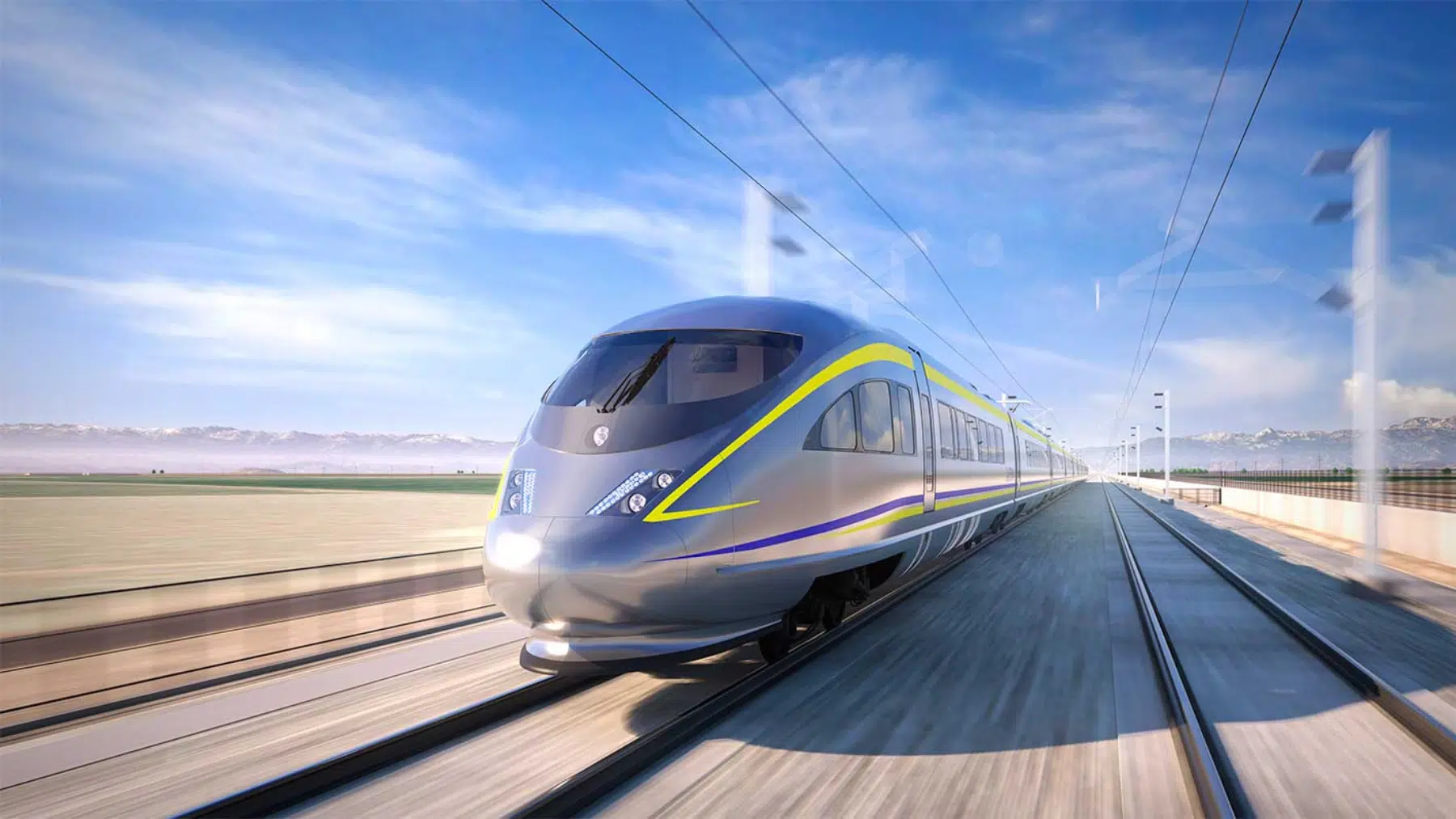
Despite a number of delays, complications, and costs running way over budget, California’s solar train project is still on track, so to speak. When it’s up and running, the United States will be the first country in the world with a completely solar-powered bullet train network, even though Tesla’s Elon Musk, who has an interest in all forms of electric transportation, says it will be “one of the most expensive per mile.”
The world’s first solar-powered rail network in California is delayed but on track
California’s long-awaited high-speed train network will extend across 800 miles of the Pacific Coast after completion of the first phase. The futuristic transportation innovation will be the world’s first high-speed train to run entirely off solar energy—when it’s finally operational, that is.
The massively ambitious project, which some believed was too complex and expensive to ever come to pass, was approved 17 years ago in 2008. At the time of conception, the projected cost was already a staggering $33 billion. The project’s progress has become sluggish, and the already huge estimated cost has snowballed to almost four times the amount at $128 billion. And it’s not to say that it will peak there.
The soaring cost was in large part due to the environmental clearance needed for the land. The majority of the train tracks will run through private land, and after negotiating prices to buy owners out and pay local governments, it cost $1.3bn alone.
However, considering the contribution that the renewably powered train will make toward reducing carbon emissions and reliance on fossil fuels, it’s apparently worth the wait and the cost.
In more news about renewable energy in the transportation sector, Norway has the grand title of having the highest rate of electrification of private transport in the world. According to annual stats, nearly all the new cars sold in the snowy Scandinavian country in 2024 were fully electric models.
How will the solar energy system generate enough power for high-speed rail travel?
A total of 44 MW of energy will be required to power the train network. It will take 552 acres of solar panels to generate this amount of electricity – this is equivalent to more than half the size of New York’s Central Park. The train will also be fitted with electric batteries capable of storing up to 62 MWh of power onboard.
Most of the energy generated by the solar power system will be utilized to power the train, naturally, and the estimated top speeds will reach 220 mph. An energy storage facility will ensure that there is backup power in the event of a primary energy failure, enabling the train to be self-powering. Some power will also be drawn to facilitate operations in the Californian climate.
When will commuters finally be able to experience solar-powered rail travel?
Construction on the initial Central Valley segment will begin in 2026, targeting an operational date of 2030. Phase 1 will focus on the 800 miles of track in California, connecting a number of Californian cities. The ultimate goal is to have terminals across the United States extending to Vancouver, Canada. San Diego, Los Angeles and San Francisco are just some of the cities planned to be connected in the future.
Unfortunately, the development has not seen all fair weather since its announcement. Questions have been raised around the selected route and why it will run through California’s Central Valley. There is a good reason for this, though. Economic growth in this area was one of the main aims behind the route selection, with Central Valley being one of the less affluent areas in California that could do with the positive economic spin-offs of the project.
Under the current targets, the project is expected to be completed in 2030. The solar energy system is planned to be ready four years earlier in 2026.
As the world’s first high-speed train fully powered by renewable energy, it could serve as a model for green solutions and spark similar projects around the globe.
In more news about a different direction of innovation in the solar power sphere, the Japanese are set to capitalize on the potential of innovative perovskite solar panels with all intensity. The mass production of these kinds of panels could pitch the country into an accelerated phase in the renewable energy transition.
Read the whole thing?
Get the week's signal, not the noise
Our sharpest reporting on energy, climate and nature — free, once a week.