
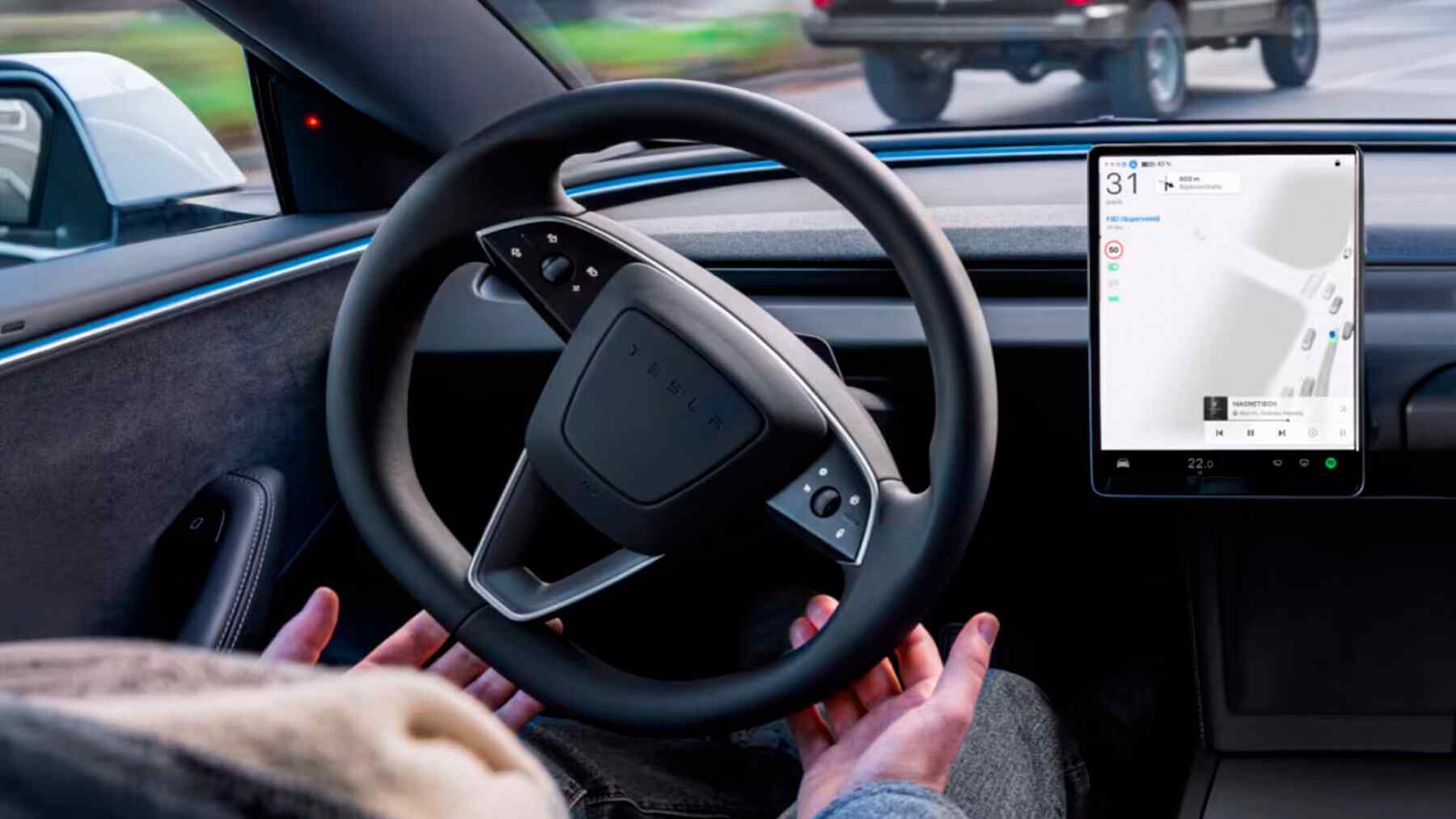
Every time a driver grabs the wheel back from Tesla’s Full Self-Driving system, a dialog box now appears on the touchscreen — and it isn’t going anywhere. No dismiss button. No timeout. Just a persistent prompt demanding a reason for the takeover, sitting there until the driver taps a response or records a voice note.
The change arrived quietly with a software update in late April. It lands at the worst possible moment: the seconds immediately after disengagement, when a driver’s eyes should be on the road — not on a menu.
A prompt that won’t take no for an answer
The new behavior came with FSD v14.3.2, bundled inside software update 2026.2.9.9. What makes it unusual isn’t just the change itself — it’s how Tesla handled the rollout. The company issued no advance notice, updating the release notes retroactively instead, leaving drivers to discover the shift on their own.
Previously, the post-intervention prompt was easy to ignore. It would appear, wait a few seconds, then vanish. Now it holds its position until it gets an answer — drivers must tap one of the on-screen categories or record a voice note using the steering wheel microphone. No dismiss button, no timeout.
The only known workaround is a double-tap of the steering wheel mic button, which sends a blank voice note and clears the screen without requiring the driver to look at it. It works. But users had to discover it themselves rather than being offered a designed solution, and that distinction matters.
Three redesigns in rapid succession
Since the mandatory prompt launched, Tesla has already revised its design three times — a pace that suggests the feature shipped before it was fully resolved. The original version offered four categories: Preference, Comfort, Critical, and Other.
Users quickly pointed out that “Other” was too vague for route-related problems, so a second revision replaced it with “Navigation.” That addressed one complaint while introducing another: the dialog was blocking access to navigation, climate, and drive controls — functions a driver might urgently need right after taking manual control.
A third iteration, rolling out with software version 2026.2.9.10, shrinks the dialog and restores access to those controls. Each fix has addressed a real problem. But the rapid cycle raises a legitimate question: why was something this consequential deployed before these issues were caught internally?
Why Tesla wants every intervention tagged
Tesla’s reasoning isn’t hard to follow. Its AI training pipeline depends on real-world data, and intervention events — moments when a human decides the system got something wrong — are among the most valuable signals available. Vague or missing feedback makes it harder to isolate failure modes and prioritize fixes.
The scale of the opportunity is significant. Tesla has nearly 500,000 active FSD subscribers generating an estimated $546 million in annual recurring revenue, and those drivers have collectively logged 10 billion FSD miles. Each tagged takeover is a labeled data point that tells engineers something specific about where the system fell short. Tesla first introduced optional voice feedback after interventions in 2023; making it mandatory is a meaningful policy shift, one that prioritizes data completeness over driver autonomy in the feedback loop.
The safety and data-quality paradox
The timing of the prompt is where the logic starts to break down. It appears immediately after disengagement — the precise moment when a driver’s attention should be entirely on the road, not on a touchscreen menu. A persistent dialog demanding a categorical response during what may be a safety-critical situation is, by definition, a distraction.
There’s also a data-quality problem embedded in the design itself. When the available categories don’t match the actual reason for a takeover, drivers don’t carefully deliberate — they tap whatever clears the screen fastest. As one widely cited observation in the tech community puts it: “The only thing worse than no data is bad data.” A system that coerces responses doesn’t necessarily produce better training signal; it may produce noisier signal dressed up as structured input. The prompt’s behavior when the car is in Park — where it still persists — further suggests the deployment wasn’t fully thought through. There’s no safety justification for blocking the screen in a stationary vehicle.
Paying customers as unpaid QA testers
FSD subscribers pay up to $99 per month for the feature. Requiring them to complete a feedback task after every intervention — with no opt-out and no clean dismiss path — effectively conscripts them as quality assurance workers without their consent. That’s a significant ask, made without explanation or announcement.
This isn’t entirely new territory for Tesla. The FSD beta program was built on the premise that paying customers would also serve as a live test fleet, and mandatory feedback is the latest expression of that same arrangement — just more explicit about the transaction. Critics argue the fix is straightforward: add a dismiss button with a reasonable timeout. Drivers who genuinely want to contribute will still provide feedback, voluntarily and accurately. Coercion doesn’t improve that signal; it degrades it.
The deeper question here isn’t really about a dialog box. It’s about what obligations a company takes on when it sells a product that is still, by its own admission, a work in progress — and whether turning customers into data contributors should happen by design or by default. Tesla may get cleaner intervention logs from this change. Whether it gets better ones is a different matter entirely.
Read the whole thing?
Get the week's signal, not the noise
Our sharpest reporting on energy, climate and nature — free, once a week.


