

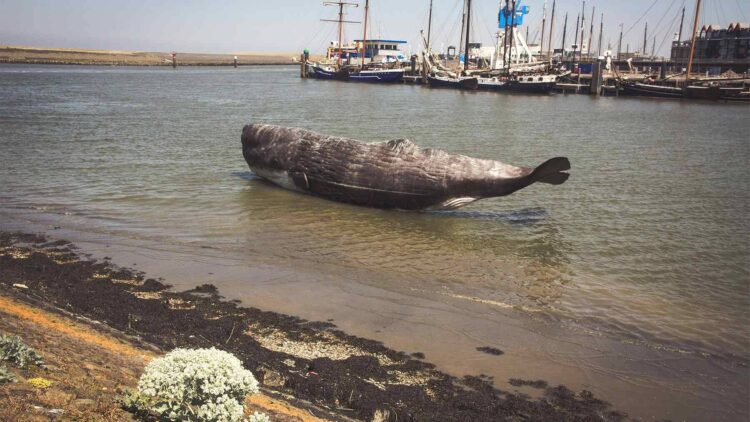
More gray whales are choosing San Francisco Bay as a “vacation” location than ever before.
But there’s nothing “friendly” about these visits.
They’re suddenly detouring from ancient, open migration routes to enter chaotic waters.
Researchers are racing to track the increased number of gray whales as a troubling reality becomes clear.
Their changed behavior is a sign of desperation to survive. So what is it about an area as crowded as a big city’s bay that’s drawing them?
How a busy metropolis is messing with ancient gray whale migration maps
San Francisco Bay has never been on a gray whale’s list of top destinations, until now.
This makes their increased sightings seem exciting… if you’re not aware how troubling the situation has become.
Since 2018, scientists have been putting their energy into studying new behaviors through a database of photos and survey responses.
Up until 2025, 114 gray whales were reported entering the bay. Of those, only four had done so before.
This means that these are not routine stops being absorbed into migration routes over time.
Instead, the behavior appears to be a response to a particular need.
And it’s not about safety or rest. Because these waters are anything but peaceful and welcoming.
Of those 114 whales that entered the bay, 21 died right there.
Migrating whales are entering a dangerous new crossroads
Gray whales cross between 10,000 and 14,000 miles to migrate each year. The route takes them from summer feeding grounds in the Arctic to winter breeding grounds in Mexican waters.
Their numbers are already not as great as they could be due to decades of commercial fishing.
But disruptions in the ecological chain are putting even more pressure on their survival rate.
A migration route is only as strong as its weakest link. This means that localized threats in a critical bottleneck like the Golden Gate Strait are not limited to that region.
If high numbers of whales are getting injured or dying during a single stopover, their entire 12,000-mile reproductive cycle will feel the devastation.
Ultimately, this creates a domino effect affecting the population across the entire Pacific coastline.
There’s even more risk for whales, and this time, it’s weather.
Gray whales frequently swim close to the surface, and in the thick fog common to the area, they are dangerously camouflaged.
The vanishing highway: What’s forcing gray whales into risky neighborhoods?
A new report, “18% of gray whales that enter San Francisco Bay die there, scientists find,” published in Frontiers, confirms the death toll is growing.
The biggest threat comes from vessel collisions. Many of the carcasses in the bay showed clear signs of strike injuries.
But some are perishing from starvation, and this gave marine researchers a vital clue.
How are environmental changes forcing whales to change migration routes and be exposed to more threats?
What is it about San Francisco Bay that offers “refuge”?
Global warming and climate change have struck again.
Even before reaching the Golden Gate, reduced food availability in the Arctic means the massive mammals are starving after winter.
This has a direct effect on migration. They are now forced to make pitstops to forage where they never had to before.
Unfortunately, San Francisco Bay is rich in both food and danger.
More hungry whales arriving means the entry bottleneck becomes deadlier.
This study has confirmed that whales are adapting. Age-old instincts aren’t viable any longer.
These desperate detours represent a permanent shift in marine conservation.
As climate collapse drastically alters Pacific conditions, researchers must rethink these ancient migration routes altogether.
If ocean giants are adapting this drastically just to survive, it leaves us with an urgent question. Where’s the next dangerous place they’ll be looking to refuel?
Disclaimer: Our coverage of events affecting companies is purely informative and descriptive. Under no circumstances does it seek to promote an opinion or create a trend, nor can it be taken as investment advice or a recommendation of any kind.