A wind turbine is a wing that happens to go in circles.
Everything it does depends on one curved edge meeting the air at the right angle.
Now put a crust of ice on that edge.
Not a dusting. A ridged layer that grows forward into the wind and changes the shape the air is reading.
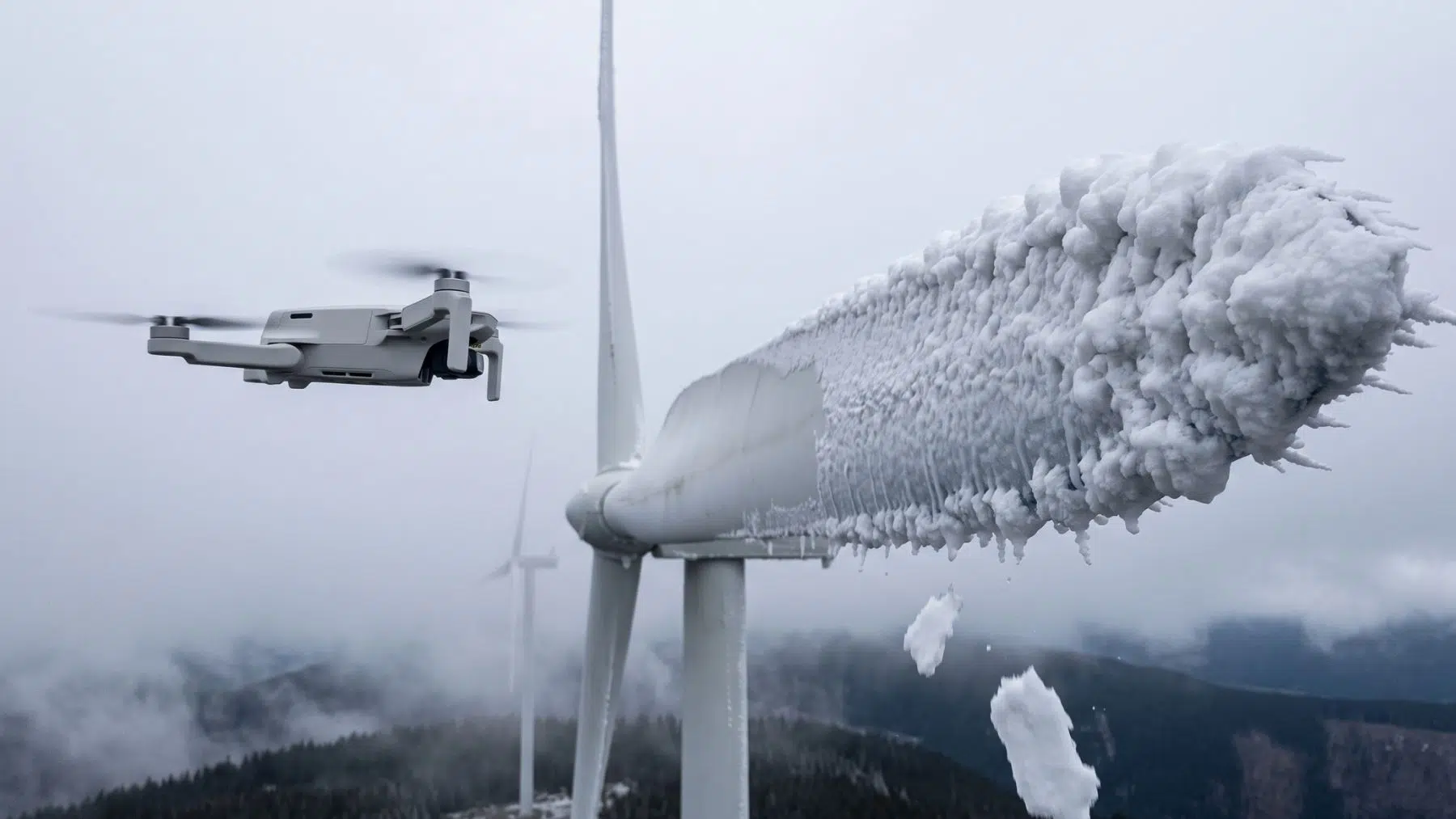
Somebody flew a drone up to photograph exactly that.
What came back was a foot of ice and a very large number.
What the pictures actually showed
The site was a wind farm on mountain ridges near the East China Sea, sitting between roughly 3,600 and 5,900 feet up, with 1.5 MW machines carrying turbine blades 164 feet long. After a 30 hour icing spell, a camera on an unmanned aircraft was flown out and photographed the blades where they stood.
The images were then measured rather than admired.
From the photographs the team worked out the thickness of the ice layer along the leading edges, and the pattern was not even. Ice covered the whole span, but the outboard sections carried far more of it, and toward the tips the layer reached about a foot thick, standing proud of a surface engineered to be smooth. Nobody had to guess at that figure, because the blade itself gave the measurement its ruler.
Why the tip collects the most
This part follows from geometry. A blade is a lever, and the far end travels much faster than the root, so in the same wind the tip sweeps through far more air in the same second.
More air means more droplets.
Every supercooled droplet that meets a surface below freezing can stick, so the section moving fastest through the cloud gathers ice fastest. That is why the damage concentrates exactly where the machine does most of its work, because the outer third of a blade produces a disproportionate share of the torque, while the root turning slowly near the hub collects almost nothing.
The effect compounds. Ice on the tip spoils the most valuable part of the airfoil and throws the rotor out of balance, because no two blades ice identically.
What ice does to a wing
A blade works because air travels farther over the curved upper surface than under the flat lower one and arrives with less pressure, and that difference pulls the section forward. Everything depends on the air staying attached to the curve.
Ice ends that arrangement.
A rime crust turns a designed profile into a rough, blunt, irregular one, so the flow separates early instead of following the surface. Lift falls, drag climbs, and the blade stops behaving like a wing and starts behaving like an awkward plank being dragged through the air.
The control system then makes matters look worse. A turbine that senses wind but not the reason its output has collapsed will keep adjusting pitch against a shape that no longer matches anything in its tables. So the machine works harder at being wrong.
The number the industry cares about
Turbine data was pulled alongside the images, and the pairing is what makes this useful. In good wind the iced machines turned noticeably slower and stopped altogether from time to time.
Peak loss during the event reached 80 percent.
“Despite the high wind, frozen turbines were discovered to rotate substantially slower and even shut down from time to time,” the authors wrote, “resulting in up to 80 percent of icing induced turbine power losses during the icing event.” Across a whole year at a site that ices regularly, the field campaign puts the production loss at more than 20 percent.
That annual figure decides where a wind farm gets built, and it is why cold climate siting is its own discipline. Getting it wrong turns a good site into a solar highway, which is to say an idea that photographed well and then met the maintenance schedule.
What can actually be done
The fixes exist and none is exotic. Blades can carry heating elements laminated inside, or warm air fed up the shell, or a coating that sheds ice before it builds. Detection has improved too, so a machine can now recognize that it is icing rather than guessing from output.
Every one of those options costs something.
Heating burns a slice of the power the turbine exists to make, coatings wear, and a blade stopped for safety earns nothing. This is a trade rather than a solution, and the sums only work where ice comes often enough to pay for the hardware.
What the drone added was not a new idea but a measured number. Ice thickness on a rotor had largely been inferred, and a turbine blade 164 feet up is not something anybody climbs out to measure in freezing fog.
So the useful result is a photograph with a scale on it. A wider review gathers the modelling work this measurement now has to agree with, and the gap between model and camera is where the next improvement comes from.
Read the whole thing?
Get the week's signal, not the noise
Our sharpest reporting on energy, climate and nature — free, once a week.