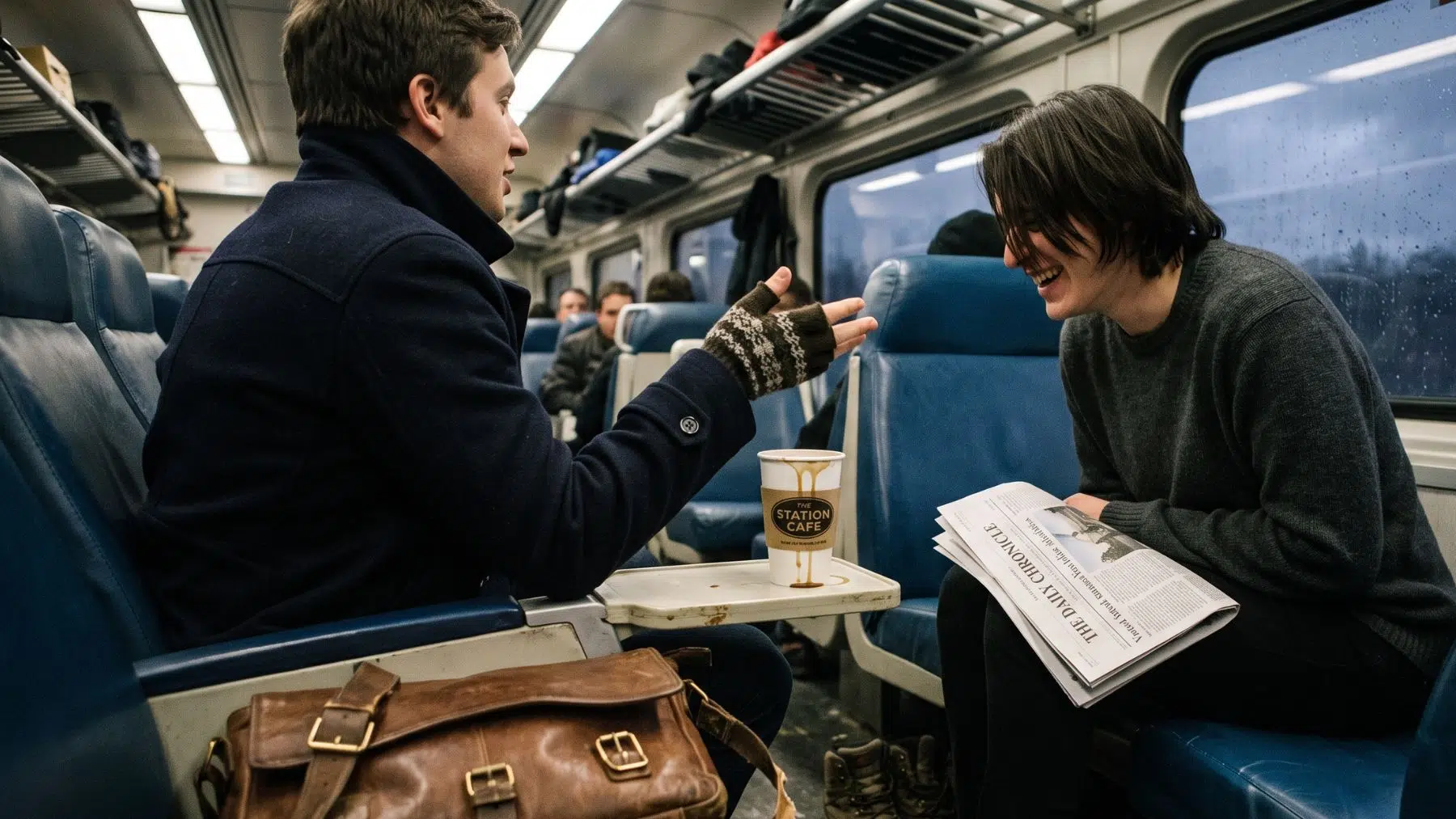
Commuters on a Chicago train were handed an instruction on the platform and sent to their seats.
Some were told to start a conversation with whoever sat down beside them, and others to keep to themselves.
Before any of it happened, a separate group was asked to guess how it would go, and they guessed wrong.
They expected the talkers to have the worse ride.
They also expected a lot of people to say no, which is the part that did not happen at all.
Nobody got turned down
The train study ran with 97 riders, and a second version on city buses used 75 more.
Asked in advance, 93 percent said that given the choice they would rather sit in silence than start something.
The same forecasters put the share of strangers willing to talk back at under 47 percent.
The actual rate of refusal was zero. Not one participant reported being rebuffed by the person next to them.
And the ride itself came out the other way round from the forecast, with the conversation group rating the trip more positively than the silent group on both the train and the bus.
The gap here is not between people who enjoy talking and people who do not. It sits between what almost everyone predicts and what actually happens.
Where the 60,000 figure comes from
The number gets quoted a lot and it is worth knowing what sits behind it.
It comes from an online questionnaire run in Britain with a national broadcaster, which collected 60,141 responses, mostly British.
People who reported talking to strangers more often also reported higher life satisfaction, along with less loneliness and more trust in others.
The same paper carries a second and much smaller sample, 3,266 adults interviewed face to face across Turkey, chosen to be nationally representative.
That second sample matters more than its size suggests, because almost all research of this kind is done on Western university populations.
Both samples pointed the same way, which is unusual enough in this field to be worth reporting on its own.
The big one was gathered through a radio programme, so it is people who chose to answer a survey about kindness rather than a random slice of the country.
What that study cannot tell you
Here is the caveat the headlines drop, and it changes what the finding means.
Neither sample was an experiment. Nobody was assigned to talk to strangers and then compared against people who were told not to.
It is a survey, so it shows that the two things travel together, not that one produces the other.
Cheerful people may simply talk to more strangers in the first place, which would produce exactly the same numbers on the page.
The authors ran a statistical technique designed to push toward a causal reading, and concluded the link was likely causal, which is a careful phrase and not the same as proven.
They also noted they never measured the quality of anyone’s close relationships, which is the single biggest factor in this whole area.
The refusal rate is about one in ten
So how often does someone actually decline. The working figure from researchers who study this is around 10 percent.
That is roughly one conversation in ten going nowhere, against a widespread expectation that more than half of them will.
The fear also drops with repetition, and people asked to try it daily for a week reported less anxiety by the end, as one researcher describes it.
Variety appears to matter as much as volume, and people whose week contains a wider mix of relationship types report better wellbeing even after total social time is held constant, as that work found.
An independent replication of it held up, though it proved sensitive to method, which is worth saying out loud.
It is the same pattern as an offshore array or a fenced solar site, where the benefit comes from the mix rather than the total.
What is actually being claimed
None of this says that a chat on a bus substitutes for anybody close to you, and no researcher in the field claims it does.
The claim is narrower. Brief exchanges appear to carry some real weight, and people systematically expect them to go badly.
The prediction error is the finding, and it has now shown up in a train car, a bus, a national street survey and a mass questionnaire.
What has not shown up, anywhere in this literature, is the wall of rejection people brace for.
The commuters who were told to keep to themselves got exactly the ride they had expected to get.
The ones told to speak got a better one, and none of them saw it coming.
Read the whole thing?
Get the week's signal, not the noise
Our sharpest reporting on energy, climate and nature — free, once a week.