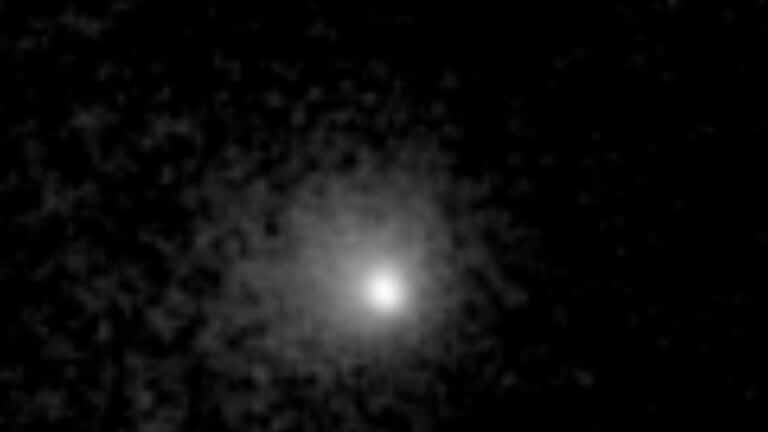
At first glance, it looks like noise — a smear of black and white pixels that could be anything. But those pixels contain four living people, hurtling around the moon at roughly 2,000 miles per hour, more than 200,000 miles from the telescope that caught them.
The image was captured on April 6 by an Earth-based radio telescope — and it may be the longest-distance photograph of humans ever taken from the ground.
A few pixels that contain four people
The image itself is easy to dismiss. Black and white, grainy, no clear subject — it looks more like static from a miscalibrated instrument than a historic photograph. That’s precisely what makes it remarkable.
“There are four people in those pixels,” said Will Armentrout, a Green Bank Telescope astronomer who helped track the Artemis II mission, when he and his colleagues first saw the image. It’s the kind of remark that reframes everything you thought you were looking at.
Those four people were mission commander Reid Wiseman, pilot Victor Glover, mission specialist Christina Koch — all of NASA — and Canadian Space Agency mission specialist Jeremy Hansen. Each crew member broke a different individual spaceflight record during the mission, layering yet another dimension of historical significance onto an already extraordinary photograph.
Because the image came from an Earth-based telescope rather than a spacecraft already in deep space, it stands apart from famous long-distance photographs like the “Pale Blue Dot,” which Voyager 1 captured from well within the outer solar system. Shot from the ground, across more than 200,000 miles of empty space, it’s a strong candidate for the longest-distance photograph of humans ever taken from Earth.
The telescope behind the image
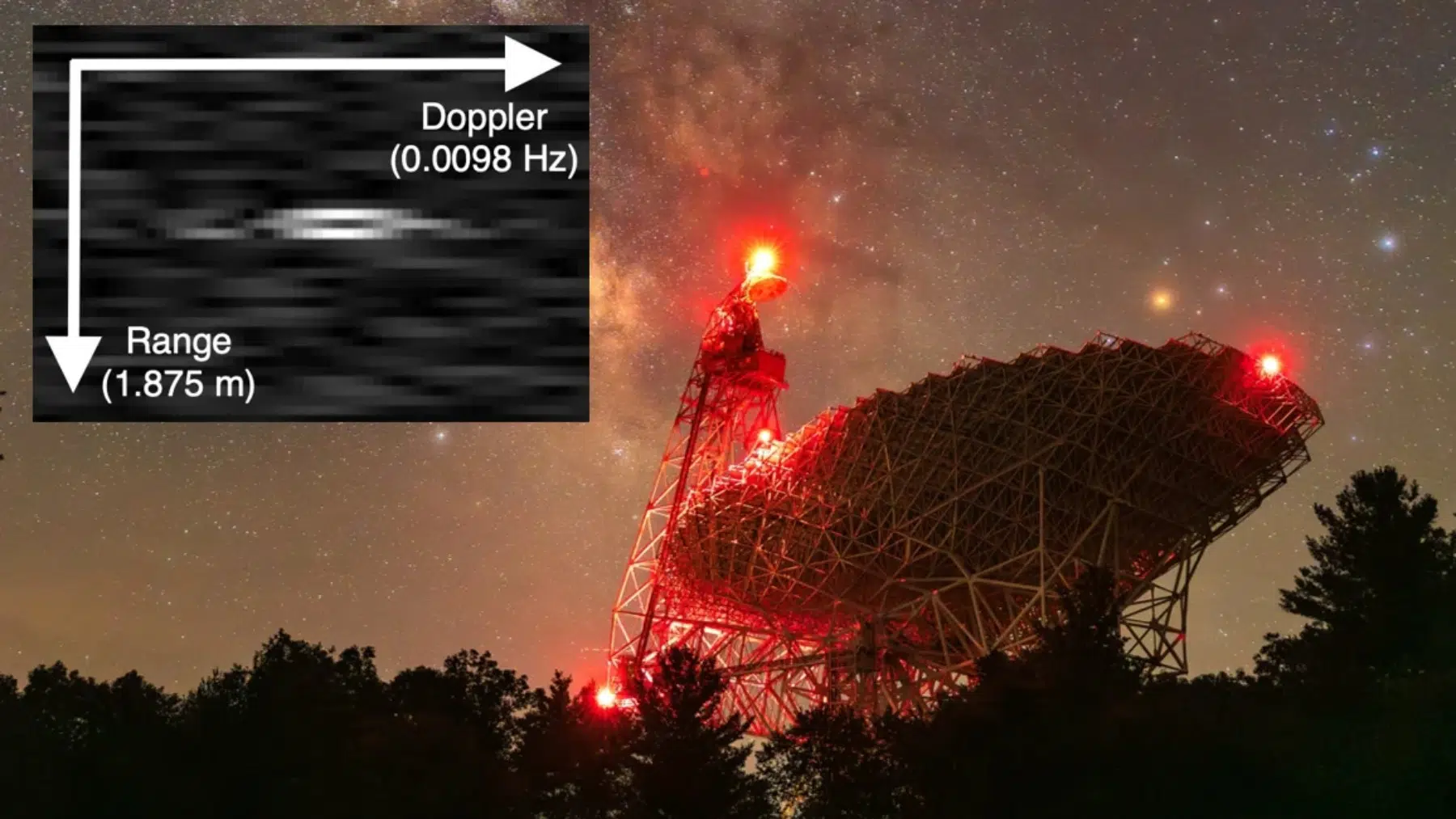
The instrument responsible is no ordinary piece of equipment. The Robert C. Byrd Green Bank Telescope, located in rural West Virginia, features a 328-foot-wide radio dish mounted on a circular rail system — the world’s largest fully steerable radio telescope, meaning it can be aimed at virtually any point in the sky with extraordinary precision.
The image, shared publicly on May 6 by the National Radio Astronomy Observatory, shows the radio waves emitted by the Orion capsule — nicknamed Integrity by its crew — as it swung around the moon. The capsule was approximately 213,000 miles away when the GBT captured the image on April 6, the sixth day of the mission. At that distance, Integrity was on the Earth-facing side of the moon, either just before or just after the crew temporarily disappeared behind the lunar far side and set a record for the farthest distance any humans have traveled from our planet. That a ground-based instrument could resolve even a handful of pixels at that range says something about what the telescope can do.
Tracking a bullet-speed capsule with millimeter precision
Capturing a single image was only part of what the Green Bank Telescope accomplished. The GBT team conducted six-hour observation windows on each of the five days the capsule was closest to the moon, maintaining continuous watch as Integrity swung around the lunar surface at approximately 2,000 miles per hour — roughly the speed of a rifle bullet.

The precision involved is difficult to fully appreciate. Anthony Remijan, the GBT’s site director, offered an analogy to make it tangible: “With the GBT, we were able to track the movement of the spacecraft within 0.2 millimeters per second of what NASA calculated in its projections. It’s like having a speedometer in your car that can track your speed within 0.0004 decimal places per hour.”
That level of accuracy — applied to a camper-van-sized object moving at bullet speed, hundreds of thousands of miles away — is the kind of engineering achievement that tends to get overshadowed by the more photogenic moments of a mission. It shouldn’t be.
Why this data matters for future moon missions
The tracking data the GBT gathered isn’t just a technical curiosity. It feeds directly into NASA’s planning for upcoming Artemis missions, which carry the longer-term goal of establishing a permanent human presence on the moon. Knowing precisely how a crewed capsule behaves in lunar orbit — how it moves, how its signals propagate, how its trajectory compares to pre-mission projections — gives engineers critical reference points for missions that will push even further.
This kind of contribution also illustrates something easy to lose sight of amid the spectacle of a rocket launch: major space achievements depend on a sprawling collaborative infrastructure spread across institutions and countries. The Green Bank Telescope is one node in that network.
Jeremy Hansen, speaking from aboard Integrity during the mission, put it plainly. “To get big things done like we’re doing in this capsule… you need a big team behind you.”
That team includes radio astronomers in West Virginia staring at a smear of pixels and recognizing, with quiet astonishment, that they’re looking at people. There’s something worth sitting with in that — four human beings, moving faster than sound, a fifth of the way to the moon, reduced to a handful of bright dots and still found.
Read the whole thing?
Get the week's signal, not the noise
Our sharpest reporting on energy, climate and nature — free, once a week.