Stand on a dry, thorny plain in northeastern Brazil and look out toward the horizon.
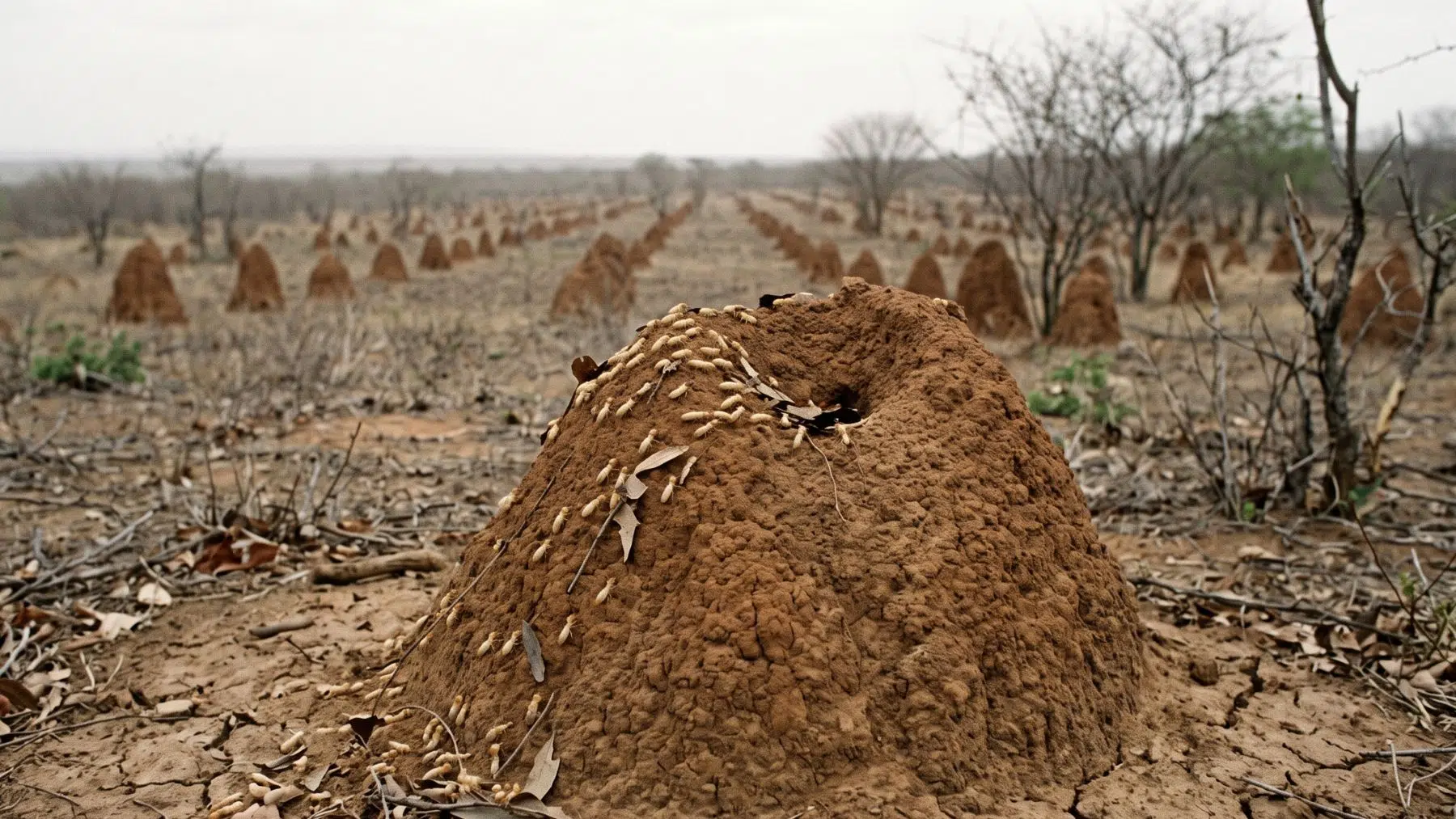
The land is dotted with low earth cones, one after another, as far as you can see.
They sit in a strange, even grid, spaced like buildings in a planned town.
There are not dozens of them, or thousands, but hundreds of millions.
And almost nobody outside the region knew they were there.
So what kind of creature lays out a city this size?
The dirt piles that are not nests
Here is the twist that caught the scientists off guard. The mounds are not homes at all. Each cone is a spoil heap, a dump of dirt that termites hauled up and out of the ground, the leftover from digging something far larger below.
The real structure is underground.
Beneath the whole field runs a vast web of tunnels, and the termite mounds are only the waste from carving it out. Counting them all, roughly 200 million cones dot a stretch of country as big as Great Britain, some of it up to four thousand years old. That makes the pile of dirt at your feet older than the Roman Empire, still sitting where a termite dropped it.
A city the size of a country
The numbers are hard to hold in the head. The mound field covers close to 88,000 square miles, near the footprint of Minnesota, and the cones stand in a loose, repeating pattern across almost all of it. From a satellite the land takes on a faint, dimpled texture. Line the cones up and they would ring a whole country, yet each one is just a heap of crumbly dirt.
Each mound is no small pile either. A single cone rises about 8 feet tall and spreads some 30 feet across at the base, the size of a small backyard shed built of packed earth.
And they sit oddly far apart.
The even spacing is part of the mystery. The cones are laid out with a regular rhythm, almost as if planned on a grid, hinting that the diggers below somehow coordinate across enormous distances.
What all that digging was for
All of it traces back to fallen leaves. The builders are one termite species that feeds on dead leaves dropping from the dry caatinga scrub. To reach that food without crossing open, dangerous ground, they tunnel to it from below. The scrub drops its leaves in a brief, unpredictable rush, and the tunnels let the colony grab that windfall before it rots.
So the mounds are a byproduct of dinner.
Over centuries the colonies dug an ever wider network to harvest the leaf fall, and every load of excavated soil got pushed up to the surface. The total moved is staggering, about 2.4 cubic miles of earth, enough to fill some 4,000 Great Pyramids. No animal on record has shifted more earth, and it was done with no plan, no blueprint and no single overseer.
It is one of the largest earthworks any animal has ever built. Cubic mile after cubic mile of dirt, shifted a mouthful at a time by insects you could balance on a fingertip.
How something this big stayed hidden
A structure the size of a nation sounds impossible to miss. But the mounds sit under dense thorny scrub that hides them from anyone standing among them, and only land clearing and modern satellite images finally revealed the full pattern, the same overhead view that maps an offshore wind farm.
Soil pulled from the cones gave their age. Dating showed the oldest heaps began piling up as far back as 4,000 years ago, meaning the network has been worked continuously since before many ancient cities were founded. The termites were already hauling dirt when the pyramids themselves were still fairly new.
The researchers struggled to describe it.
One who studied the field said the scale was beyond belief and called the whole thing mind bending. For an ordinary looking patch of dry Brazilian backcountry, it was hiding a world record.
What the mounds still hold
The field is no ruin. Many of the cones are still active, with termites living and digging below them right now, steadily extending a project their ancestors began millennia ago. It is less a monument than a machine still running. The colony working the tunnel below your feet may be older than any tree in sight.
That patience is the real lesson. A single termite moves almost nothing, yet steady work over centuries built one of the biggest structures on the planet, the way a fox settles in around some solar panels and slowly makes strange ground its own.
Insects turn out to be serious engineers.
Termites, ants and their kin reshape soil, water and whole landscapes far more than their size suggests, and this buried city is the clearest proof yet. The mounds were never meant to impress us. They are just the dirt left over from four thousand years of lunch.
Read the whole thing?
Get the week's signal, not the noise
Our sharpest reporting on energy, climate and nature — free, once a week.