It sounded like something had exploded. A loud bang, sudden and sharp, followed by a strange silence that didn’t quite feel normal. At first, it could have been anything—something falling, something breaking, maybe even a distant accident. But when the homeowner stepped into the next room, it became clear that this was something entirely different.
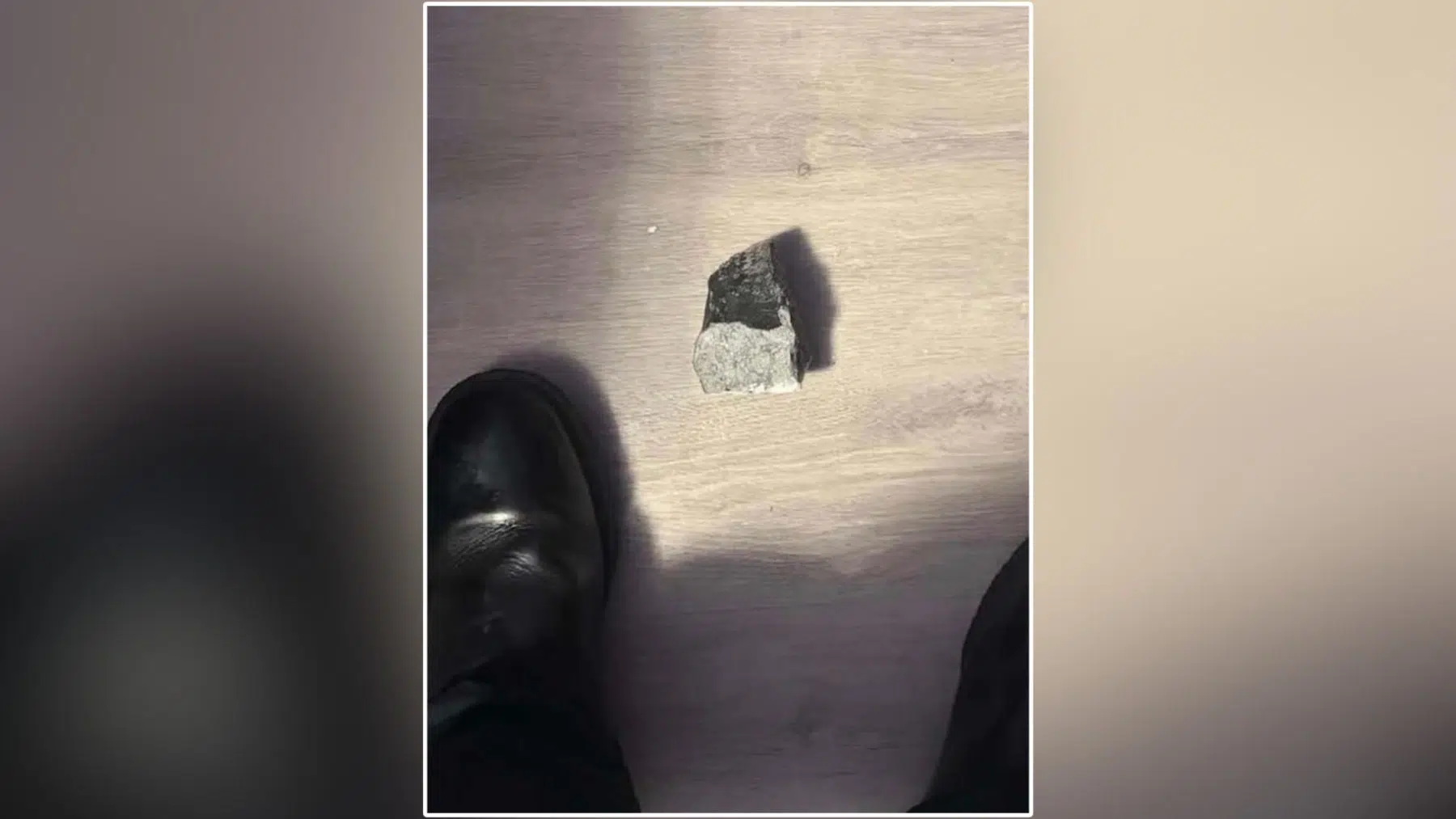
There was a hole in the roof, debris scattered across the floor, and sitting inside the room was something that didn’t belong there at all: a rock that had fallen from space. What began as a brief flash in the sky had turned into a moment that blurred the line between everyday life and the vast unknown above us.
A Fireball That Didn’t Stay In The Sky
On March 21, just before sunset, witnesses across Texas reported seeing a bright streak cutting across the sky, followed by a powerful explosion that echoed for miles. What they were witnessing was a 3-foot-wide (0.9 meter) asteroid entering Earth’s atmosphere at more than 35,000 mph (56,300 km/h).
As it tore through the air, intense friction caused it to heat up and break apart, creating a fireball that lit up the sky in broad daylight. The explosion released energy equivalent to around 26 tons of TNT, producing a shockwave that many people both saw and heard.
At least 180 witnesses reported the event, describing a flash that lasted only seconds but left a lasting impression. Simulations later showed that the asteroid broke apart roughly 29 miles (47 kilometers) above Houston, and while most of it disintegrated, several fragments likely survived and fell toward the ground.
What made this event stand out wasn’t just its brightness or its sound—it was what happened next, when one of those fragments didn’t land in an open field or ocean, but instead found its way into a home.
The Moment It Hit The House
In a neighborhood near Houston, one of those surviving fragments punched directly through the roof of a house, carrying enough force to travel further inside. According to reports, the object didn’t simply drop to the floor. It ricocheted, bouncing off the ground, striking the ceiling, and finally coming to rest near a television inside an empty bedroom.
The homeowner, Sherrie James, initially had no idea what had caused the noise. Her first reaction was confusion, followed by concern. When she saw the damage, she suspected it might have been something more ordinary—perhaps debris from an aircraft or something falling from nearby structures. But the more she looked at the object, the less it resembled anything familiar.
Only after reports of the fireball began spreading did the situation become clear. What had crashed into her home wasn’t man-made. It had traveled from space, survived a fiery descent through the atmosphere, and ended its journey inside her house. The reaction quickly shifted from frustration over the damage to a mix of excitement and disbelief. It’s not every day that a piece of the solar system lands in your living space.
A Rare And Unusual Pattern
As extraordinary as this incident was, it didn’t happen in isolation. Over the span of just seven days, at least four major fireballs were reported across the United States. The sequence began on March 17, when a car-sized meteor exploded over Ohio, producing a sonic boom powerful enough to shatter windows near Cleveland. Fragments from that event also reached the ground, with several pieces later recovered.
Just days later came the Texas fireball, followed by another event over California, where more than 200 people reported seeing a bright meteor streaking across the sky. Shortly after that, a second, smaller fireball was observed again over Ohio. In total, at least nine major fireballs have been recorded across the U.S. since early February.
This cluster of events has caught the attention of scientists, not just because of their visibility, but because of how closely they occurred in time. While meteor sightings are not unusual on their own, seeing multiple large fireballs within such a short period is less common. It raises questions about whether something larger is influencing the frequency of these events.

Why These Events Might Be Increasing
One possible explanation lies in a phenomenon known as “spring fireballs.” During the months between February and April, Earth’s position in its orbit makes it more likely to encounter debris traveling in the same direction, increasing the chances of visible meteor events. In some years, sightings can rise by as much as 30% during this period.
However, even with this seasonal pattern, the recent spike still stands out. NASA has acknowledged the unusual frequency of these fireballs but has not provided a definitive explanation. There are no currently active meteor showers or known asteroid clusters that fully account for the recent activity.
This leaves part of the mystery unresolved. While science can explain the mechanics of how these events occur—how objects enter the atmosphere, break apart, and release energy—it doesn’t always explain why they seem to cluster in certain moments. For now, researchers continue to observe and collect data, hoping to better understand what’s driving this recent pattern.
When Space Gets Too Close To Home
Events like the one in Houston are rare, but they are not completely unheard of. In recent years, meteorites have struck homes in Germany, Georgia, New Jersey, and Canada, sometimes causing damage and, in rare cases, even fires. There have also been extremely uncommon instances of direct human contact, including a reported case in 2023 when a woman in France was struck by a small meteorite fragment.
Despite these stories, the overall risk remains incredibly low. Most space rocks burn up entirely before reaching the ground, and those that survive often fall into oceans or uninhabited areas. Still, incidents like this serve as a reminder that Earth is constantly interacting with its cosmic surroundings.
For scientists, these fragments are invaluable. They offer insight into the early solar system, containing materials that date back billions of years. For the people who encounter them unexpectedly, however, the experience is far more immediate.
In this case, what began as a flash in the sky ended as a tangible piece of space resting inside a home. A reminder that the universe isn’t as distant as it often feels—and that sometimes, it quite literally comes knocking.
Read the whole thing?
Get the week's signal, not the noise
Our sharpest reporting on energy, climate and nature — free, once a week.