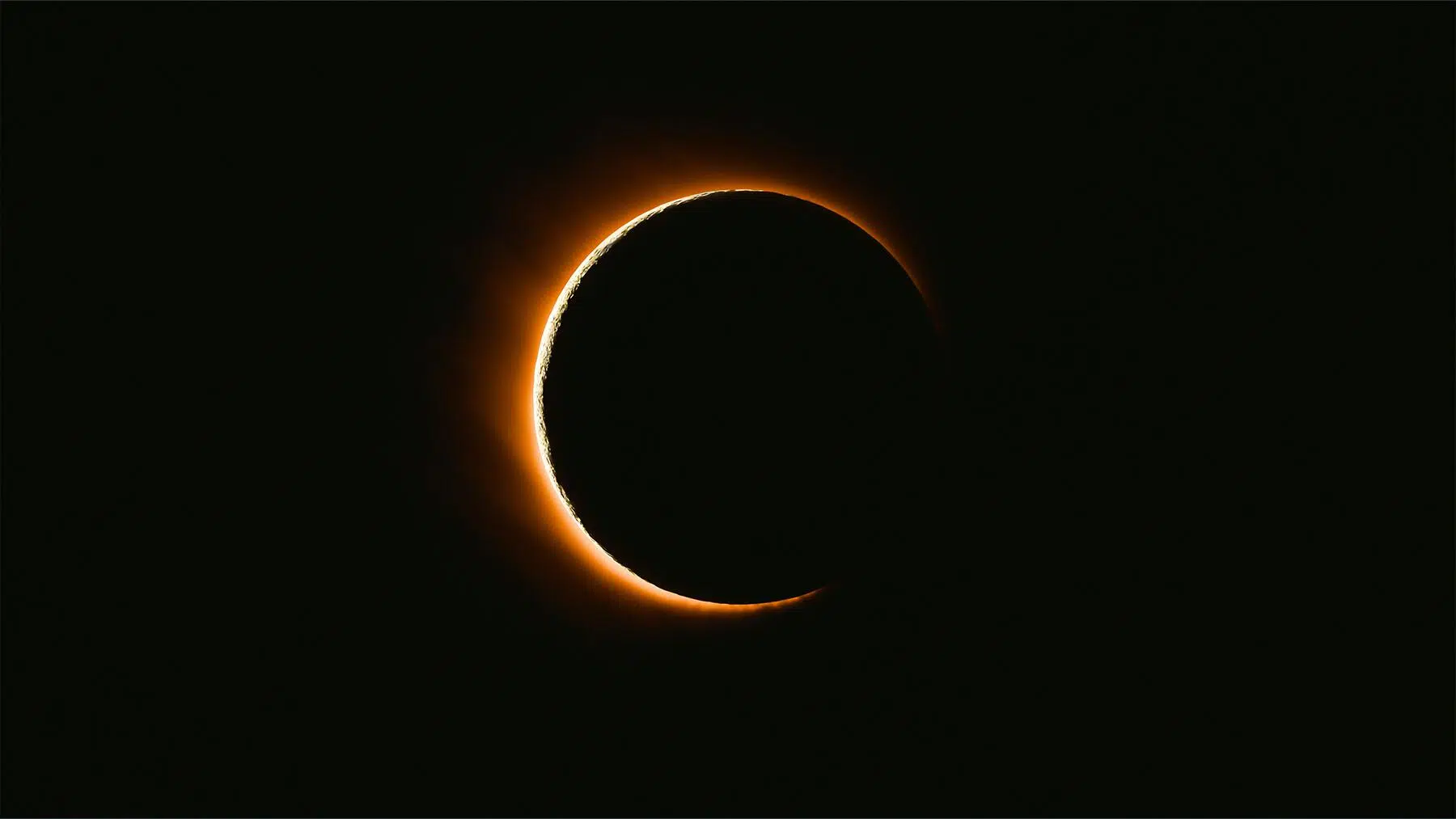
The sky provides some pretty spectacular displays for us humans here on Earth, lighting up with all kinds of colours and shapes throughout the day and night. We are quite lucky to be able to witness phenomena like rainbows, sunsets, shooting stars, and so much more. Nothing can quite compare to the stunning show we get from a solar eclipse—especially one as rare as this.
What exactly are solar eclipses, and why are they so special?
Among the many other incredible demonstrations that nature provides through the sky, solar eclipses are some of the most awe-inspiring. A solar eclipse occurs when the Moon passes in front of the Sun and temporarily blocks the light from reaching Earth, creating a shadow. Only around two to five solar eclipses happen each year, and all of them are slightly different.
The reason solar eclipses don’t occur all the time is that the Moon usually passes just above or below the Sun, due to a tilted orbit. The Sun, Moon, and Earth have to align just right for us to experience a solar eclipse. And they’re not all the same, nor can everyone around the world see one when it occurs. They are actually only visible in narrow paths, so not everyone gets lucky enough to see them very often.
There are partial, total, and annular eclipses, each categorised by how much of the Sun is covered. For a total eclipse, the Sun is completely covered by the moon and viewers can actually notice the Sun’s outer atmosphere, called the corona. In a partial eclipse, only half the Sun is covered, and in an annular eclipse, arguably the most interesting to observe, the moon appears farther away and appears to have a bright ring of fire around it.
The ‘ring of fire’ eclipse that some may experience this February
This annular eclipse will occur on February 17 this year, when the Moon will align with the Sun, but because it will appear slightly smaller, it won’t completely cover the Sun. This is what leads to the incredible display, where a ring of fire seems to appear around the Moon. It is important to note that all observers must wear eclipse glasses when observing this occurrence to protect their eyes.
With that being said, not everyone will be able to view this incredible spectacle. The full ring of fire effect will only be visible in remote areas of Antarctica, and reportedly only for 2 minutes and 19 seconds. However, individuals in other regions will be able to see a partial eclipse, which is still not a common occurrence. These areas include parts of Southern America and Southern Africa, such as Argentina, Chile, Botswana, and Zimbabwe.
But the rest of the world need not be disappointed, there is much more in store for 2026 when it comes to solar eclipses, and maybe even other cool planetary displays like last year.
What else can we expect to witness in the sky this year?
If you’re not lucky enough to witness the annular eclipse this February, worry not, as there will be much more in store this year. In August, the world will experience a total solar eclipse, which will be fully observable in Greenland, Iceland, Spain, and Russia, as well as a certain area in Portugal. For those who will miss the total eclipse, there will still be a partial eclipse visible across most of Europe, Africa, and North America.
2026 is a year that is clearly bringing an abundance of beautiful displays across the sky, and hopefully, we will all be lucky enough to witness at least a partial eclipse from wherever we are in the world. Other types of displays that have occurred before include this incredible snow moon of last year, but nothing will quite compete with the beauty of the annular eclipse.
Read the whole thing?
Get the week's signal, not the noise
Our sharpest reporting on energy, climate and nature — free, once a week.