It looked like nothing special.
Just a dark stone lying in the Sahara. The kind of rock you could step over without thinking twice. No glow. No strange shape. No sign that it carried a secret.
Then scientists tested it.
And the numbers refused to behave.
A stone that wouldn’t fit the pattern
Meteorites are not rare in deserts. The dry air preserves them. Collectors find them. Scientists study them. Most tell familiar stories about the birth of the Solar System.
At first, this one seemed no different.
The rock, later named Erg Chech 002, was discovered in Algeria in 2020. It looked dense and dark — typical for space material that has survived a fiery journey through Earth’s atmosphere.
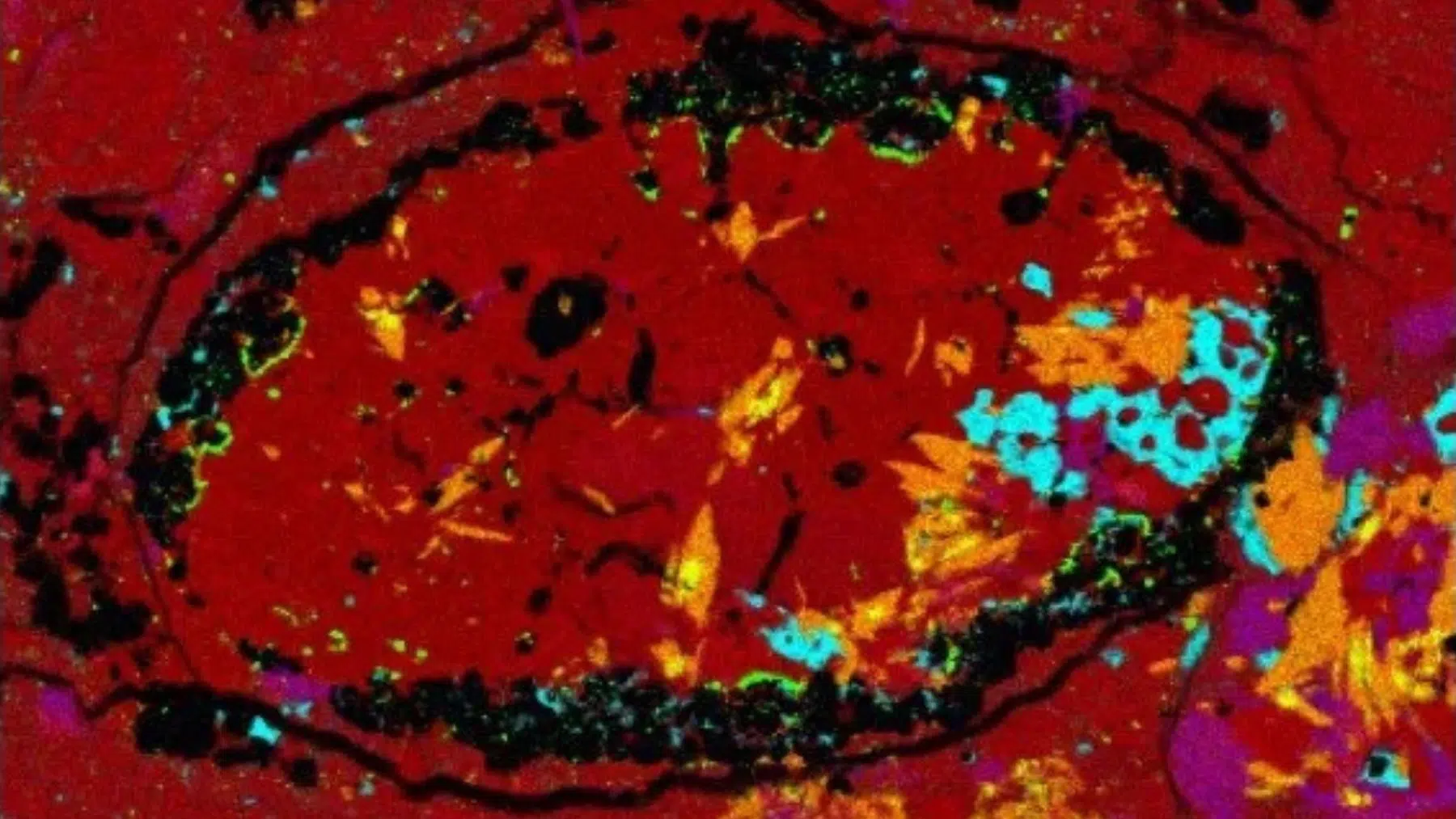
But when researchers examined its minerals, something felt off.
The chemistry didn’t match the usual categories. Parts of it were unusually clean. Other parts were strangely complex. It was volcanic rock — meaning it once came from molten material — but not the kind scientists normally see in meteorites.
That was the first sign this was not just another space souvenir.
A timeline that made scientists pause
Dating meteorites is like checking their birth certificate. Scientists measure radioactive elements to determine when the rock solidified.
Most igneous meteorites — rocks that were once molten — formed during the chaotic first few million years of the Solar System. Asteroids melted, cooled, and shattered as planets were still forming.
Erg Chech 002 appeared to come from a body that melted extremely early. It formed a crust quickly, cooled, and then somehow disappeared.
That alone was interesting.
But the deeper puzzle was its composition.
It looked like it came from a type of planetary crust that scientists almost never find.
The missing crust no one expected
In a study led by Southwest Research Institute (SwRI), researchers revealed that Erg Chech 002 is an andesitic rock from a differentiated parent body — essentially a small early planet that had already formed layers and developed a crust.
Andesitic rocks are important on Earth. They are associated with volcanic processes that help build continents. But in meteorites, this chemistry is extremely rare.
Most space rocks are basaltic — simpler, more common material. EC 002 was different.
It suggests that in the early Solar System, there were more complex crusts forming than scientists previously believed.
And then they vanished.
A world that formed — and was erased
The data point to something unsettling: an early generation of planetary crust that once existed widely but left almost no trace.
Scientists call it a “missing reservoir.” It likely formed during the Solar System’s earliest stage, when young planetary bodies were melting internally due to radioactive heat.
But the early Solar System was violent.
Collisions were constant. Bodies smashed into each other. Crusts were shattered. Material was recycled back inside forming planets or broken into dust.
Erg Chech 002 may be one of the only surviving fragments from that lost generation.
Not because it was unique — but because everything like it was destroyed.
Why one rock changes the bigger story
For decades, scientists believed that early rocky bodies mostly produced simple basalt-like crusts. More complex crust — like Earth’s — was thought to be a later development.
This meteorite challenges that assumption.
It suggests that “Earth-like” chemistry may have appeared much earlier in Solar System history. It just didn’t survive the chaos.
That changes how scientists think about early planetary evolution. It hints that the building blocks of continents — and possibly habitable environments — may not have been as rare as once believed.
And it reminds us of something simple.
The Solar System does not always leave monuments to its biggest events.
Sometimes it leaves a single stubborn rock in the desert — a fragment from a vanished world that formed, cooled, and disappeared before Earth had even settled.
And sometimes, that’s enough to rewrite history.
Read the whole thing?
Get the week's signal, not the noise
Our sharpest reporting on energy, climate and nature — free, once a week.