
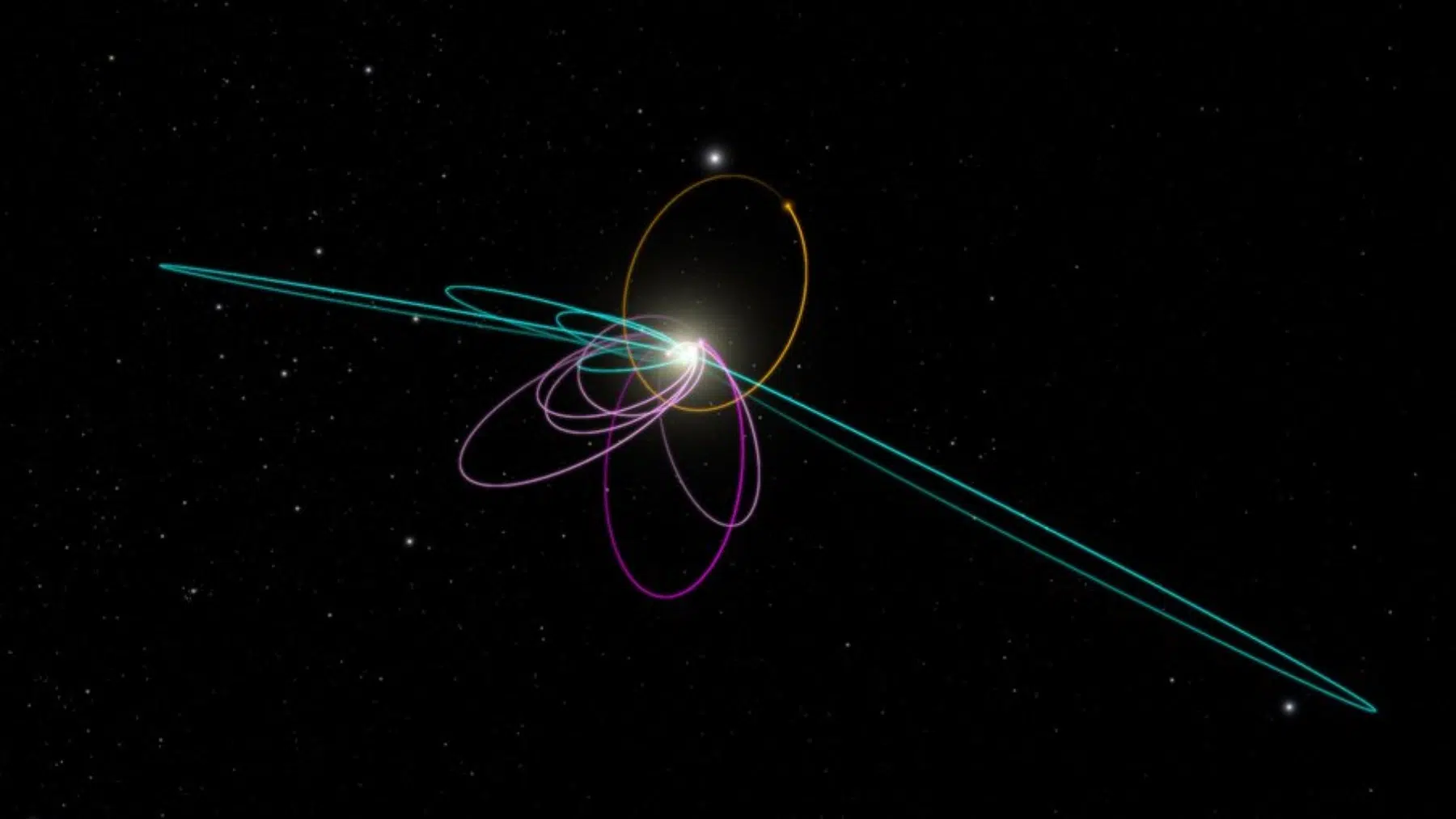
A ninth planet may be tugging at the outer edges of our solar system.
Astronomers were studying distant icy objects beyond Neptune.
In 2014, astronomers found six Kuiper Belt objects clustered in identical, elliptical orbits. Multiple objects seemed to cluster together in ways that shouldn’t naturally happen.
Mathematical models suggest a ‘super-Earth’ located 20 times further from the Sun than Neptune.
According to NASA, telescopes have been capturing signs of it since 1930.
What cosmic giant is casting a 20,000-year shadow over our telescopes?
How something huge is pulling strings in deep space
The mystery lies in the Kuiper Belt, a graveyard of icy debris beyond the known planets.
This region in deep space contains several icy worlds. As well as dwarf planets and frozen debris.
Pluto is probably the region’s most famous resident.
But researchers studying this part of deep space noticed something rather unusual.
Icy bodies are physically tilted 30 degrees downward, defying known physics.
Statistically speaking, this pattern shouldn’t exist naturally.
Something’s gravity was disturbing the outer solar system. A similar reality led to the discovery of Pluto.
Pluto is one fifth of the mass of Earth’s moon—far too weak to cause this chaos.
A bizarre pattern in deep space: Clustering of objects in our solar system
The strange orbital behavior in deep space suggested something strange.
The odds of this ‘party’ happening by chance are one in 14,000.
Most had elongated orbits that pointed in the same direction.
Was it an Einstein cross? Was it something else entirely?
Under normal conditions, this should not be happening.
Gravitational interactions should normally scatter those objects randomly.
Instead, they behaved like something huge was shepherding them from afar.
And the patterns kept expanding.
Certain objects even traveled on odd retrograde orbits.
Planets alone struggled to explain what these anomalies were.
Computer simulations consistently pointed to one possibility: an invisible and hidden planet.

NASA has the technology nowadays to track distant cosmic objects.
But even the most powerful telescopes struggled to get a glimpse.
Calculations suggested a planet several times larger than our own. But why was it so difficult to see?
At such extreme distances, sunlight is one one-millionth as bright as on Earth, rendering the planet nearly pitch-black.
Experts note that glimpses of this planet were unknowingly captured around the 1930s. How could we have missed this?
NASA‘s Michael Brown and Konstantin Batygin have narrowed the search to a specific patch of the sky.
NASA believes this could be “planet nine” beyond Neptune
Experts from NASA think this huge object could be “planet nine”.
It could have been a cosmic fossil ejected from the inner solar system four billion years ago.
Pluto was relegated from being a planet. But this one would be different.
Due to its massive size, it would hypothetically be categorized as a new planet. The ninth in our solar system.
“Planet nine” may be five to ten times the size of Earth. It sits 400 to 800 Astronomical Units away—so distant that one ‘year’ lasts two ice ages.
One orbit may take as long as 20,000 years to complete.
Researchers did not discover “planet nine” through telescopes
They inferred its existence through observations of its gravitational pull. NASA calls these “gravitational footprints”.
Some think this could point to hidden worlds on the edge of our solar system.
But no official confirmation has emerged yet.
The concept has fueled one of the largest searches in astronomy.
Astronomers are now using the Vera C. Rubin Observatory to hunt for its faint infrared heat signature.
Was this the newest addition that emerged from the inky darkness of deep space?
A planet unlike anything we have ever seen?
Is it a planet, or is it a primordial black hole the size of a grapefruit?
Read the whole thing?
Get the week's signal, not the noise
Our sharpest reporting on energy, climate and nature — free, once a week.


