
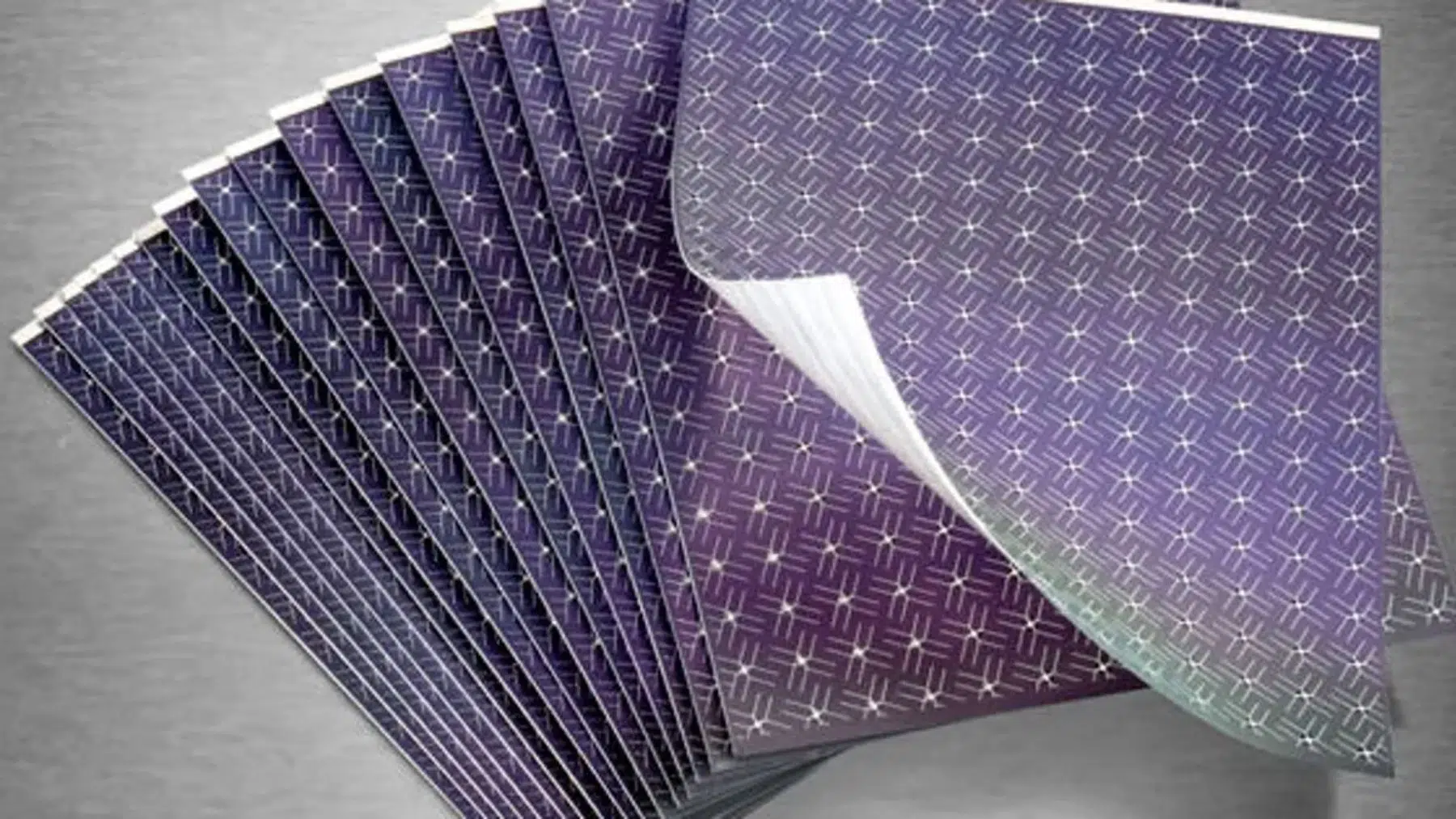
Researchers at MIT have unveiled groundbreaking power with ultra-thin solar panels, which are thinner than paper! An MIT research team invented a fabrication technique, producing ultrathin, lightweight solar cells that can be seamlessly placed onto any surface. Today, we will be telling you more about the invention that could become a lifesaver in cases of emergency.
How this ultra-thin solar panel produces groundbreaking power
Traditional solar panels require immense infrastructure due to extremely fragile solar cells. They require protection, which causes solar panels to weigh two to four pounds per square foot, or about 40 pounds for one average-sized residential solar panel.
Thankfully, the ultra-thin solar panels made by MIT require very little infrastructure. The team, led by Vladimir Bulović, used a slot-die coater to deposit layers of electronic materials onto a releasable substrate. Using screen printing, an electrode is deposited onto the structure to complete the solar module. The researchers then peel the printed module off the plastic substrate, forming an ultralight solar device. They then adhere the solar modules to sheets of Dyneema fabric using a layer of UV-curable glue, forming an ultra-light and mechanically robust solar structure.
According to Bulović, their goal is to make solar energy more accessible and portable, so it can be utilized in scenarios where traditional panels become impractical.
“The metrics used to evaluate a new solar cell technology are typically limited to their power conversion efficiency and their cost in dollars-per-watt. Just as important is integrability — the ease with which the new technology can be adapted. The lightweight solar fabrics enable integrability, providing impetus for the current work. We strive to accelerate solar adoption.” – Vladimir Bulović, the Fariborz Maseeh Chair in Emerging Technology, leader of the Organic and Nanostructured Electronics Laboratory (ONE Lab), director of MIT.nano.
The benefits of the ultra-thin solar panels with groundbreaking power
We just love it when a product has a lot of pros, so we thought we would share them with you:
- It is strong and flexible, extremely thin, and is fixed onto a durable, lightweight fabric, ensuring simple installation.
- After rolling and unrolling a fabric solar panel more than 500 times, the cells kept more than 90 percent of their initial power generation capabilities.
- It provides energy on the go as apparel, or it can be conveyed and quickly distributed to remote locations in cases of emergencies.
- It produces 18 times more power per kilogram, resulting in the groundbreaking power of 730 watts of power per kilogram when freestanding and about 370 watts per kilogram if deployed on the high-strength Dyneema fabric.
- It is made from semiconducting inks utilizing printing procedures that can be scaled up in the future to large-area production.
The applications of the ultra-thin solar panels
The solar cells can be laminated onto various surfaces thanks to the solar cells being so thin and lightweight. This means they can be utilized on boats by combining them with the sails, which will supply power at sea. They can also be applied to tents and tarps that are used in disaster recovery actions, or onto a drone’s wings to expand the drone’s flying range. The extremely thin and lightweight solar technology can essentially be combined with built environments with very few installation needs.
“My expectation would be that the format of these new cells should allow us to completely rethink how rapidly we can deploy solar cells, and how rapidly we can manufacture solar cells. In the long run, we think this can be as rapid as printing a newspaper.” – Vladimir Bulović.
MIT leads the way at photovoltaics! The team’s paper is written by Vladimir Bulović, as well as co-lead authors Mayuran Saravanapavanantham, an electrical engineering and computer science graduate student at MIT, and Jeremiah Mwaura, a research scientist in the MIT Research Laboratory of Electronics.
Read the whole thing?
Get the week's signal, not the noise
Our sharpest reporting on energy, climate and nature — free, once a week.


