The world of solar power is expanding daily and this latest innovation proves the sky’s the limit—literally. Researchers from Austria have combined solar electricity generation with flight and it’s opening up a whole new realm of possibilities. Imagine if we could deploy drones into the air that never have to come down, in theory? This may well come to pass if the recent successful testing of this new concept is anything to go by.
Flight plus light: Solar panels are taking to the skies
The solar power sector is developing more rapidly than any of the other forms of renewable energy generation. It seems like every day, there’s a novel way to catch sunlight in the news. One of the latest involves a project being undertaken by researchers operating in Austria and it’s already shaping up to be a winner in the world of photovoltaics.
The team, who work out of the Johannes Kepler University (JKU) in Linz, are working on solar cells 20 times thinner than a human hair that deliver power output as high as 44 watts per gram. But this is not the groundbreaking aspect.
You may never have to charge your drone again
The technology was recently applied to drones and successfully sustained long-duration flight, meaning that drones could be deployed almost anywhere where there’s sunlight and they may never have to return to their pilot for charging ever again. Obviously, this is an extreme view of how the lightweight PV panels may be applied. More practically, if the technology makes it to commercialization, drones will be solar-powered and won’t need to “return to base” for manual recharging.
How did the solar-powered drone testing go?
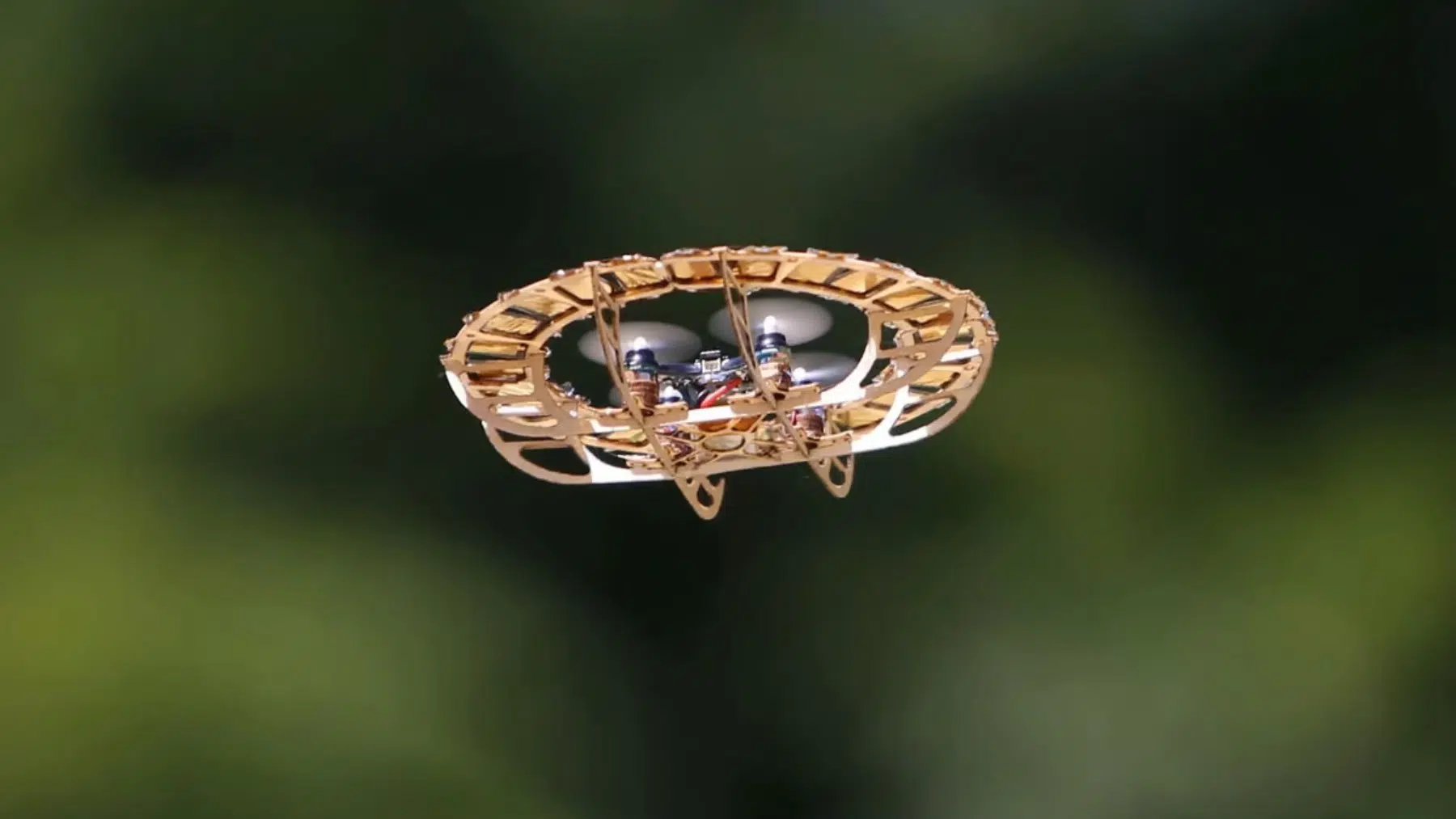
The JKU scientists equipped a palm-sized, commercial quadcopter drone with cutting-edge, super-light perovskite solar cells and launched it over a series of consecutive charge-flight-charge cycles. The point was to figure out if it could take off, recharge, and land without wired recharging, and their endeavors paid off in the clear success of the test.
This solar-powered drone solution delivers an ultra-lightweight, flexible, durable solar cell that will facilitate long-term, self-sufficient energy generation. Aside from powering itself, the solar drone has a relatively high degree of stability. The enhanced output is up to 44 watts per gram thanks to thin quasi-2D perovskite solar cells, which are known for their advanced performance. The cells added just 0.25% to the drone’s weight but could fully recharge the batteries.
One of the research leads, Christopher Putz, expressed his confidence in his team’s achievements:
“Lightweight, adaptable, and highly efficient photovoltaics are the key to developing the next generation of self-sufficient energy systems.”
Why is autonomous energy important and what are its applications?
Autonomous energy is what keeps power systems functioning independently for extended periods. This applies on Earth but also in space, where there’s a growing need for solutions to power missions beyond our atmosphere. This applies especially to distant or unpredictable situations.
The JKU researchers claim that the new approach could be scaled up for mapping, space-based solar power generation, search and rescue missions, and exploration of the solar system. Putz elaborated:
“Ultra-thin and lightweight solar cells not only have enormous potential to revolutionize the way energy is generated in the aerospace industry, there are also a wide range of applications that include wearable electronics, and the Internet of Things.”
The team also noted the significance of self-sufficient aviation, such as the helicopter Ingenuity demonstrated with its successful mission to Mars. It made history as the first aircraft to achieve powered, controlled flight on another planet, all thanks to an effective state-of-the-art onboard solar power generating system. Any development in the direction of self-sufficient energy in space is welcomed by the scientific fraternity and there’s no doubt more to come.
Read the whole thing?
Get the week's signal, not the noise
Our sharpest reporting on energy, climate and nature — free, once a week.