

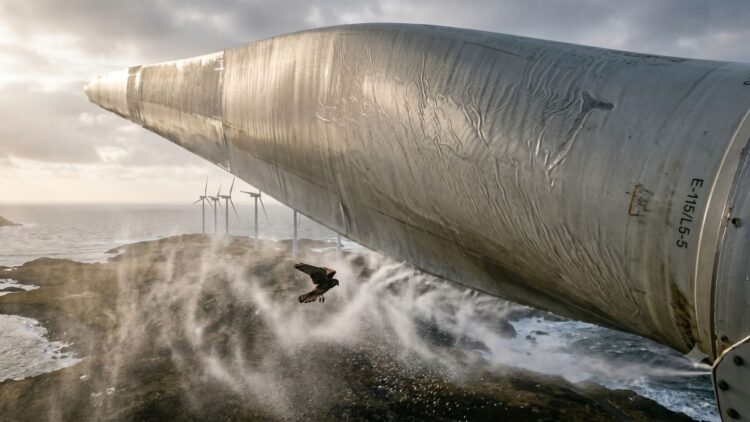
On a windswept island off the coast of Norway, rows of tall turbines turn slowly in the salt air, doing exactly what they were built to do.
They pull clean power out of the wind.
For years, though, they were also doing something nobody intended.
They were killing the eagles that had hunted those cliffs for generations, and for a long time no one knew how to make it stop.
A wind farm with a problem in the sky
The island is called Smøla, and it is one of the richest places for birds in all of Norway.
It is also home to a large wind farm, switched on in the early 2000s.
It runs dozens of turbines across the low, treeless ground.
Soon after the blades started spinning, the bodies began turning up.
Among them were sea eagles, huge raptors with wingspans wider than a person is tall.
Trained dogs and workers walked the bases of the towers, counting the dead.
The toll grew high enough that the wind farm became a symbol for everything critics feared about green power.
The criticism landed hard at the very moment the world was trying to build far more of it.
Why the birds never saw it coming
The strange part is that eagles have superb eyesight.
They can pick out a fish from hundreds of feet up.
But a hunting bird tends to look down and to the side for prey, not straight ahead.
So why would one fly straight into a blade the length of a bus?
The answer lies in something called motion smear.
When a blade tip whips around at well over a hundred miles an hour, the eye can no longer hold it as a solid object.
It blurs into a faint transparent haze, a patch of sky the bird believes it can pass straight through.
The faster the blade turns, the more completely it seems to vanish.
By the time the eagle is close enough to sense the mistake, there is no time left to turn.
A fix hiding in an old, ignored report
Switching the turbines off whenever birds came near did work.
But it threw away the very power the farm existed to make.
Radar and camera systems were costly and easily fooled.
So a team of Norwegian researchers went hunting for something cheaper.
They dug up a decades old laboratory report from the United States that almost nobody had ever acted on.
It had sat in the literature for years, never properly tested out in the open.
It pointed to a fix so plain it sounded like a joke.
The trick was not to add anything to the turbines, but to change something about how they looked.
The change that turned out to be a paintbrush
The idea was to paint one of the three blades black.
That single dark blade breaks the blur, giving the spinning rotor a streak the eye can lock onto.
The effect is strongest out at the fast moving tip, where the blur is worst and the danger highest.
In 2013, scientists at the Norwegian Institute for Nature Research painted one blade on four of the Smøla turbines.
Then they kept counting bodies for another three years.
Their records reached all the way back to 2006, giving them years of before and after to weigh.
Deaths at the painted turbines dropped by around seventy percent next to the untouched ones nearby.
The result for the eagles was starker still, with not a single sea eagle found dead beneath a painted turbine after the change.
A near miracle that still needs proving
It is tempting to call the problem solved.
The honest answer is not yet.
The Smøla result came from only a handful of turbines, and one larger trial in the Netherlands has so far shown no clear benefit.
Bigger experiments are now running in Wyoming, South Africa and Spain to learn where the trick works and where it falls flat.
Across the United States, wind farms are thought to kill somewhere between 140,000 and 679,000 birds a year.
It is a real loss, though far smaller than the millions taken by glass windows and house cats.
Even so, the appeal is obvious, because a tin of paint costs almost nothing next to the price of a turbine standing idle.
It joins a growing list of small fixes that let energy and wildlife share the same space, from lobsters living among offshore foundations to cod gathering beneath the turbines at sea.
None of it needs a new machine, only a different way of seeing an old problem.
The eagles never learned to dodge the blades.
We simply made the blades easier to see.