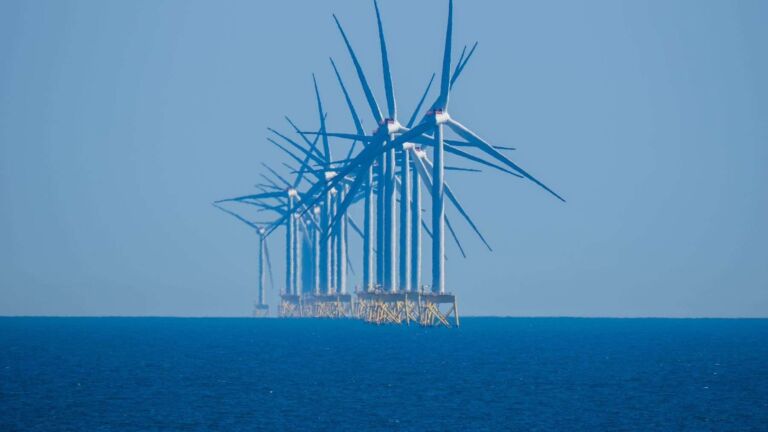
From a distance, offshore wind turbines are a vision of serenity. Their motion is calm and quiet as they go about their business of harvesting energy from the air.
This is never the case in the air above.
A meteorological mystery is developing as the green energy industry booms. An unintended consequence is changing the weather forecast.
Giant steel wind turbines are launching invisible forces against storms, forcing shifts before reaching land.
What is this new “wind wave” phenomenon?
The unseen wake: How wind farms have generated a meteorological mystery
Towering offshore wind farms used to be novelties to gaze at in wonder. Now, they’re operating predictably in our peripheral vision as if they’ve always been there.
Wind farms have one job: take the wind and make clean power.
But something is happening in the skies that no one predicted. An atmospheric disruption is becoming clear in the data.
University of Delaware researchers caught a twist in their advanced weather simulation models.
It turns out that the expansive turbine arrays were doing more than just harvesting energy.
Data from farms on the western coast of the United Kingdom shows that they are physically altering the atmosphere.
The motion of the blades doesn’t leave a vacuum. It triggers an invisible ripple effect in the atmosphere that heads straight for the coast.
Scientists are calling this phenomenon “wind waves,” and they have the potential to impact the environment. To what degree, no one knows yet.
Nevertheless, they’re changing the clouds. How do farms out at sea dictate the rain on our roofs?
Droughts and downpours: Cause or coincidence?
The distinct anomaly emerged in the data from the UK’s Walney and Burbo Bank wind farm sites.
There are subtle but undeniable changes being felt on land downwind of the farms. The rainfall patterns show a drop in steady precipitation in some areas. In others, drizzling conditions have spiked all of a sudden.
Not everyone believes that turbines could have such great effects. They cite standard variations in climate or seasonal flukes.
But determined researchers isolated the variables with statistics. Natural ocean and wind patterns were ruled out. The facts were clear: wind turbines are changing the weather, says the University of Delaware.
Compare how mountain ranges interact with the atmosphere. When a weather front meets a barrier, the air is forced to compact or dissipate outward. This changes precipitation behavior.
A similar thing happens with the turbines acting like mountains of steel and moving air.
And how exactly does an array out at sea rewrite the weather script for a town miles inland?
Ripples across the sky all the way to your hometown
The puzzle of the altered inland rainfall has to do with the physics of the atmosphere.
A wind wave has nothing to do with water. It’s a repetitive, back-and-forth movement of atmospheric pressure and air density on a huge scale.
The turbine blades function by extracting kinetic energy from the wind.
But the slow wake left behind is chaotic, generating outward-expanding ripples.
Two forces interacting with turbines
It gets more complex because two distinct zones of convergence and divergence are created.
When fast wind hits the farm, it slams into slower air, creating convergence. The air under pressure has nowhere to go except up.
It rises, cools, and condenses, leading to rain just above or before the farms.
But after passing the farm, the air speeds up and sinks to fill the vacuum. This is the divergence part of the cycle. The air that drops is warmed up and dried out. Now, onshore communities’ rainfall will be less intense.
This situation doesn’t call for offshore wind farming to be labeled as “bad.”
But it means that engineering layout and shoreline distance are vital factors to consider.
Is there a “sweet spot” where clean energy can be maximized without rewiring the climate?
Read the whole thing?
Get the week's signal, not the noise
Our sharpest reporting on energy, climate and nature — free, once a week.