
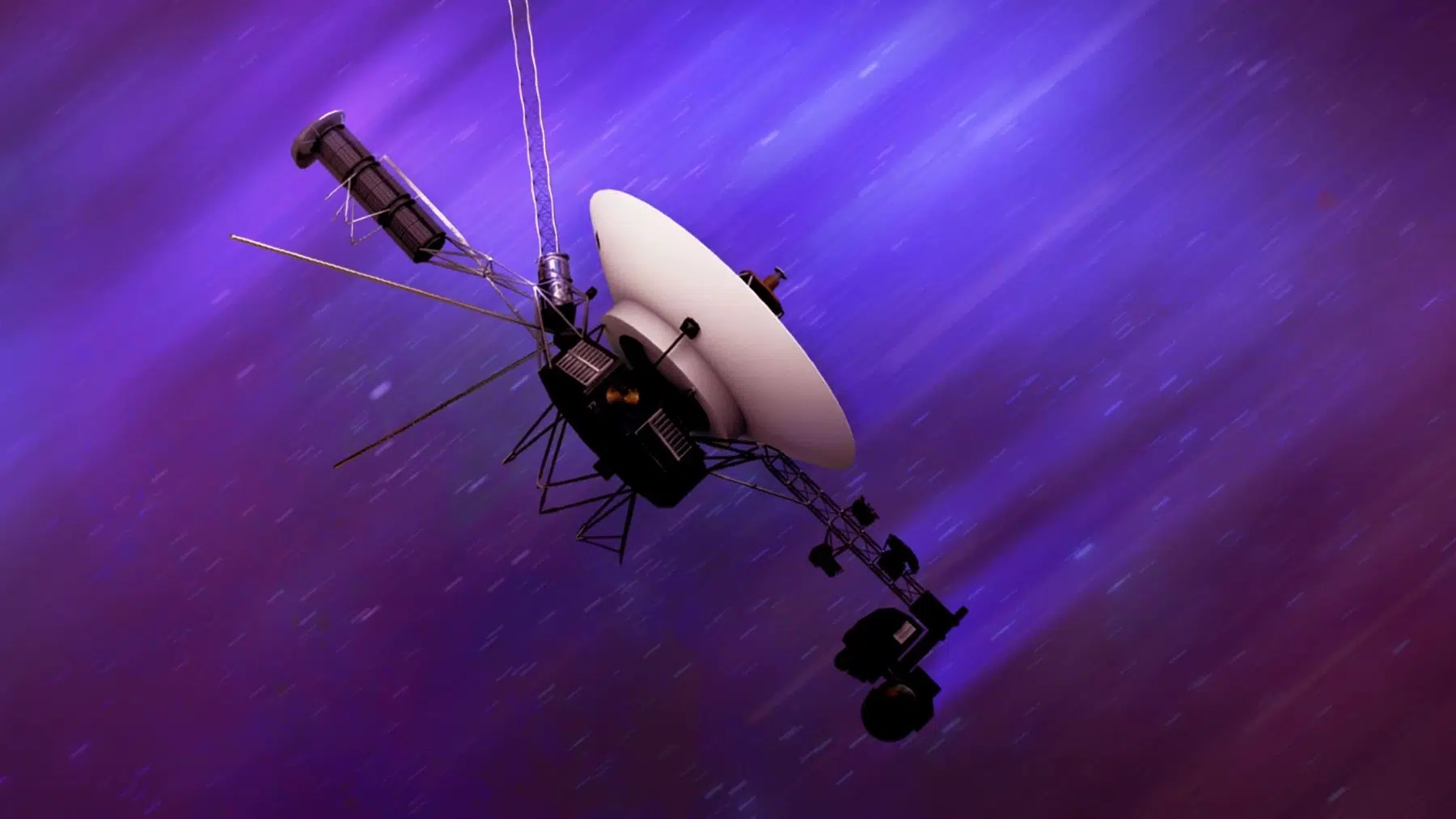
A faint sound described as a ‘ghostly signal’ by global news was detected near Voyager 1, the farthest ever launched spacecraft in human history. The spacecraft is currently more than 25 billion kilometres away from Earth, operating in interstellar space. The ambiguity of initial descriptions led the public to speculate; some thought there was alien activity, whereas others speculated that Voyager 1 had been reactivated.
Voyager 1 is so far away in space that the Sun isn’t a factor
Voyager 1 has reached a distance so far from Earth that the Sun no longer has influence where it currently is. To really grasp the magnitude of this situation, one must first understand the scale at which it takes place. The distance from Earth to Neptune is approximately 4.5 billion kilometres, and another 4 billion kilometres beyond that lies interstellar space, which is beyond our solar system. Voyager 1 is currently at a magnitude where it is no longer navigating the solar winds but rather making its way through the galaxy’s cosmic rays and other gases.
As far as it has been researched, Voyager has only been able to detect the natural, eerie sounds of interstellar plasma. It was not expected to transmit or interpret new signals, which is why the detection that was received was so uncanny. With no immediate clarification from NASA or the European Space Agency (ESA), the term “ghostly signal” spread like wildfire, causing all types of speculation to arise from the public.
However, the signal was not an anomaly or an accident, but was a scheduled programming — one that combined science, culture, and deep space engineering never seen before.
The origin of the ‘ghostly’ signal: What has Voyager 1 been up to?
Soon after the speculation, space agencies and telecommunications located the source of the transmission, a planned message from the ESA’s Deep Space Antenna in Cebreros, Spain. It was a live radio broadcast of The Blue Danube by Johan Strauss II, performed by the Vienna Symphony Orchestra. Performed in celebration of the ESA’s 50th Anniversary, as well as the 200th anniversary of the birth of Strauss, the project was titled Waltz into Space.
The choice to convey the popular waltz by Strauss was intentional and symbolic. As the waltz was iconic in space culture because of the film 2001: A Space Odyssey. The organizers of the project referred to the transmission as tribute. By sending the music almost five decades later, the ESA and the orchestra hoped to give the piece the space legacy it missed and take its rightful place amongst the stars. The event was technically extraordinary due to the position of the Voyager 1.
The position of Voyager 1 and the long journey of the transmission
The spacecraft, moving at a speed of approximately 17 kilometres per second, entered interstellar space in 2012. The communication at the range that it is at currently can take up to 23 hours to travel one way, with the radio signal traveling at the speed of light.
According to engineers, it takes an accurate transmission to clearly produce an audio signal and has to be streamed over 168 Astronomical Units. The 36-metre high-gain antenna at the Cebreros ground station generated a narrow high-power beam that was accurate in a few degrees.
Voyager 1 doesn’t have the capacity to translate the signal
By the time the transmission reached Voyager 1, the signal was barely detectable. Hence, it was described as a “faint whisper” deep within space.
The spacecraft’s technology is outdated as it was made in the 1970s, so it is incapable of decoding and storing the audio; however, the spacecraft was still hit by the signal and was able to fulfil its mission. As Voyager 1 continues its journey, the radio signal of the waltz has already moved far beyond that. What was thought to be a ghostly signal will now serve as a reminder that even though our machines fade, the creativity of mankind can still travel through space.
Read the whole thing?
Get the week's signal, not the noise
Our sharpest reporting on energy, climate and nature — free, once a week.


