You’ve probably asked this question at some point — and maybe more than once.
Are we actually alone?
Right now, that question isn’t just fuel for movies or late-night curiosity. New data coming out of a NASA mission is forcing scientists to pause — and pay closer attention.
What’s unusual is where the signal is coming from, and why it’s being taken more seriously than before.
The answer isn’t here yet. But what NASA just detected could change how close you think we really are.
What are the chances of alien life? Perhaps more than you think
When you think about life beyond Earth, it’s easy to picture movie aliens and move on.
But the real idea is much simpler—and much bigger.
You’re living in a universe with more than 200 billion galaxies. Each galaxy holds billions of stars. Many of those stars have planets. When you stack those numbers together, the question stops being “Is alien life possible?” and starts sounding more like “How could it not be?”
Scientists aren’t looking for little green men. They’re looking for chemistry, energy, and water. Even microbes would count. Finding simple life would be proof that biology isn’t unique to Earth—it’s something the universe knows how to do.
That’s why researchers focus on familiar ingredients. Places with liquid water. Organic molecules. Energy sources that could keep something alive.
And you don’t have to look across the universe to find those conditions. Not even to search for strange places that NASA describes as… the fifth dimension.
Here’s where things start to feel strange
You’ve probably been told Mars is our best bet. Maybe a distant exoplanet light-years away. But some of the most compelling evidence is much closer—and completely hidden.
Certain moons in our own solar system appear lifeless on the surface, yet may be active underneath. Ice. Darkness. No atmosphere you could breathe.
And still, scientists keep coming back to one place in particular.
Not because it looks alive—but because everything needed for life could be buried below layers of ice you can’t see.
That raises the unsettling question: what if life is common… just invisible?
NASA knows where to start looking: And it has found something
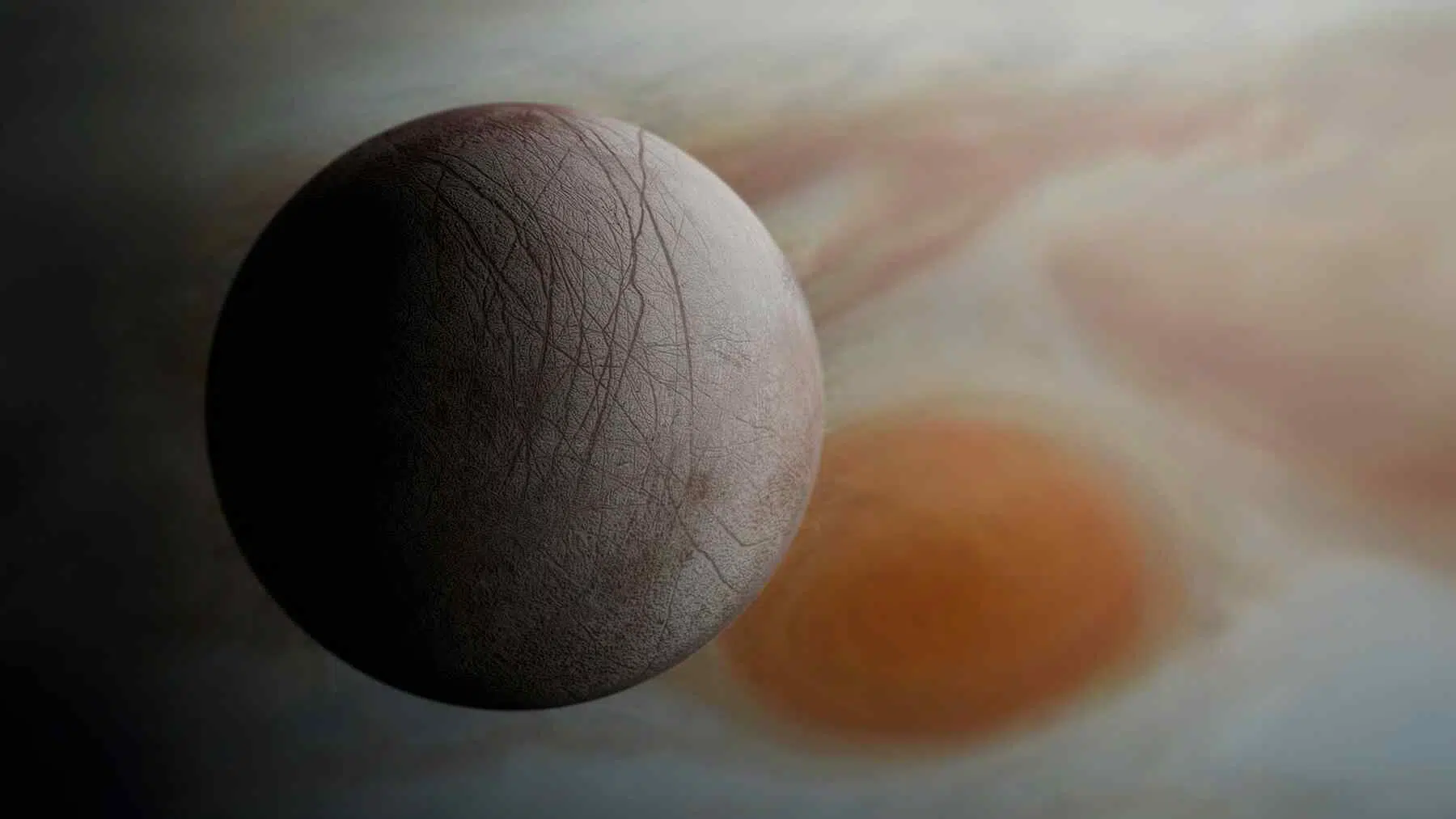
The focus is Europa, a moon orbiting Jupiter.
Beneath Europa’s frozen surface is a global ocean of liquid water. Not a lake. An ocean—potentially deeper than all of Earth’s oceans combined. It has chemical ingredients, energy from tidal forces, and temperatures that allow water to stay liquid.
In January 2026, new findings from NASA’s Juno mission changed how clearly we understand that hidden world.
The data showed Europa’s ice shell is about 18 miles thick. Thick—but not impossible. The mission also revealed cracks, pores, and surface features that suggest movement between the ocean below and the surface above.
That matters because life needs interaction. Energy. Chemistry in motion.
No one has seen what’s under the ice yet.
But for the first time, scientists know exactly where—and how deep—they’d need to look.
So the idea of life beyond Earth doesn’t feel quite as distant anymore. With each new mission and each unexpected discovery closer to home, the question has shifted from if to how likely.
You’re watching science slowly narrow a mystery that once belonged only to science fiction. Not with dramatic announcements, but with steady clues that add up over time.
Nothing has been confirmed yet. But the growing evidence suggests the universe may be more familiar—and more alive—than we once thought.
And as the search continues, it’s hard not to wonder what we’ll learn next. Let’s hope that this time it doesn’t do like the strange object that simply “vanished without a trace.”
Read the whole thing?
Get the week's signal, not the noise
Our sharpest reporting on energy, climate and nature — free, once a week.