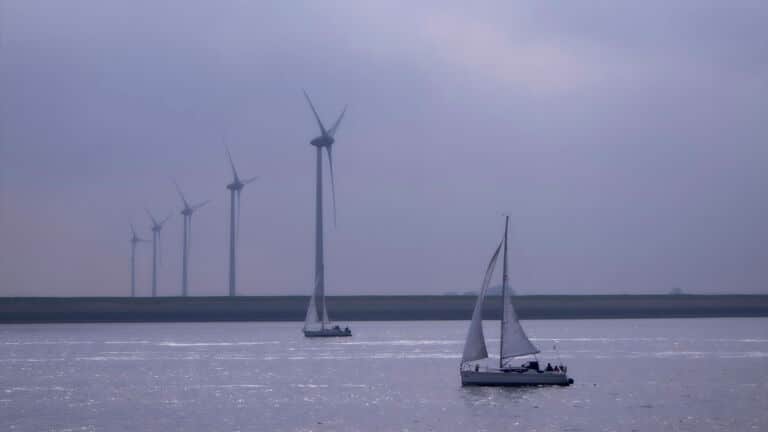
A commercial wind energy operation in Klickitat County, Washington, secured a 30-year ITP to continue operating. This long-term federal authorization enables the facility to maintain commercial energy generation while complying with strict wildlife protections.
However, it imposes numerous physical restrictions on properties throughout the county that may be affected by raptors.
Most notably, the facility owner and operator must pay for upgrades to thousands of rural power transmission lines and poles. These upgrades are designed to reduce the chance of electrocuting local raptor populations.
The federal wildlife agency decision represents an effort by the U.S. government to provide consistent nationwide enforcement.
This approach applies to commercial wind farm operations under current national wildlife laws.
How a 30-year federal permit reshapes the site
Juniper Canyon Wind Project is in unincorporated Klickitat County and features 62 utility scale wind turbines.
Combined, these wind turbines generate approximately 151.2 MW at the project site.
On June 22nd, 2026, the United States Fish & Wildlife Service approved a 30-year eagle incidental take permit for the site. The approval keeps the facility in compliance with state and federal regulations until January 31st, 2056.
Under the Bald and Golden Eagle Protection Act (BGEPA), commercial wind farms must secure an Incidental Take Permit before operating. This requirement exists because fast-moving wind turbine blades create hazards for low-flying raptors.
A long-term permit allows energy companies to operate commercially while meeting BGEPA rules.
It also fulfills key conservation obligations.
The mandate behind the power pole retrofits
To gain approval, the project owners and operators must implement measures to mitigate impacts on regional raptors.
As outlined by the U.S. Fish and Wildlife Service, owners must select a retrofit schedule for nearby power distribution poles.
The permit states that either 2,369 or 5,444 distribution power poles need modification. The total depends on equipment durability over a 10-year or 30-year period.
Required modifications include line insulation updates, perch deterrents, and reorienting exposed conductor wires. These modifications prevent large birds from contacting lethal electrical components when roosting or flying over the structure.
Documents from Klickitat County further outline these specific pole modification requirements.
Why do they have to retrofit so many power poles?
In accordance with BGEPA, compensatory mitigation is required as part of the permitting process. Compensatory mitigation means making biological trade-offs for potential habitat or wildlife losses caused by wind turbines.
Since some birds will die from turbine blade strikes, operators must remove equivalent hazards within the same environment.
Large birds like golden and bald eagles land on overhead distribution poles because the crossarms fit their large wingspans.
When these birds touch an energized wire, they face a risk of fatal electrocution.
Permit holders might choose retrofits that last 10 years. Under that timeline, a total of 5,444 pole retrofits are required during the permit term.
However, if the owner or operator installs retrofits built for 30 years, only 2,369 poles are required.
Installing physical barriers between energized wires and grounded metal objects protects against avian electrocution. These barriers also reduce risks associated with turbine collisions.
The approach supports raptor conservation in Klickitat County.
How local zoning protects nesting grounds
Alongside BGEPA conditions, Klickitat County Energy Overlay Zone rules govern local activities to minimize environmental impacts. County rules mandate that all construction and maintenance work observe specified buffer zones around active raptor nests.
During nesting season, all construction and maintenance must stay at least one mile away from active Ferruginous Hawk nests.
Work must also stay outside a 1,300-foot radius for all other active non-Ferruginous Hawk nests during nesting season.
Additionally, specific soil management practices are required to protect ground habitat at the project site. Proponents must separate native topsoil during land-disturbing work to protect local seeds.
They must also create native vegetation restoration plans with input from the Washington Department of Fish and Wildlife (WDFW).
In addition, they must avoid streams and wetlands to preserve regional biodiversity, highlighting the wider environmental challenges associated with retired turbine blades.
Read the whole thing?
Get the week's signal, not the noise
Our sharpest reporting on energy, climate and nature — free, once a week.