
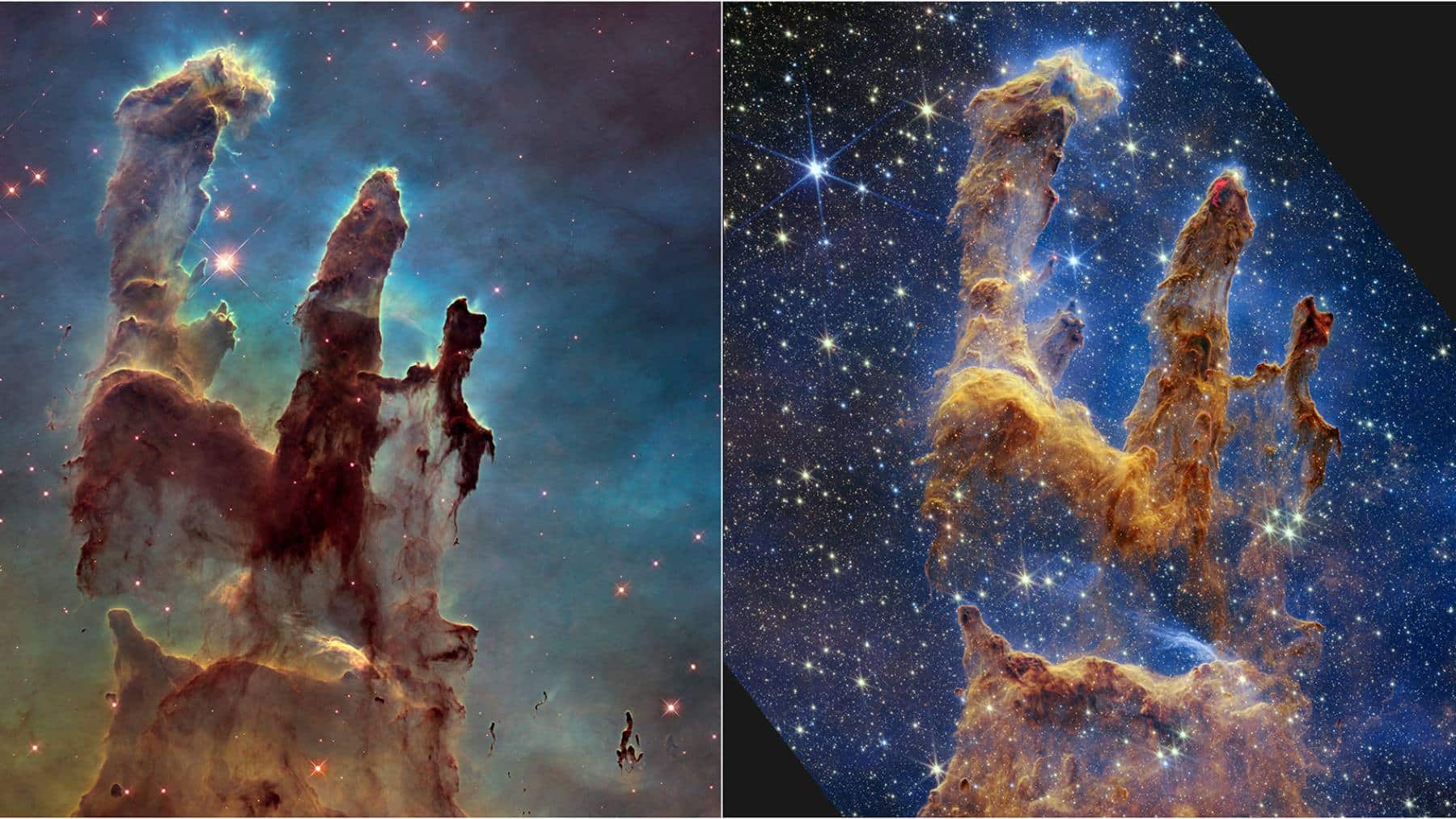
The Pillars of Creation were captured in a photograph more than 25 years ago by the Hubble Telescope, and the image is now among the most famous views of the sky ever taken, which is clear of deep space phenomena. The James Webb Space Telescope used its sharp near-infrared camera to create a new image of the Pillars of Creation. These pillars are about 6,500 light-years away from Earth, which is around six trillion kilometres, and the images show us a view from the distant past.
Do the Pillars of Creation still exist today, and what are they made up of?
The semi-permeable Pillars of Creation exist in the centre of Messier 16 and are made up of icy interstellar gas and dust.
The Hubble Space Telescope first captured an image of the Pillars of Creation, which shows elephant trunk-shaped formations of interstellar gas and dust in the Eagle Nebula. They are approximately 6,500 to 7,000 light-years (2,000–2,100 pc; 61–66 Em) away from Earth, in the Serpens constellation.
John Charles Duncan discovered this phenomenon in 1920. The gas and dust formations are in the process of being observed using the 60-inch telescope at the Mount Wilson Observatory as they are being worn away by the light from newly formed nearby stars while simultaneously creating new stars.
The pillars mentioned as rock towers are located in an active star-forming region and have undulating borders that point to star formation ejections, according to NASA.
The Pillars of Creation are disappearing, according to NASA
The Pillars of Creation are being bathed in bright ultraviolet radiation by a cluster of young stars in the area, and the winds from these stars are gradually wearing the gas and dust towers away.
A supernova explosion from a star around 6,000 years ago may have destroyed the Pillars of Creation, according to some scientists. The phenomenon will only be visible to star watchers on Earth for approximately 500 more years before it disappears. The pillars have been degrading slowly, according to some scientists.
NASA stated that the Webb telescope’s photos are assisting scientists to update their star formation models by revealing much more accurate counts of recently formed stars, as well as the amounts of gas and dust present in the area. According to NASA, they will eventually start to develop a more comprehensive knowledge of how stars grow and explode over millions of years from these dusty clouds.
Infrared detail from the Webb Telescope shows the secret depths of the Pillars of Creation
The James Webb Telescope, a joint project between NASA (which is also developing a new kind of fuel), the European Space Agency, and the Canadian Space Agency, is a spacecraft designed for data collection and infrared imaging. Having been launched in December 2021, it orbits the sun at a distance of one million miles from Earth.
This new view will help researchers improve their models of star formation by identifying more precise counts of newly formed stars and gas and dust quantities.
Webb telescope captures young stars and cosmic jets in pillars of creation
The picture from the Webb’s Near-Infrared Camera (NIRCam) revealed newly formed stars as bright red orbs outside dusty pillars.
These pillars collapse and heat up as knots develop inside them, eventually creating new stars. The wavy lines at the edges indicate the ejections from young stars that produce bow shocks and supersonic jets. The crimson shine is caused by hydrogen molecules, which are thought to be hundreds of thousands of years old and are high in energy.
The columns allow for the observation of cosmic distances using near-infrared light; however, no galaxies are visible. The first images of this area were taken by Hubble in 1995, and in 2014, it was photographed again, giving fresh information about the location. This is exciting for the world of science, proving yet again how much mankind still has to learn about the universe.


