In the summer of 2001, a small research boat drifted in the Bay of Fundy.
On board, a team watched for one of the rarest animals alive.
Fewer of them survive today than people in a small village.
Their target was the North Atlantic right whale.
Their odd task was to scoop up floating droppings.
From that scat they could read each animal’s hidden stress.
They were building a baseline, one sample at a time.
None of them knew a tragedy was about to hand them a rare experiment.
What they were about to witness would rewrite the science of ocean noise.
The scientists who read a whale’s stress
The team came from the New England Aquarium, led by biologist Rosalind Rolland.
For them the Bay of Fundy was a familiar summer office.
They had tracked North Atlantic right whales for years, a species down to a few hundred.
Every calf lost or saved matters to the whole species.
Each animal quietly carries a story written in its own hormones.
When a whale is stressed, its body floods with stress hormone chemicals.
Those chemicals pass into its waste and float at the surface.
A fresh sample can hold days of hidden emotion.
The researchers even used dogs on the bow to sniff out fresh samples.
Back in the lab, they measured the hormones drop by drop.
It was slow, strange, and oddly painstaking science.
But scat was the one window they had into a whale’s inner life.
A giant propeller and the roar it makes
To understand what they found, look at what makes a ship loud.
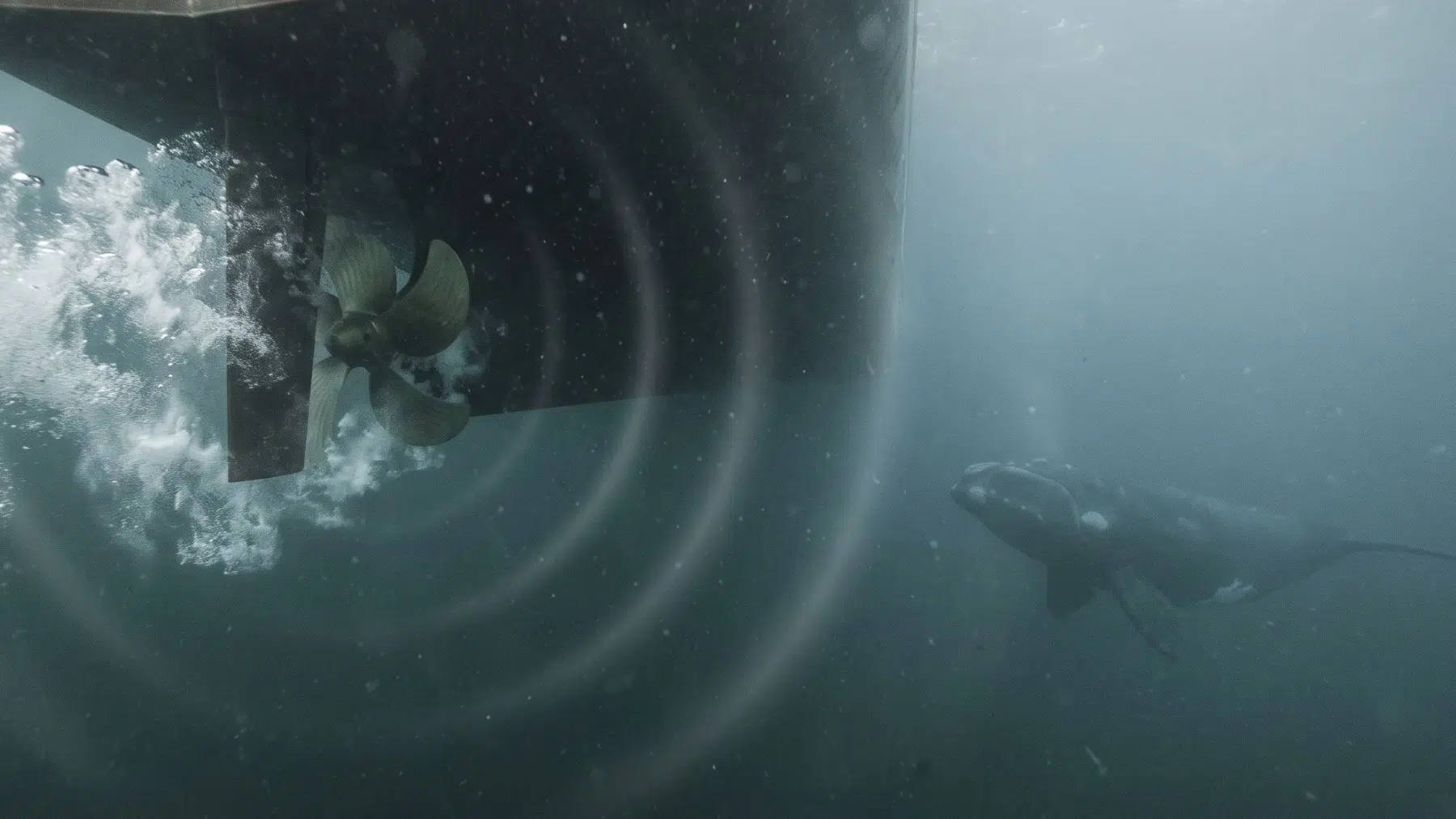
Under every big vessel spins a massive bronze propeller.
The largest, like the one on the Emma Maersk, weighs a full 131 tons.
As the blades whirl, they drop the water pressure behind them.
It is the same drop that makes water flash to vapor in a spinning pump.
The sea then boils into bubbles even in the freezing cold.
This has nothing to do with heat and everything to do with pressure.
An instant later those bubbles implode with a sharp violent crack.
Millions of these tiny collapses blur into a steady low roar.
That roar is the loudest thing most ships put in the water.
Sensors can pick a single freighter out from dozens of miles away.
The morning the shipping lanes emptied
Then came the eleventh of September, 2001.
In the hours after the attacks, ports and shipping lanes shut down.
For the first time in living memory, the great trade routes fell still.
Freighters sat at anchor, and the busy Bay of Fundy went still.
By chance, the team was still out on the water.
They were recording underwater sound and collecting scat as usual.
Their timing could not have been more accidental or more perfect.
Their microphones caught the ocean noise falling about six decibels.
The steepest drop was below 150 hertz, deep in the whales’ own range.
For a few days, the sea was as calm and silent as it had been in decades.
The researchers realized they were suddenly listening to a preindustrial ocean.
What the droppings finally showed
Months later, the first results came back from the lab, and they were startling.
The samples from that silent fall told a striking story.
The right whales’ stress hormone levels had dropped.
With the ships gone, the animals had visibly calmed down.
It was a pattern no one had ever managed to catch before.
In later, busier years the same hormones climbed back up.
Published in 2012, it was the first hard proof that ship noise stresses whales.
The sudden silence had not just felt different to the whales.
It had changed their bodies from the inside.
Like the hum around an offshore wind farm, the harm had been invisible.
What the discovery changed
That one small accidental experiment reshaped how we think about the whole sea.
It showed that noise alone can wound, even without a single collision.
Ports began testing ways to hush their busiest waters.
Small changes in speed turned out to make a real difference.
Off British Columbia, the ECHO program asks ships to slow down.
A slower propeller cavitates less and roars far softer.
In some seasons the underwater noise has fallen by almost half.
It is the same trade as a fox pushed from its den by solar panels, a gain shadowed by a cost.
Their work still guides how ports and shippers try to quiet the sea today.
Thanks to a boat, some dogs, and a pile of scat, we finally heard what the whales endure.
Read the whole thing?
Get the week's signal, not the noise
Our sharpest reporting on energy, climate and nature — free, once a week.