Alaskan winters can be dangerous as the roads become snowy, icy, and slippery, with the possibility of moose appearing out of nowhere.
The drive can be very risky as your reaction time decreases quickly.
Longer shadows stretch across the road. There is less daylight in November, meaning only a few hours.
Snow will fall in the mountains early, making it so that both drivers and wildlife are in the same dark areas.
Dark November days hide roadside giants until too late
Long periods of twilight and darkness dominate Southcentral Alaska throughout the month.
The issue is made much worse when the lowlands don’t have a thick layer of snow.
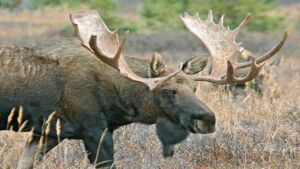
Snow creates a bright white background that makes it easier to pick out the shape of the animal.
Without it, even a 6-foot-tall moose can be hard to see until you get close enough for your headlights to pick it up.
Heavy mountain snowfall forces wildlife toward lower valley routes
If the moose stayed in the deep backcountry, this wouldn’t be an issue.
In winter, heavy snowfall in the Chugach Mountains and upper foothills makes it harder for moose to move.
They struggle to find food, so many slowly move down to lower valleys to conserve energy.
These areas often have open willow and birch browse, and many roads go straight through the same valley bottoms moose use in winter.
As the snow gets deeper in the mountains, more animals end up near the roadside bushes.
Vehicle collisions carry severe risks on icy winter roads
A moose is certainly quite a bit more dangerous than smaller animals. Their long legs mean they sit perfectly level with the windshields.
Generally, if you hit one, it will knock their legs out from under them and cause the heavy body to crash through the glass.
November can really increase your stopping distances with frost and black ice.
Reducing speed and scanning unlit shoulders prevents dangerous surprises
Icy roads mean it is important to slow down on unlit stretches, advice also included by the Alaska Department of Fish and Game.
Slower speeds give you more time to react and reduce the distance needed to stop.
If you are only looking at the lines on the road, you may not see any animals.
Look out toward the sides of the road, as well as medians and bushes.
Paying attention to these areas becomes even more important near wildlife corridors, where moose are more likely to appear.
Spotting one moose often means calves are nearby
Even if you are looking carefully at the sides of the road, you may still be surprised.
Often when one moose is crossing the road, there will be more than one.
Cows frequently have one or two calves with them that take a few extra seconds to cross.
Many drivers speed up as soon as the lead moose has left the road, missing the calves right behind it.
Sometimes moose also give themselves away before your lights hit them.
A reflector on the side of the road may flash suddenly, or an oncoming car’s headlights may briefly flicker as a moose crosses in front of them.
Treating unlit shoulders as active wildlife travel zones
As the snow gets deeper, it becomes harder for moose to travel through deep drifts.
That migration forces them back across the valley roads where traffic moves fastest.
Some areas around Anchorage have had more wildlife fencing, underpasses, and improved lighting systems.
Until there are more areas like this, it is very important to treat any dark sides of the road as an active area for wildlife.
Read the whole thing?
Get the week's signal, not the noise
Our sharpest reporting on energy, climate and nature — free, once a week.