Picture a toilet flushing in a London flat on an ordinary Tuesday.
The wipe swirls away and disappears from view.
It should be gone for good.
Instead, years later, it was still out there.
It had joined millions of others clumped into a mound on the riverbank of the Thames.
That mound grew large enough to do something a pile of bathroom waste is not supposed to do.
A material that will not break down binds itself into the riverbed
Wet wipes are mostly made of plastic fibers like polyester, not the paper pulp that makes toilet tissue fall apart in water. Most wet wipes are made with plastic, which does not break down when flushed, according to environmental charity Thames21. So when they slip through a sewer overflow during heavy rain, they do not disintegrate.
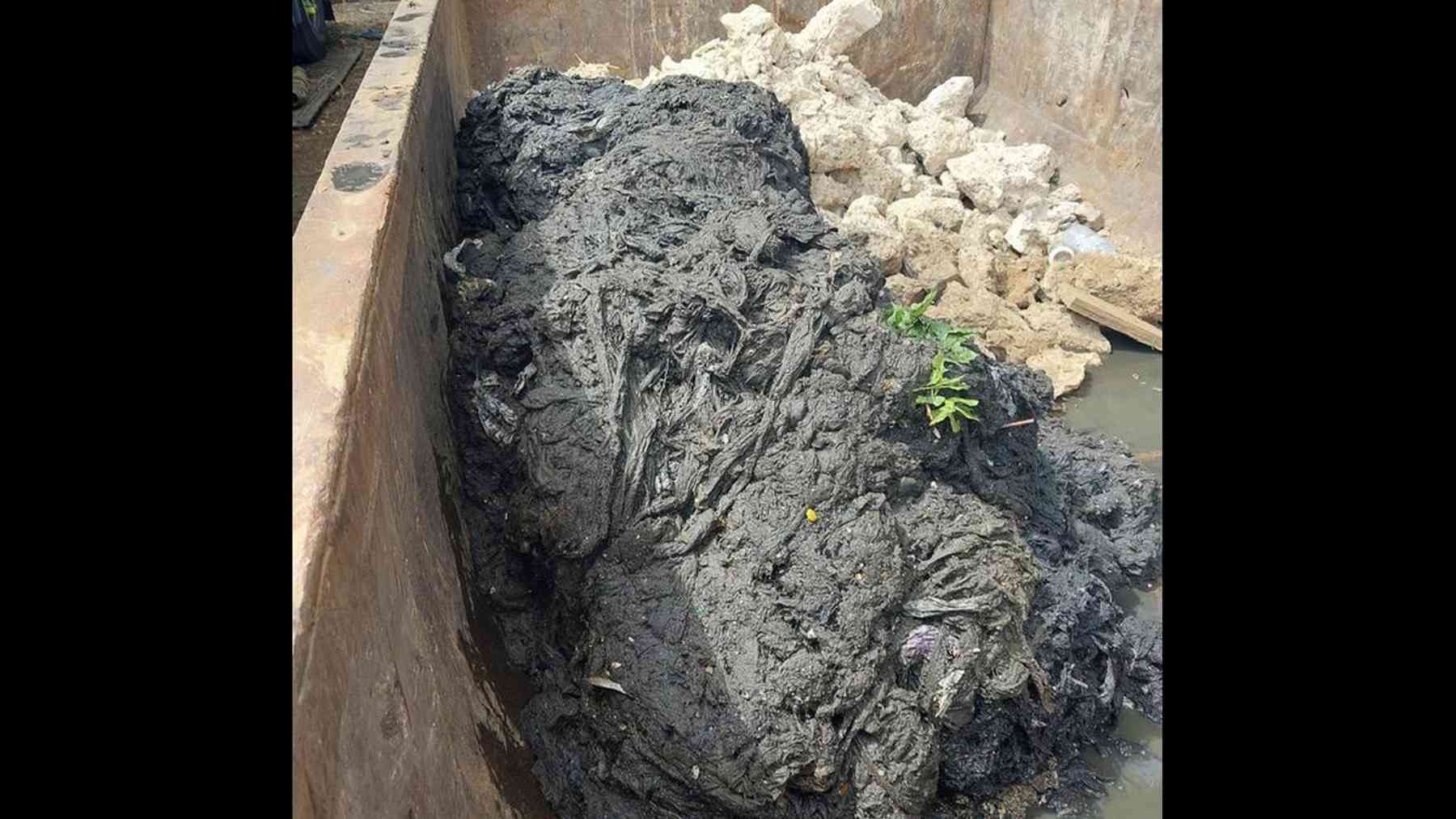
When wet wipes get into the Thames, they bind with natural sediment to create large mounds, tangling with silt, mud and grease the way hair knots up a shower drain. The scale here is a riverbank rather than a bathtub.
The clumps build at hotspots like Battersea, Hammersmith and Barnes, where the river bends and the water moves more slowly. At one bend near Hammersmith Bridge, that slow buildup turned into something solid enough to stand on.
Five million wipes fused into a mass the size of two tennis courts
Crews removed about 5 million wet wipes that had congealed into a 820 foot island on the foreshore of the Thames near Hammersmith Bridge. That is longer than two football fields laid end to end, pulled out chunk by dripping chunk.
The island was about the size of two tennis courts and up to three feet deep in places, packed wipes, sediment and grease sitting in the tidal zone. In all, 114 metric tons of material was cleared and taken away in skips, including almost 260 cubic yards of wet wipes containing plastics. That is less than the predig estimate of roughly 180 metric tons of congealed wet wipes modelled by the river authority.
Riverbed scans tracked the mound as it thickened
Thames21 has been tracking wet wipes on the Thames foreshore since 2017. High resolution sonar and laser scans of the riverbed in west London were collected in Hammersmith as part of work to build the capital’s new super sewer.
In just under five years, one mound grew by 55 inches in height and covered the area of two tennis courts, data from Tideway and the Port of London Authority shows. That is taller than a kitchen counter, built entirely from things flushed down toilets across the city.
The density at these hotspots was heavy. Thames21 recorded hotspots covering the area of two tennis courts, some with a density between 40 and 170 wipes per square yard. At the Big Wet Wipe Count at Battersea Bridge, volunteers logged about 27,400 wet wipes in two days.
Fleur Anderson, the MP who campaigned for years on flushed plastics, visited the mound and said: “There’s an island the size of two tennis courts and I’ve been and stood on it.” In a later Commons committee committee debate she said, “The island changed the course of the River Thames.” The Port of London Authority has likewise said the island changed the river’s course and potentially harmed aquatic wildlife in the area.
A record breaking dig turned up timing belts and false teeth
Clearing the mound meant putting excavators onto the tidal foreshore itself. It was the first large scale, mechanical removal of wet wipes from a UK riverbed. St Paul’s School in Barnes supported the work by giving access to its grounds so the nine ton excavators could reach the island, a detail that shows how embedded in the landscape the mass had become.
The two excavators used a “rake and shake” method to separate wipes from the natural sediment and riverbed. They also dug up towels, scarves, trousers, a car’s engine timing belt and a set of false teeth.
Odd objects had drifted in over the years and fused to the mass alongside the wipes themselves.
This is not purely a London curiosity. Flushed hygiene wipes and fibers that evade sewage screens have turned up far beyond any riverbank. In a case study of untreated wastewater in Greenland, large quantities of wet wipes were discovered and observed on the seafloor next to the outlet, thousands of miles from the Thames, much as the hidden valleys beneath Greenland’s ice stayed invisible until someone went looking.
Billions of wipes a year are still pulled out of the sewers
Even with the mound gone, the habit behind it has not changed. Thames Water says blockages caused by wipes are a leading cause of pollution, and that it removes an estimated 3.8 billion wipes from its network each year.
Against that figure, the five million wipes dug out at Hammersmith amount to a fraction of one percent of a single year’s haul.
The original cleanup report frames the work as a method that can be used again, and it came as the government published draft legislation to ban wet wipes that contain plastics. Until that rule bites, the supply keeps arriving with every heavy rain.
Whether rivers elsewhere avoid a repeat depends less on engineering than on a decision made at home. Bag it rather than flush it, before the next mound starts rising from the riverbed.
Read the whole thing?
Get the week's signal, not the noise
Our sharpest reporting on energy, climate and nature — free, once a week.