
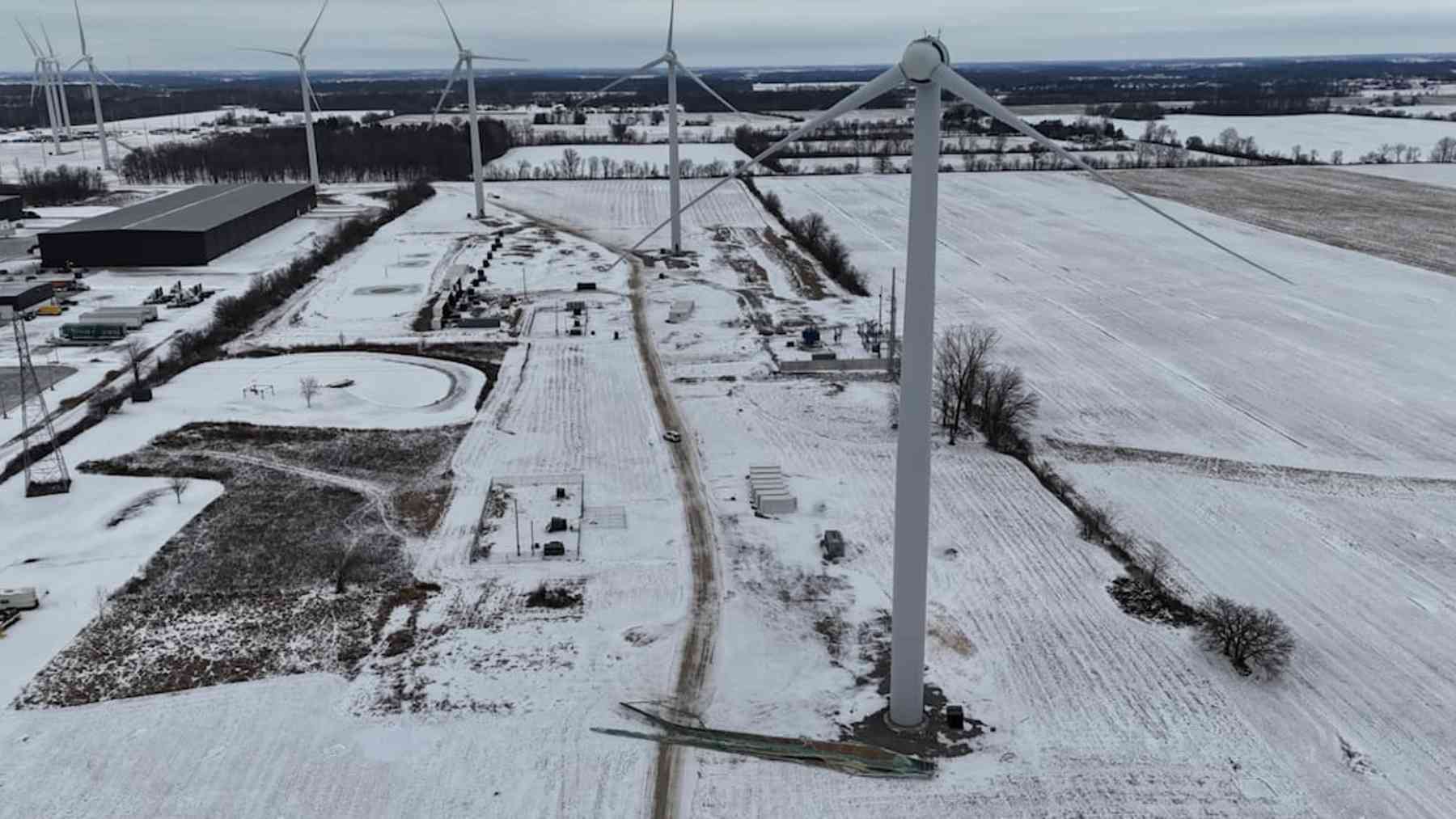
The southernmost turbine at a wind campus outside Findlay, Ohio had been spinning without complaint.
Then, just before noon on a January day, something let go near the top of the tower.
A 140 foot blade broke free of the hub.
It came down on the operator’s own land, well back from the interstate that runs past the site.
Nobody was hurt, and the question everyone wanted answered was simple: what actually let go?
The joint at the blade root cracked, not the blade itself
The answer was small compared with the size of the failure. One Energy, which owns and operates the turbines, worked with independent engineers and research institutions and reported that the break traced not to the blade, not to the internals of the bearing, and not to the blade bolts themselves, but to an abnormality in the bolted flange assembly that connects the blade to the hub. That abnormality, the company said, led to a higher than intended load transfer onto the blade bolts, which fatigued much faster than designed.
“That shifted a lot of load from the flange to the bolts,” chief executive Jereme Kent told WTOL.
Instead of holding steady for decades, as a properly loaded ring of fasteners should, the bolts accumulated damage every time the blade flexed in the wind. The company concluded that the fatigue loads eventually led the ring of bolts to fail one after another, and the blade separated completely from the turbine. It is a strangely human kind of failure, a connection meant to share a load evenly instead pushing more and more of it onto whatever is still holding.
A 13,000 pound blade stayed inside the fence line
Picture the scene that followed. The blade measured 140 feet long and weighed about 13,000 pounds. Crews inspected it and the turbine from the ground, from inside the tower and from the air using drones.
That much material coming off a tower sounds like a disaster waiting to spread, yet the siting of the machine did the opposite. No part of the blade or debris field left the company’s property, crews were on site within 10 minutes, and no local emergency responders were needed. “Nothing left our property,” Kent said at the time.
So instead of a scattered debris field across farm fields or the nearby highway, there was one broken machine sitting on company ground. That gave engineers an undisturbed scene to work through at their own pace.
Twenty nine other turbines sat dark for two months
The blade came off on January 22, 2024, and even though only one had failed, the response was immediate and total. The company kept all 29 of its other turbines offline until it was clear the failure was not an ongoing problem across the fleet.
That meant an entire distributed wind operation, built to sell power straight to nearby manufacturers, went quiet on the strength of a single failure nobody could yet explain. The shutdown held for more than two months while the company, independent engineers and outside research institutions worked through a root cause assessment that included examining damaged bolts under an electron microscope.
The campus itself is modest by utility standards. Its first turbines were 1.5 megawatt machines supplying Whirlpool and Ball plants under long term agreements, and every other turbine needed the same scrutiny the broken one had just received. The question was no longer whether this blade had a problem, but whether the same unnoticed abnormality sat inside other flange assemblies.
Every blade bolt got swapped before restart in April
In early April the fleet began controlled restarts, but only in stages. The restart started with turbines that did not have the flange abnormality, while the company replaced every blade bolt in the turbines that have or may have one, a full replacement intended to reset the fatigue life of the hardware.
Turbines cleared first spun again while the rest waited on new bolts and on indicator devices, similar in appearance to washers, that show when a bolt is properly installed. That staged approach echoes work seen elsewhere on the grid, like the careful teardown process now used to recover value from aging solar panel hardware rather than scrap it outright.
Methodical, piece by piece checking beats guesswork every time a hidden flaw is involved.
One small connection decided a 30 turbine fleet’s fate
What makes this story linger is the mismatch in scale. A machine with blades sweeping a circle hundreds of feet across came down because of a small anomaly in the joint where the blade root meets the hub, a fit that was not tight enough inside the connection.
Kent has said that in a 20 year wind career he had not seen this kind of blade failure, which is why he wanted the investigation made public. That is the pattern turbine engineers keep running into. The failure point is rarely the giant, visible part. It is often the small connective hardware holding the giant parts together, the kind of fastener a technician might walk past a hundred times without a second look.
That is similar in spirit to the fish friendly hardware tested where 131 eels showed that small design choices decide big outcomes. The fleet is spinning again, rebuilt bolt by bolt, and the lesson the fall left behind is unglamorous. The biggest machines on the horizon can still be undone by the smallest ring holding them together, and the fix is simply checking every single one.
Read the whole thing?
Get the week's signal, not the noise
Our sharpest reporting on energy, climate and nature — free, once a week.


