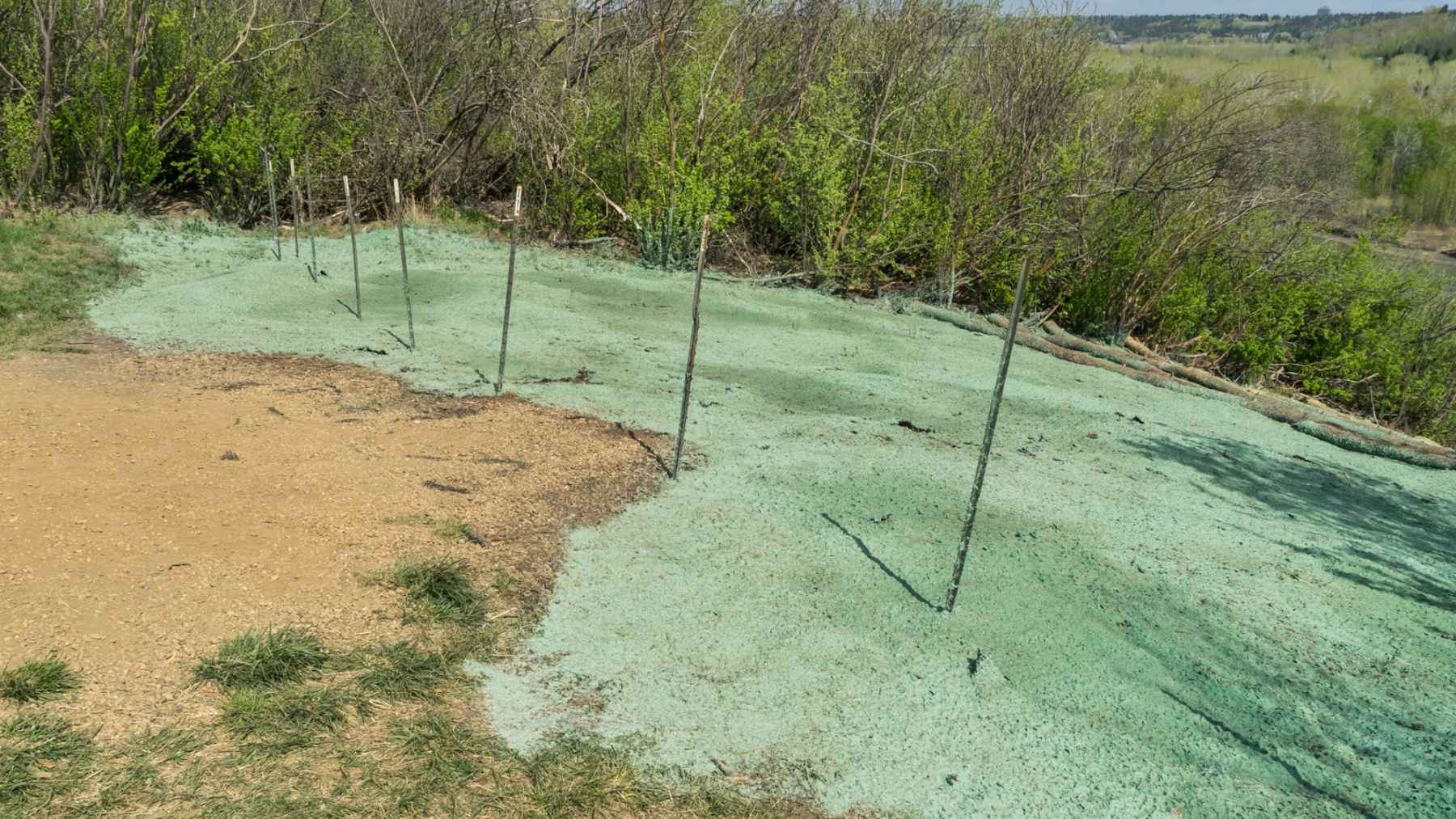
A hose swings across a raw cut bank and the whole slope turns golf course green in minutes.
There is no grass in it. The color is a dye, stirred in so the operator can see where the spray has already landed.
The machine behind that hose was trademarked in 1953, and the idea came out of Connecticut highway work in the 1940s.
On a lawn it does what it promises. Shoots in 7 to 14 days.
On a burned hillside, federal plots say something else entirely.
Which raises the question a lawn never asks. Why does the same mix fail on ash?
Why 1 thin film loses to straw
Erosion after a fire is not the same problem as a bare lawn, and the spray was built for the lawn.
On a seedbed the job is moisture. A damp fiber blanket glued down with guar holds water against the seed for the few days germination needs, and then it is finished.
On a burned slope the job is armor. Fire bakes a water repellent layer into the soil, so rain does not soak in, it runs, and the damage comes from raindrops hitting bare ground and from sheet flow dragging loose ash away.
Stopping that takes physical cover sitting on the surface through an entire wet season.
A sprayed film is thin by design, because it has to go through a hose. It bonds to the soil rather than lying on top of it, and it breaks down inside a year.
Straw does neither. It is loose and thick, and it stays.
6 cents a foot and 3 months of waiting
Take the lawn case on its own terms first, because the numbers there are solid.
Hydroseeding runs 6 to 20 cents a square foot. A 5,000 square foot yard lands between 300 and 1,000 dollars.
Sod is 35 to 85 cents a square foot before installation, so the same yard costs 1,750 to 4,250 in material alone.
That is a real saving. It is also smaller than the ten to one gap the pitch usually implies.
The waiting runs longer than the pitch too. First mowing comes around six weeks, foot traffic should stay light for four weeks after that, and one trade guide calls the lawn usable at 3 months.
Sod is walkable in about ten days.
4 fires and 7 years of plots
The burned ground question has an answer, and it was measured rather than argued.
A Forest Service team ran plots on four wildfires, in Colorado in 2002, Idaho in 2003 and Washington in 2005, and kept them running four to seven years.
Treatments went down side by side at stated rates. Wheat straw at about 1,960 pounds an acre, wood strand at roughly 8,900 to 10,700, and hydromulch at 535 and 980.
That spread is most of the story. The sprayed treatment carried a third to half the mass of the straw and about a tenth of the wood.
Wood strand cut sediment yields at both fires where it was tested. Wheat straw cut them at two of the four.
Hydromulch cut them at neither fire, and none of it could be found after the first year.
The 1 hydromulch that worked
There is a wrinkle here, and it is the most useful thing in the file.
An earlier trial of hydromulch dropped from the air did cut erosion 95 percent in the first year and 50 percent in the second, in the way that a capped dump or a burst pipe turns into a settled question.
That mix carried a soil stabilizer called polyacrylamide alongside the fiber and the guar. A second wood based hydromulch without it did nothing at all, and the field study prints both results on the same page.
So what held that hill may have been the additive rather than the mulch, while the cost table stays the one part of this nobody disputes.
The limits are real. Two fires is a thin test, the authors say the fire by fire results are the fairer read, and a separate review of stabilization seeding found fewer than half the reports showed any sediment reduction at all.
Nothing here shows the spray never helps.
What the hose is actually good at
Strip the fire claim away and the tool is still a good one.
It was born on highway cuts, and that is where it still earns its money. Fresh engineered fill, no ash layer, no baked crust turning water away, a seedbed that only has to last until roots arrive.
Mines, pipelines and building pads sit in the same category.
What it is not is armor. Armor is bulky and it has to still be lying there in March, which is a different product on a different truck.
A green slurry is a seedbed you can spray onto a slope.
Calling it a fire fix is where the evidence stops following along.
Read the whole thing?
Get the week's signal, not the noise
Our sharpest reporting on energy, climate and nature — free, once a week.