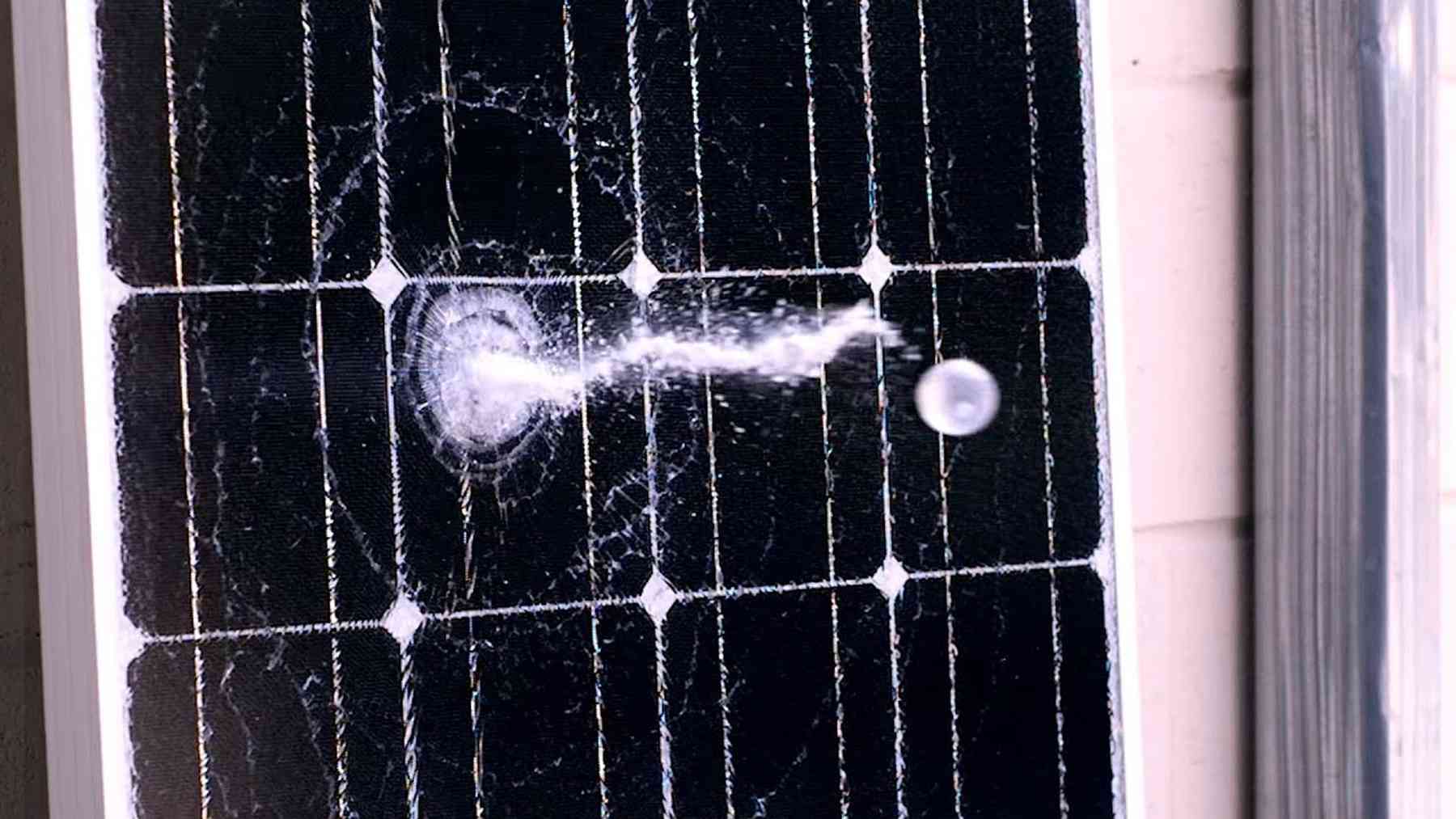
An ice ball a little over two inches across leaves a steel barrel and crosses a padded test bay in a blink.
It meets the front glass of a solar module standing upright in a frame.
For a fraction of a second, nothing on the surface looks any different at all.
Then something gives way, far too fast for an ordinary camera, or a trained eye, to catch.
Engineers at a federal laboratory in New Mexico filmed it anyway.
So what is actually happening inside that glass in the instant before it fails?
The glass dents first, and the dent takes time to form
A hailstone hitting a solar panel does not crack the surface the moment it touches it. Companion work at the same lab, using stereo high speed video and digital image correlation, found that the impact first pushes a localized dimple into the glass, with peak deflection proportional to the square root of the incident energy.
The sharpest displacement gradients show up immediately after contact, which the authors say implies the largest mechanical stress, and the greatest likelihood of damage, sits under the impact point in those first moments. That is the delay the high speed footage pins down.
Engineers at the lab reported that the observations confirm glass failure from hail is a time and rate dependent event, not an instant snap. The stress inside the glass builds through a window far too short for a normal camera to resolve.
A 76 mile per hour ice ball fired like a ballistics range
Picture a windowless bay lined with padding, a module bolted upright in a steel frame, and a barrel aimed at its face like something from a ballistics range. That barrel fires manufactured ice spheres instead of bullets, aimed at the glass rather than at armor plate.
A sphere at the severe end of the standard hail table is 2.2 inches across and weighs about 2.8 ounces, fired at close to 76 miles per hour, delivering roughly 46 joules. The federal energy department’s own table lists that same ball at 2.8 ounces and about 76 miles per hour, several rungs above the shot every certified panel must survive.
The baseline certification hail test is far gentler. It uses a 1 inch ball weighing about 0.27 ounces at roughly 51 miles per hour. For that reason, federal guidance tells buyers to ask for testing above the minimum, warning that in severe hail prone areas the basic certification is not sufficient.
Three hundred thousand frames a second caught the crack forming
The footage came from fifteen test modules built with glass on both faces, recorded at 300,000 frames per second during hail impacts that happened to cause glass fracture. Image processing put the first plausible crack at an average of 126 millionths of a second after impact, with a spread of about 59 millionths of a second, during impacts with a median energy of 47 joules.
A confirmed, fully formed crack showed up later, at an average of 158 millionths of a second. Those spreads are wide, so the gap between the two averages is best read as the blur between a crack’s first hint and its certainty, not as a fixed interval.
The team was candid about the limits. Ice ball fragmentation obscured the impact site, and the initial crack appearance was indistinct in a way that processing could not improve. Even so, the averages held steady enough to use, which is the whole point of filming an event no inspection after the fact can reconstruct.
Thinner glass cracked at a lower energy in parallel tests
The modules filmed here used glass on both the front and back, a construction different from the glass and backsheet design found on many rooftop arrays across the country. A separate study at the lab comparing both types found that impacts of 20 joules or less did negligible damage.
The thinner glass in the double glass modules cracked at lower energies, around 25 joules, than glass and backsheet modules, which held until around 40 joules. Both types cracked at lower energies when struck near the edges rather than the center, which tells engineers where reinforcement matters most.
None of that undermines the value of solar power itself, any more than a fish friendly turbine undermines hydropower. It means some panel designs carry a narrower safety margin against one specific hazard than others, and that where a stone lands can matter as much as how hard it hits.
126 microseconds gives designers a number to beat
What the lab produced was not a verdict on any single product. One researcher involved in the broader hail testing effort put it plainly: the goal is a fracture criterion that predicts module damage during an impact, so that glass thickness, coatings, cell layout and mounting can all be tested against the same yardstick before a storm ever arrives.
Engineers still cannot stop hail from falling, and the standard test rig cannot schedule a storm. But turning an instant too fast for the naked eye into hard, repeatable data gives the next generation of rooftop and solar farm glass a measurable target to beat, and that is a win worth filming frame by frame.
Read the whole thing?
Get the week's signal, not the noise
Our sharpest reporting on energy, climate and nature — free, once a week.