
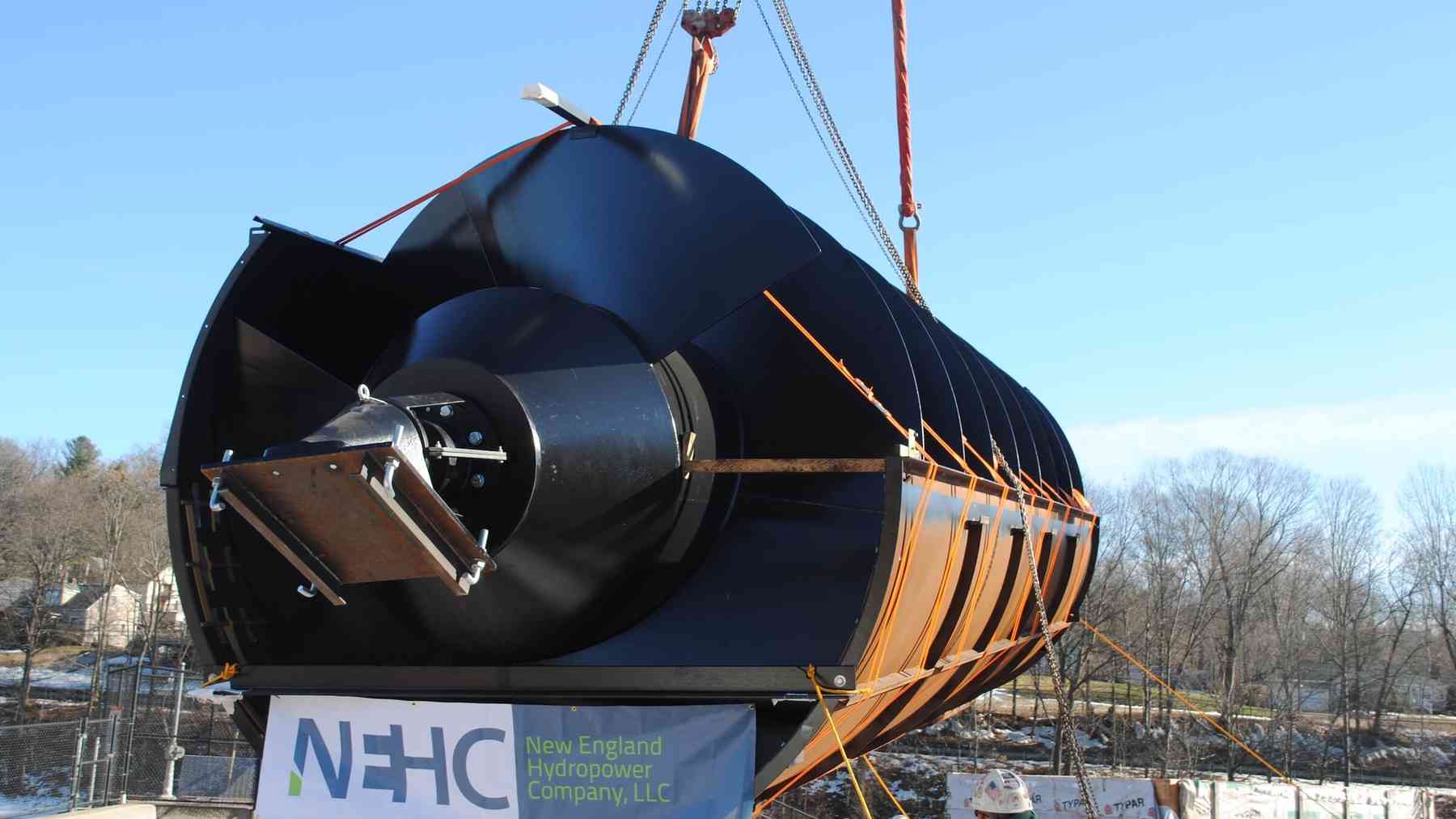
The dam on the Quinnipiac River in Meriden, Connecticut used to just spill water over a concrete lip.
Now a steel screw nearly 12 feet across runs down its face.
It turns about once every four seconds.
Water slides through its open spiral, and so do fish.
Alewife, shad and eels headed downstream ride through the turning metal.
What happens to them once they are inside comes down to one simple shape.
A wide slow spiral replaces a fast narrow blade
Most hydropower turbines are built the opposite way from this one. They spin fast and narrow, forcing water through tight gaps to wring out every possible watt, which leaves very little room between a moving blade and a fixed wall. The screw at Hanover Pond Dam does the reverse, turning slowly inside a wide open trough with no narrow pinch points for a body to be caught in.
That shape is not new. It is one of the oldest water lifting machines on record, a helical blade turning inside a trough, and what changed is the direction of the flow.
The ancient version lifted water uphill. This one lets water fall through on its way down, and the weight of that water presses on the blades and forces the screw to turn. Because the gaps stay wide and the rotation stays gentle, a fish riding through meets something closer to a slow water slide than a strike from a blade.
The first screw of its kind runs for 46.5 feet
The machine is 46.5 feet long and 11.65 feet in diameter, set in a concrete trough sloping down the downstream face of the dam and fed by an intake structure and a buried penstock, with an installed capacity of about 220 kilowatts. It is the first hydroelectric facility in the United States to use an Archimedes screw turbine for power generation, taking the head of an existing, previously unpowered dam and sending the electricity out to the grid.
Before the screw went in, the dam already sat across a river that migrating fish use every year. Species in the project area include American eel, sea lamprey, alewife, blueback herring and American shad, and the city built a Denil style fish ladder for upstream passage when it rebuilt the dam.
So the question engineers actually needed answered was not how much power the screw could make. It was whether a migrating fish could survive passing through it.
A 48 hour check found zero injuries
In the eel evaluation, animals were fitted with tags that floated them to the surface so crews could recapture them right below the machine, which was run at roughly 15 revolutions per minute. Every treatment and control eel was alive at the one hour check with no injuries observed, giving a 48 hour survival estimate of 100 percent.
The institute that certifies the dam as low impact reports a 100 percent survival rate for migrating fish at Hanover Pond, including alewife, American shad and American eel, and its certification record describes the screw as chosen partly for that reason.
The result is specific to this site, this screw and these species. It is not a blanket guarantee.
A European test found mortality for other species
A multi species European study of a much larger screw found substantial mortality for bream and roach, though almost none for eel, so the shape alone does not make every screw safe for every fish.
Other rivers are testing different machines toward the same end. A reshaped turbine at a small Maine dam recorded 98.2 percent immediate and 100 percent 48 hour survival for juvenile alewives once corrected for control mortality, and in separate work eels passed through a novel propeller style turbine with a survival rate of 100 percent.
Those numbers, taken together, suggest the gentle geometry matters more than any single brand of machine.
A dam with 14.7 feet of head sets the limit
The screw carries the name of Archimedes, though by one account he never claimed to have invented it. The design is simple: at least one blade wrapped around a central shaft, surrounded by a fixed or rotating outer cylinder. That geometry has been moving water for irrigation and drainage for a very long time.
It is also being pointed in the original direction again, this time for fish rather than fields. At the Cheboygan Dam in Michigan, researchers used a screw to lift 704 fish into a collection basket over 11 days, testing whether the device could move fish across low head barriers without injury.
None of this means every dam can drop in a screw and solve fish passage. Screws suit small scale, low head sites, and the Meriden dam works with a hydraulic head of about 14.7 feet, while even a large European screw studied for fish safety sat at roughly 33 feet of head. That rules the design out for the tall dams behind most large hydropower output.
Upstream passage is still a separate problem the screw does not solve on its own. Fish heading the other way need the ladder or a trap built alongside, and the project operates an eel trap for upstream passage and files an annual summary of what it finds.
Even with those limits, a machine that does the job of an old spillway while letting a migrating fish ride straight through is a small but real sign that power generation and a living river need not work against each other. Watching what comes out the other side, alive and unhurt, is the whole point of keeping an eye on it.
Read the whole thing?
Get the week's signal, not the noise
Our sharpest reporting on energy, climate and nature — free, once a week.


