Astronomers may have finally spotted what has been hiding at the edge of our solar system. There are things in our stellar formation that we simply cannot see due to our position relative to the sun and the light it emits. Sometimes, instead of sending heat to our world and making everything bright during the day, the big star can also hide many secrets that we will probably never know about. Even its own structures were not visible to us until recently. Now, researchers think they may have identified what astronomers have been chasing for years near Neptune—an object believed to be messing with the planet’s gravitational field.
NASA has been keeping track of an elusive object at the edge of the solar system
While NASA has been focusing on finding out the truth about 3I/Atlas, which recently entered our solar system, it has also contributed to a very famous discussion about the existence of a ninth planet in our solar system. At first, astronomers thought it would be too close to the sun, and for this reason, it could not be seen due to the light coming from the opposite direction.
Then, they began to look for any structures near Neptune that could be classified as planets. Since the Big Blue Planet is the farthest away from the sun, the possibility of holding organic life forms as we know them is reduced. On the other hand, it also opens up other doors for astronomers to study. While it would not be possible for humans to live on this planet, this does not exclude the curiosity aimed at answering the questions about what is influencing its gravitational movement. Now, scientists believe they may have a strong candidate.
Researchers say: There’s something there, but we can’t study it directly yet
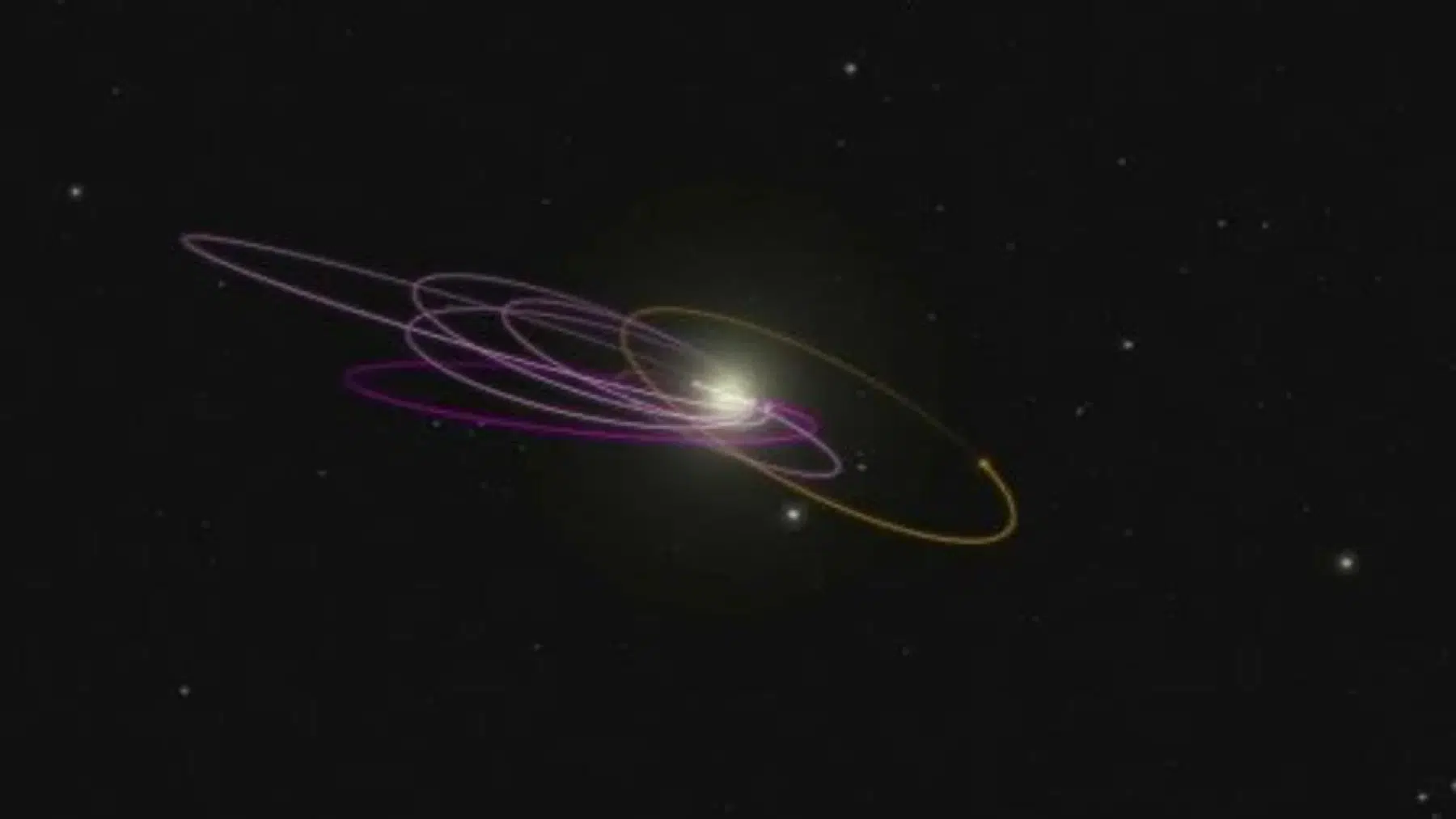
A team of astronomers may have finally spotted a candidate for the mysterious Planet Nine—a planet hiding far beyond Neptune. Researchers from Taiwan, Japan, and Australia went through 40 years of old space probe data, tracking down what could be this distant world slowly orbiting our sun. Planet Nine first became a real possibility in 2016, when astronomers noticed something strange: a big gravitational pull from an object far past Neptune.
Now, after narrowing down 13 possible candidates, scientists think they might have found the one. This planet would be unimaginably far away—between 46.5 and 65.1 billion miles from the sun. To put that in perspective, it is nearly 20 times farther than Pluto, which sits in the Kuiper Belt just under four billion miles out. Being so distant, Planet Nine would likely be an ice giant, like Uranus or Neptune.
Planet Nine would look like this: Cold and no liquid water
On Planet Nine, conditions would be even harsher, with temperatures dropping somewhere between -364°F and -409°F. Based on how it tugs on other objects, this world could have the mass of seven to 17 Earths, roughly the size of Uranus or Neptune. Liquid water probably does not exist on the surface, and sunlight would be barely a glimmer, forcing any life to find other ways to survive.
Scientists found the candidate using old satellite data
To track it, scientists compared old data from NASA’s Infrared Astronomical Satellite (IRAS), launched in 1983, and Japan’s AKARI satellite from 2006 to 2007. They were hunting for anything moving slowly across the sky—about three arc minutes a year. Finding Planet Nine could also explain some of the oddities in our solar system. For example, objects in the Kuiper Belt tilt about 20 degrees from the plane of the planets. Other stars often have “super Earths”— planets bigger than ours but smaller than Neptune.
Read the whole thing?
Get the week's signal, not the noise
Our sharpest reporting on energy, climate and nature — free, once a week.