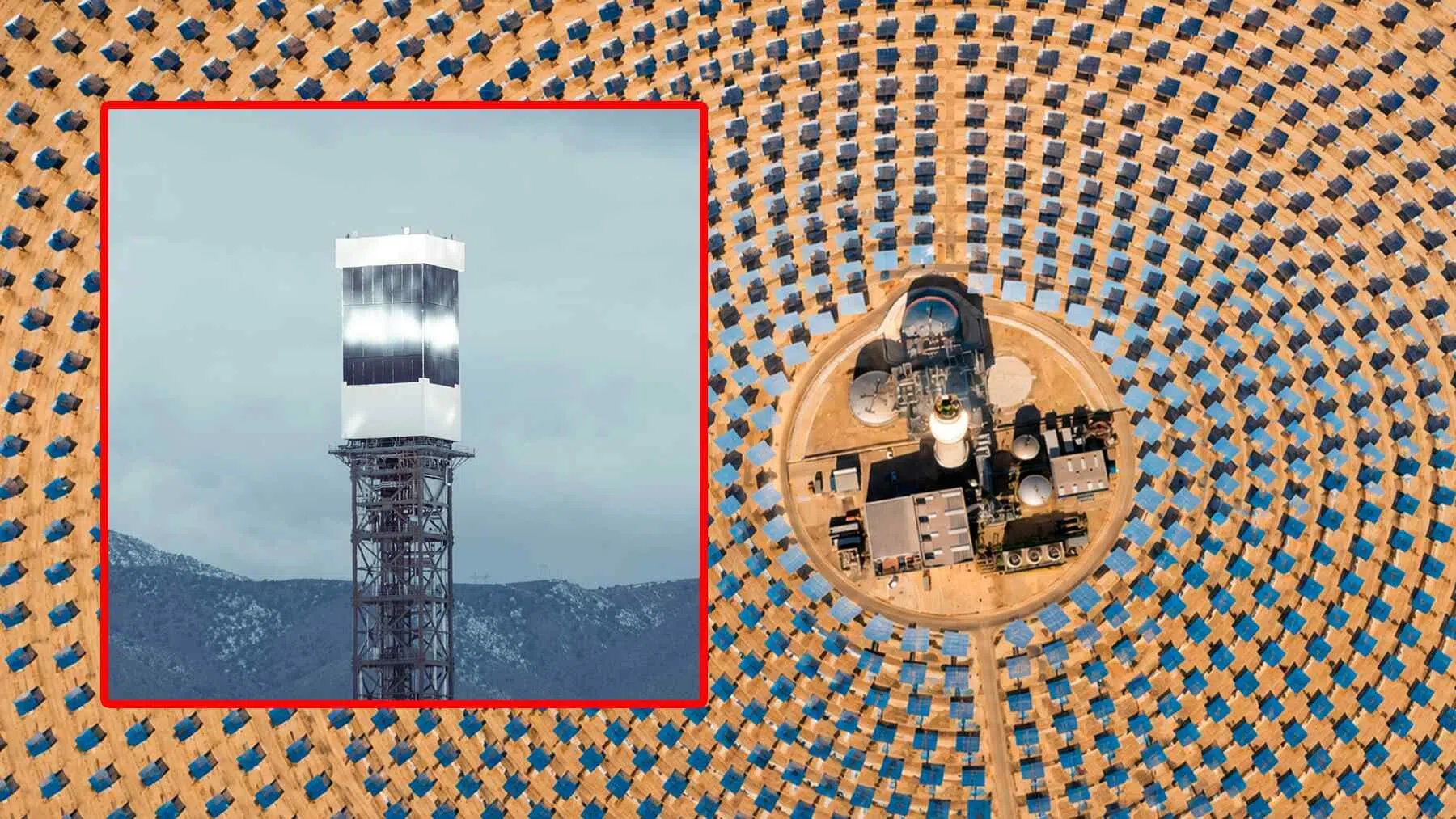
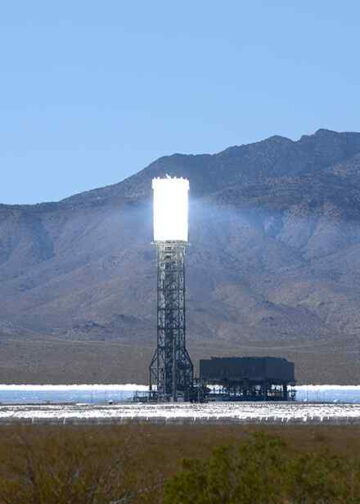
In the Mojave Desert, three 450-foot towers concentrate sunlight to 990°F (537°C).
Over 173,000 mirrors focus intense beams onto central boilers. This creates a glowing orb of light visible for miles.
However, the “solar flux” is a death trap.
Ground crews regularly find charred remains. Some birds ignite mid-flight and plummet as “streamers.”
Why were 50,000 birds found incinerated in midair, and what happened to the solar plant afterward?
Does the massive environmental cost of this facility justify its clean energy output?f
The Ivanpah Incident: A 537°C Sky Trap
Located near the Nevada border, the Ivanpah Solar Power Facility uses 173,000 “heliostat” mirrors to focus sunlight onto three 450-foot towers.
This 392-megawatt plant generates enough steam to power 140,000 homes.
On paper, it was a green energy miracle.
In reality, the “solar flux” creates invisible zones of heat reaching 537°C—hotter than most lava. Birds entering these beams suffer instant feather ablation.
Ground crews discovered “streamers”—birds that ignited mid-air and plummeted with visible smoke trails behind them.
The facility sits on a Pacific Flyway migratory route.
From above, the massive mirror fields create a “Lake Effect,” tricking thirsty birds into diving toward the heat.
Researchers think some species were unintentionally drawn toward the reflective fields.
A growing death toll forced investigators to study the sky itself
Early monitoring around Ivanpah revealed far more bird deaths than expected.
Some carcasses showed burn damage consistent with intense thermal exposure.
Others appeared injured after colliding with mirrors or structures.
Scientists studying the facility found that flying animals sometimes entered zones where the solar flux intensity hits 800 kilowatts per square meter.
This is roughly the intensity of an industrial furnace, but in open air.
Birds passing through certain sections risked feather damage almost immediately.
Smaller birds struggled most. Damaged feathers reduce lift and insulation.
Some animals lost the ability to stay airborne within seconds.
Researchers also noticed another pattern. A hidden effect that reshaped the climate.
The towers act as giant light traps. Insects swarm the glow, attracting songbirds, which in turn lure predatory raptors directly into the death rays.
The plant unintentionally created a layered food chain around the towers.
The issue was no longer only about collisions.
The concentrated sunlight itself had become part of the hazard.
Concerns have now been raised by the Association of Avian Veterinarians.
What happened after the deaths became impossible to ignore
Following a U.S. Fish and Wildlife Service report, operators began repositioning mirrors into “safe” standby modes to lower flux density during peak migrations.
Some methods focused on altering standby mirror positions.
Others attempted to discourage insects from gathering near bright structures.
Researchers also expanded carcass surveys around the facility.
Independent biologists estimated mortality rates at one bird death every two minutes. This data halted the expansion of concentrated solar in the U.S.
The issue behind the deaths was the plant’s concentrated solar technology.
What made this particular solar facility so different
Unlike standard solar farms, Ivanpah used mirrors to compress sunlight.
Birds flying through those areas could be singed, disoriented, or ignited in midair.
The problem became severe enough that the facility later reduced portions of its operations.
One generating unit was eventually scheduled to shut down earlier than originally planned.
The debate surrounding Ivanpah also changed how future concentrated solar projects were evaluated in the United States.
Newer solar developments increasingly shifted toward photovoltaic panel systems instead.
These generate power without creating the superheated airspace that turned Ivanpah into a hazard.
Ivanpah still operates today, but the site became a warning inside the renewable-energy industry.
Even technologies designed to reduce emissions can reshape ecosystems in ways never predicted.
Ivanpah survived a 2016 shutdown threat by agreeing to a massive mitigation plan. It remains a $2.2 billion cautionary tale of the hidden costs of carbon-free power.
Disclaimer: Our coverage of events affecting companies is purely informative and descriptive. Under no circumstances does it seek to promote an opinion or create a trend, nor can it be taken as investment advice or a recommendation of any kind.
Read the whole thing?
Get the week's signal, not the noise
Our sharpest reporting on energy, climate and nature — free, once a week.