
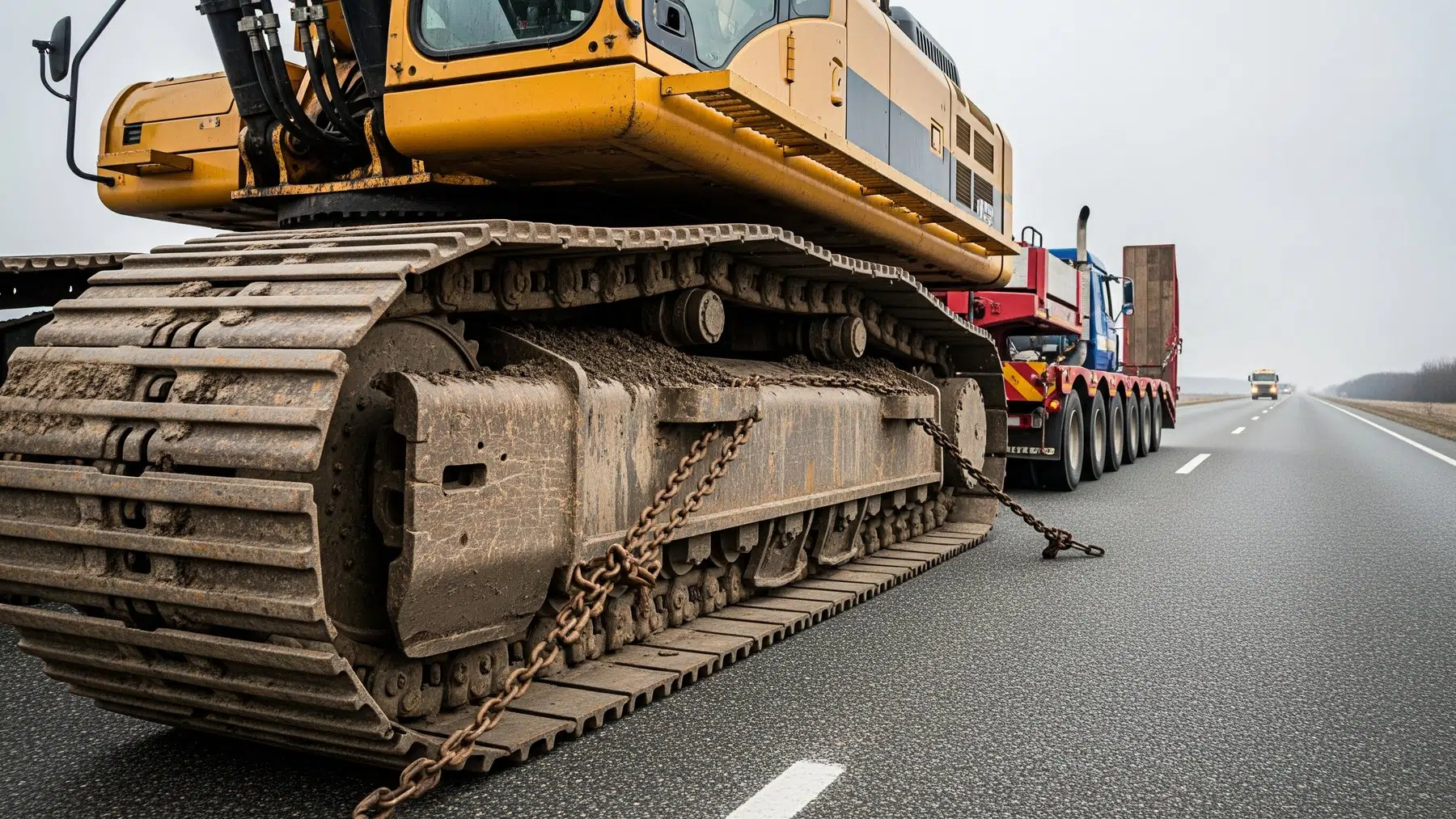
Picture a steel machine that weighs as much as 60 family sedans strapped together.
Now watch it creep down a public highway at little more than walking pace.
That is the reality every time a giant excavator leaves a job site and hits the road.
Few sights on the interstate stop traffic quite like it.
At a glance it looks like a very large truck with an odd passenger.
What keeps that load safe is far stranger than it looks from the roadside.
The machine that makes moving look impossible
The excavator at the center of this is not one most people stand beside.
A 90 ton excavator like this weighs around 91.6 tons in full working trim.
Its steel tracks alone are wider than most residential driveways.
The bucket can hold a small car’s worth of rock in a single scoop.
On a job site, that mass is an asset, pressing into the earth with real force.
On a public road, the same mass becomes a problem that takes days of planning.
It cannot simply drive itself to the next site, since the tracks would tear the asphalt apart.
Loading it calls for ramps, cranes, or the machine slowly walking itself aboard.
Even chaining it down follows a strict pattern, so nothing shifts at speed.
So the whole machine must be lifted, chained, and hauled, and that is where the real work starts.
A trailer built like a bridge on wheels
The trailer chosen for a load like this is a lowboy, with a deck slung close to the road.
The low deck is not a style choice at all.
Most states cap legal transport height near 13 feet 6 inches.
Drop the deck closer to the road and you win back precious inches of clearance.
Then come the axles, far more of them than any ordinary truck carries.
Some rigs carry twenty wheels or more beneath a single long deck.
Each axle takes only a slice of the total weight off the road.
Together they spread the load the way a snowshoe spreads a hiker across soft snow.
The trick is to multiply the axles until each one sits below the legal limit.
The paperwork that rivals the physics
Before a single wheel turns, a stack of permits has to be approved.
Every state the convoy crosses wants its own oversize or overweight approval.
Route planners study the bridge rating for every crossing on the way.
By federal data, nearly 7 percent of US bridges are rated in poor condition.
A convoy this heavy must route around every flagged span, sometimes adding miles.
A wrong turn onto a weak bridge could end in real disaster.
Pilot cars run ahead, and police escorts often join for the tightest stretches.
Then there is the wind, which few onlookers ever think about.
A tall excavator on an open deck acts like a sail in a crosswind, and a hard gust can shove the whole rig toward the next lane.
The hidden star is not the digger
Here is what almost no roadside watcher ever notices.
The most impressive machine in the convoy is the trailer, not the excavator on top.
Its many axles ride on hydraulic cylinders filled with oil.
Those cylinders keep every axle pressing evenly, even as the rig tilts through a curve or climbs a grade.
The axle lines can also be steered on their own.
That lets the rear wheels track the truck’s path instead of cutting across the lane.
All of that runs while a driver up front barely creeps along.
A self leveling suspension soaks up the bumps and shields the deck and the machine’s own hydraulic lines.
According to the maker, the same idea scales from a highway rig up to the largest cargo moves on Earth.
The convoy arrives, and the road holds
When the escort cars peel away and the excavator rolls off at its new site, the highway looks unchanged.
That is the entire point of the effort, to move something enormous and leave no trace.
The permits and escorts exist to protect public safety and the road itself.
The alternative, leaving giant machines stranded at distant sites, would stall whole industries.
Construction and mining depend on moving this iron from one job to the next.
The same distributed force shows up in other feats, from an ice drill to an offshore wind farm.
So the next time an oversize load creeps past you on the interstate, look closer.
Under that huge machine is a trailer doing something engineers spent careers perfecting, holding a building’s worth of steel steady while the road barely feels a thing.
Read the whole thing?
Get the week's signal, not the noise
Our sharpest reporting on energy, climate and nature — free, once a week.


