

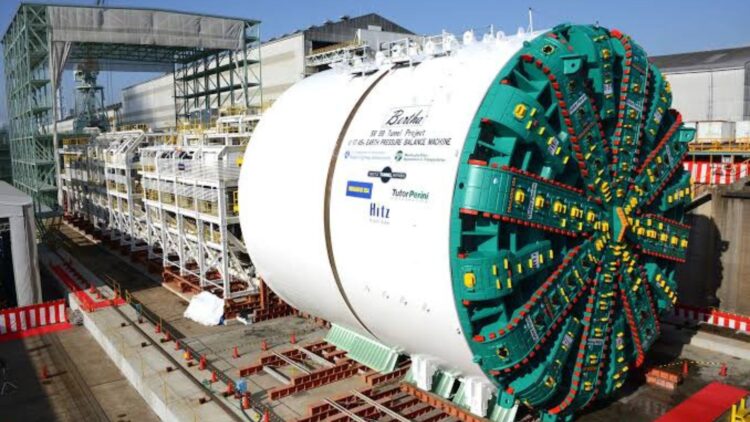
Beneath the streets of downtown Seattle, the largest machine of its kind sat dead in the dark.
She had ground forward only about a thousand feet before falling silent.
She was supposed to be finishing the job, not sitting frozen in place.
Above her, traffic and coffee shops carried on with no idea she was stuck down there.
She was the biggest tunneling machine anyone had ever built.
Her name was Bertha, and she weighed almost 7,000 tons.
Getting her moving again would become one of the strangest rescues in engineering.
A giant named after a mayor
Tunnel crews have a tradition of giving their boring machines a woman’s name.
By custom a machine is not supposed to start work until it has one.
This one was called Bertha, after Bertha Landes, the first woman to lead Seattle.
The machine named Bertha was built in Osaka, Japan, and shipped across the Pacific.
She stretched about 326 feet long, roughly the length of a city block.
Her spinning front face measured nearly 57 feet across, taller than a five story building.
That face alone carried dozens of steel discs to grind through dirt and rock.
At the time she was the widest tunneling machine ever built.
Her whole reason to exist was one ambitious underground job.
The tunnel meant to replace a highway
Seattle had an aging elevated highway running along its waterfront.
An earthquake had left it cracked, and the city wanted it gone.
Tearing it down without a replacement would have choked the whole waterfront.
The plan was to bury the traffic in a wide tunnel below the city instead.
The old road still carried tens of thousands of cars every single day.
Bertha would chew that 2 mile path through soil, sand, and old fill.
Her cutting face would turn slowly, scraping earth loose as she pushed ahead.
Behind her, crews lined the fresh tunnel with heavy concrete rings.
She was designed to grind on around the clock, day after day.
A full crew rode with her, steering and lining the tunnel as she advanced.
In July she started digging, and at first she moved as planned.
A thousand feet in, everything stopped
Then, only about a thousand feet into a job of over nine thousand, she stalled.
Her temperature climbed while her progress fell to nothing.
The first suspect was a steel pipe left in the ground years earlier.
It had been sunk in 2002 to measure groundwater, then forgotten.
For weeks the machine barely crept forward, then not at all.
According to local coverage, she had struck and shredded it early on.
But that pipe did not fully explain why the giant would not turn.
Something deeper inside the machine had gone badly wrong.
The truth would take engineers months to pin down.
Digging out the machine that digs
The real fault lay in Bertha’s main bearing, the joint that let her face spin.
Its seal system had been damaged, and without it the bearing overheated and seized.
You cannot simply reverse a machine this size back out of a tunnel.
She was wedged deep below busy streets, with buildings pressing in on every side.
So crews chose a stunning fix, they would reach her from above.
In front of the stuck machine they sank a rescue shaft roughly 120 feet deep.
Then they lifted her enormous front end and cutting head back up to daylight.
The damaged parts were rebuilt at the surface, then lowered back down.
Workers first built a huge steel frame over the pit to take the weight.
According to an archive of the project, the repair alone took most of two years.
Pulling apart the biggest borer on Earth was almost a project itself.
Back to daylight, then gone
Late in 2015 Bertha finally began turning again.
She ground the rest of her route and broke through in the spring of 2017.
Crowds gathered above to watch her cutting head finally punch into daylight.
The finished tunnel opened to traffic, and the old highway above was torn down.
The city spent years and vast sums finishing what she started.
Her digging done, the record breaking machine was taken apart for scrap.
Other machines are pushed to similar limits, like an ice drill boring deep into Antarctic ice or a wind farm anchored far out at sea.
Bertha showed both the promise and the risk of building at record size.
Bigger is not always safer when a single seal can stop everything.
Her story is now a lesson taught to young tunnel engineers.
For two long years the largest borer ever made just waited in the dark, until people dug down to set her free.