
Every single day, the Arizona sun quietly lifts millions of gallons of water straight off the surface of the state’s canals.
It rises into the dry air and disappears long before it ever reaches a tap, a field, or a home.
Now picture something stretched over that same water, catching the sunlight before it can do any damage.
It is not a lid, and it is not a tarp.
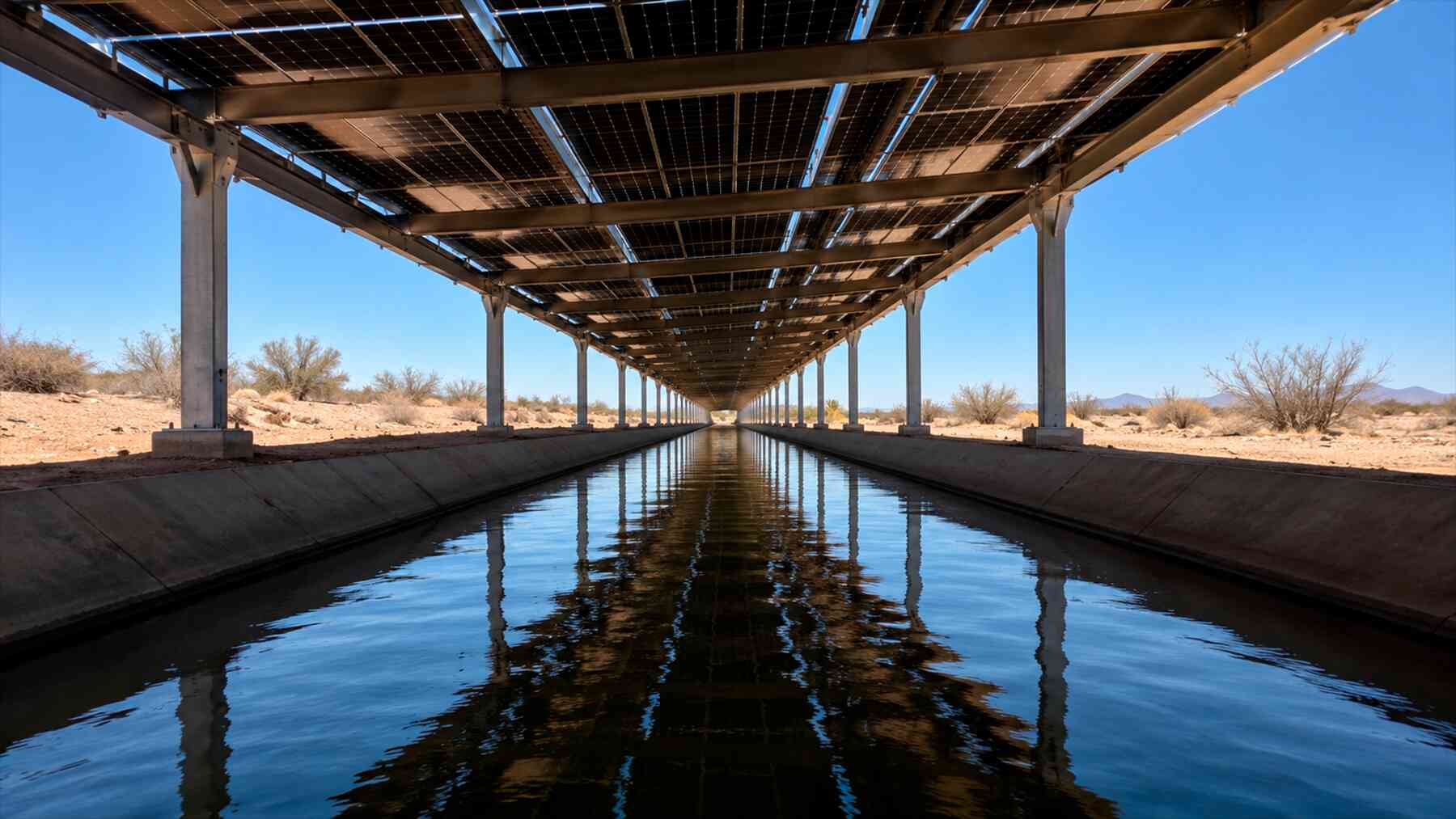
It is a canopy of solar panels, and it is already running on a canal south of Phoenix.
That single structure is quietly solving two of the desert’s hardest problems at once.
How the desert sun steals both the water and the land
Arizona is caught in a double bind, and the sun sits at the center of it.
Open air canals carry the water that keeps the Southwest alive, threading through cities, farms, and reservations.
But the same relentless heat that defines the desert pulls that water straight back into the sky.
Millions of gallons vanish to evaporation every day, in a place that cannot spare a single drop.
The second problem is land, and it is running out fast.
Solar power needs space, and the desert has sunshine to spare.
But traditional solar farms sprawl across open ground, tearing into fragile ecosystems and stirring up the communities nearby.
So the region needs more water and more clean energy, and until recently those looked like two separate fights.
What if a single idea could win both at the same time?
How a small Arizona lab found the perfect match
The answer took shape in Bisbee, a small town in southern Arizona.
At the Bisbee Science Lab, researchers ran a real world experiment backed by the Department of Energy.
Working with the company Tectonicus, the University of Arizona, and others, they built a prototype of solar panels suspended directly above flowing water.
They wanted to know whether water and clean energy could help each other instead of competing.
The results were beyond insightful and verging on staggering.
By shading the moving water, the panels cut evaporation by up to 50 percent.
The shade also starved the algae blooms that constantly clog irrigation channels.
And the benefit ran both ways.
The cool water flowing beneath the panels lowered their temperature and pushed their output up by about 5 percent.
The obvious question was whether something this neat could stretch across miles of open canal.
Building the canopy over the water
Scaling it up meant building straight over the canals, in space no one had ever thought to use.
When land is scarce, the empty air above the water suddenly becomes valuable ground.
Engineers designed strong, tensioned structures that arch over the waterway like a canopy.
The patented system even has a name, Solar River, and it leaves room around and beneath it so crews can still service the canal as usual.
The first canal of its kind in the Western Hemisphere
South of Phoenix, on the Gila River Indian Community reservation, sections of the Casa Blanca and Level Top canals now sit beneath that steel and glass.
Clean power is already flowing to the Pima and Maricopa tribes, built on Tectonicus‘s design.
The half mile Casa Blanca pilot alone generates 1.3 megawatts of electricity.
It also keeps around eight acre feet of water from evaporating every year.
Because it uses land already spoken for, not a single acre of open desert had to be cleared.
The water cools the panels, and the panels shield the water.
In the end, the American West’s most precious resource is being saved by the very sunlight that was drying it up, a blueprint California is already testing on its own canals.
Read the whole thing?
Get the week's signal, not the noise
Our sharpest reporting on energy, climate and nature — free, once a week.


