
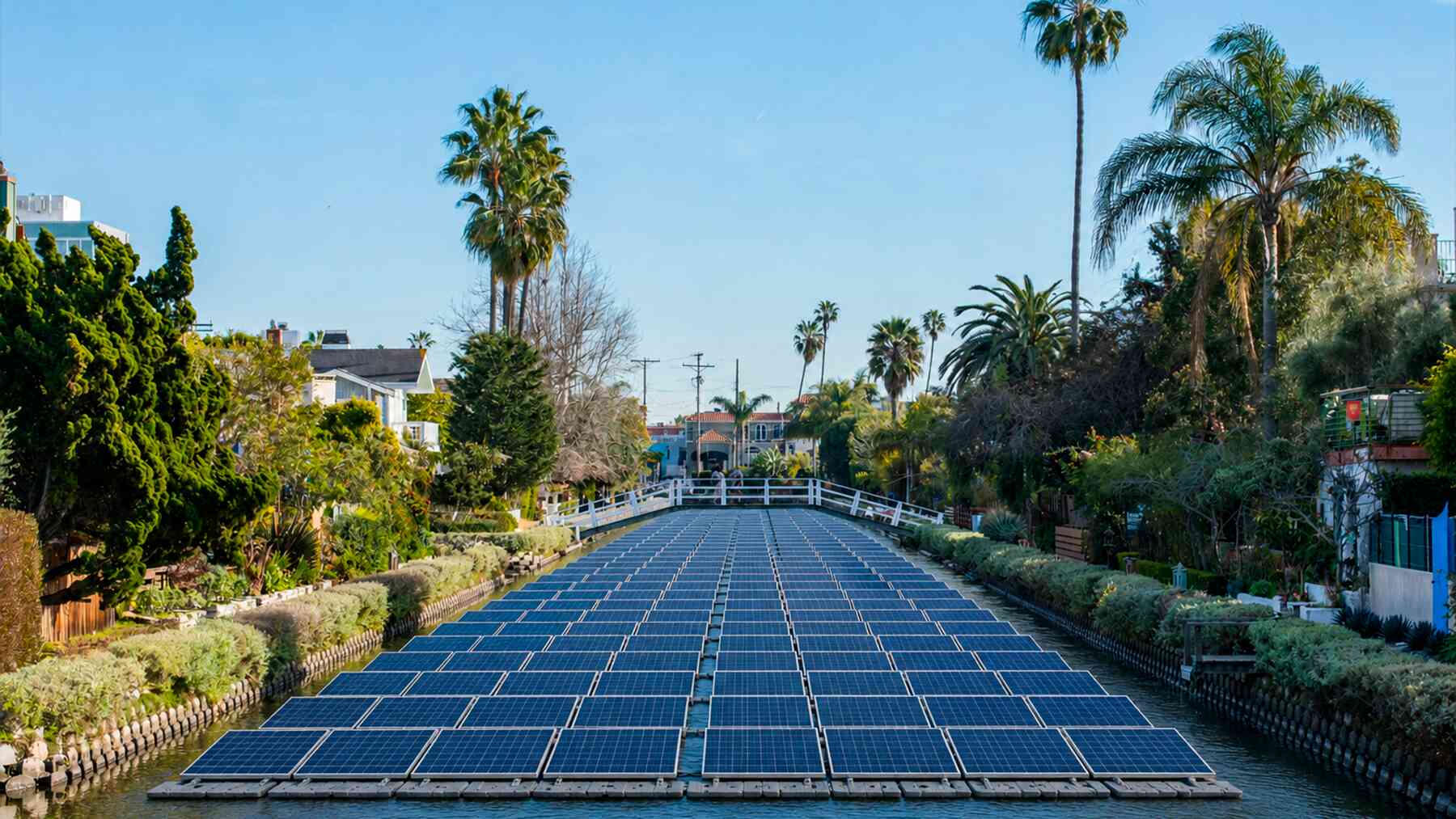
Parts of the waterway got covered by solar panels, but there was a reason beyond simply generating electricity.
The obvious benefit was that the design used existing infrastructure rather than taking up valuable land. Yet, the $20 million pilot project proved the panels were doing something radical.
A hidden, self-sustaining cycle was happening right above the water. What else are solar panels doing?
How a $20 million pilot project is delivering more than clean power
The blistering heat in California means that its irrigation infrastructure is facing unique challenges, leading the state to launch Project Nexus, inspired by a major UC Merced study.
$20 million was invested in installing solar canopies over parts of the Turlock Irrigation District canals.
The point was to change how renewable energy infrastructure interacts with natural variables, according to the California State Portal.
Generating green electricity on already productive land is only the first part of this story. There’s something else that happens under the panels when the switch is flipped.
This proves that infrastructure can be enhanced when smart design is applied.
Flipping the light switch changes the canals in a couple of ways.
Normally, the combination of sun and open water is a recipe for trouble.
The clearing of extensive aquatic weed and vegetation growth to prevent the waterways from choking is a constant headache. It costs the Turlock Irrigation District millions of dollars annually to maintain the canals.
Multiple benefits from one solar power system
But with the solar panel canopies, the sun is blocked. This has the effect of minimizing weed growth.
In turn, the water quality goes up before it reaches any farm or faucet. And maintenance costs are considerably slashed.
The state’s studies indicate that canal solar systems could generate 13 gigawatts of electricity. This is enough to cover half the new solar capacity California needs to meet its decarbonization goals set for 2030.
Yet, the real magic goes beyond clean power and clean water, according to TID Water & Power. It turns out that the canals are paying the panels back.
What new beneficial relationship has been created?
The canals pay the panels back through pure physics. You may think that the hotter a solar panel gets, the better it functions.
But this is not the case, and they actually lose efficiency beyond a certain temperature.
A secondary cooling function to boost efficiency
But by placing the panels in direct contact with moving water, a cooling loop is created. This means that even more power can be drawn from the same infrastructure without having to optimize a single thing.
California didn’t stop there. Cutting-edge grid integration was added at the 20-foot-wide solar array location, which was completed in 2025.
Several 75-kilowatt iron-flow batteries were installed for energy storage, so when generation drops, the grid remains stable.
But this brings us back to the ultimate question: what else are these panels doing out there?
Using land twice and maximizing benefits
The true secret of the ultimate water-energy symbiosis comes down to blocking the intense sun and wind to reduce water loss to the atmosphere.
If all 4,000 miles of the state’s public water infrastructure were covered, the savings would be huge. We’re talking about 63 billion gallons saved from evaporation every year.
This is the equivalent of watering 50,000 acres of Central Valley farmland, or meeting the household water needs of two million people.
The panels protect the water from evaporation and weeds. In return, the water optimizes the panels to generate the most clean power possible.
It’s a very clever way to use already productive land twice.
Project Nexus has gone beyond the concept stage, and it’s proving what can happen when innovation and action are applied.
What else can we achieve by reimagining and combining infrastructure with clean energy generation?
Read the whole thing?
Get the week's signal, not the noise
Our sharpest reporting on energy, climate and nature — free, once a week.


