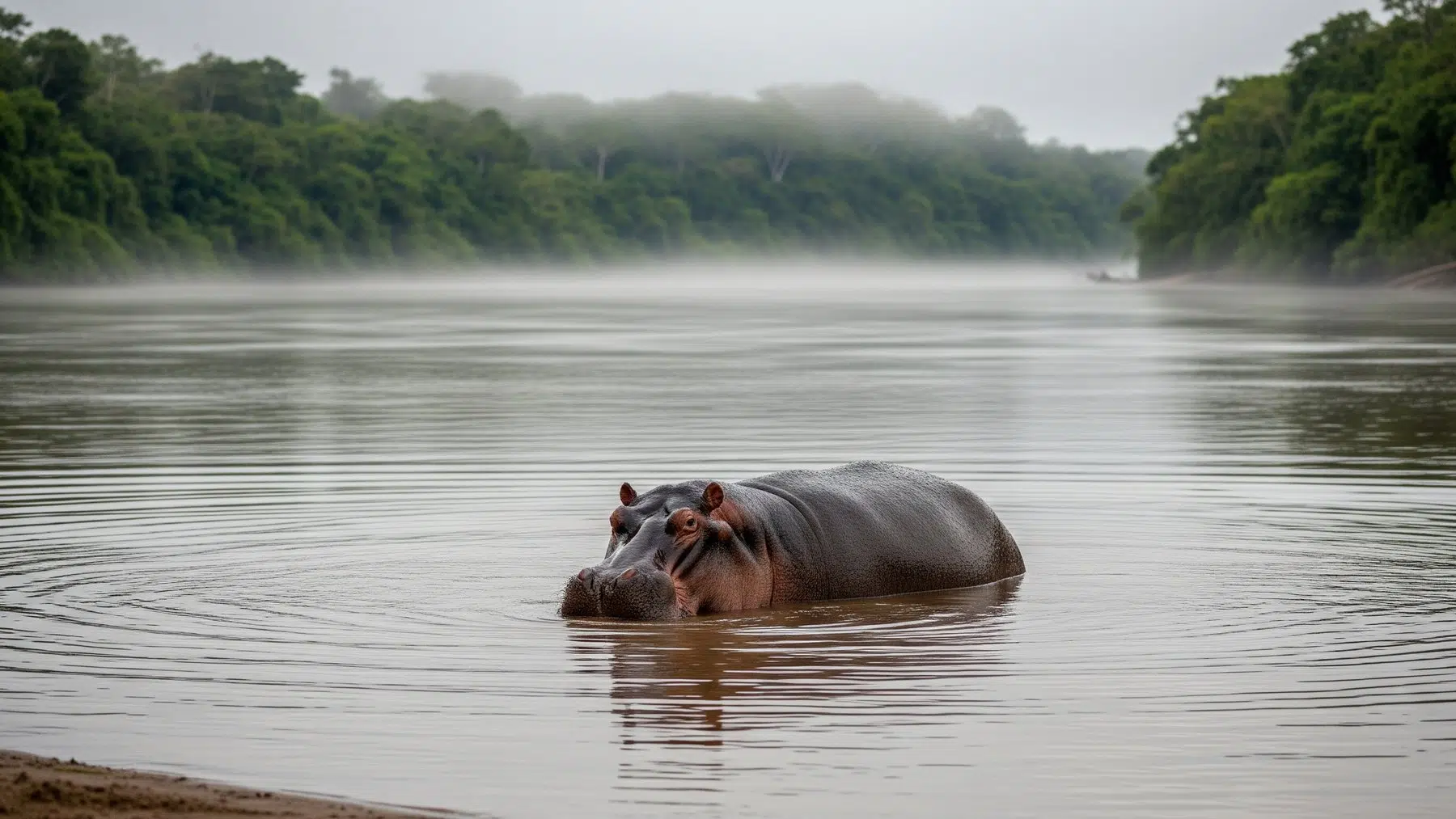
Along the Magdalena River in Colombia, something enormous has been happening in plain sight.
A population of animals has been spreading through wetlands and tributaries for decades, growing faster than anyone tracking it had guessed.
Scientists knew there was a problem.
They did not know how large it had grown until they went out and counted every one.
What they found stopped them cold.
A private zoo that nobody planned for
In the early 1980s, Colombian drug lord Pablo Escobar decided that his sprawling Hacienda Nápoles estate needed something extraordinary.
He imported four hippos, three females and one male, to his private menagerie located between the cities of Medellín and Bogotá.
The animals were a spectacle, drawing curious onlookers to the estate’s fenced perimeter during the years Escobar held power.
They were also, as it turned out, completely unstoppable.
Upon Escobar’s death in 1993, authorities removed most of the zoo’s animals, but the hippos were deemed too dangerous to approach and were left behind.
In time, they escaped into the surrounding area.
Nobody brought them back.
Nobody could.
The river that became their home
The marshy environment of the Magdalena River Basin turned out to be a paradise for the hippos, with plenty of vegetation to eat and no natural predators in a warm, moist landscape.
Colombia has no equivalents to the lions and crocodiles that help control hippo numbers in sub-Saharan Africa.
In Africa, drought and predators keep populations in check.
The Magdalena offered neither threat.
Without those pressures, the giant herbivores bred rapidly and formed the largest population of the animals outside that continent.
The warm wet season floods the basin’s oxbow lakes, creating shallow nursery pools where young animals can move safely and feed without competing with adults.
The river had become a nursery, and no one was counting.
Counting something that hides in water
When scientists finally launched a serious census, the task proved harder than expected.
Despite their enormous size, hippos spend their days wallowing in the river and roam large distances on land at night.
A research team counted the animals in person, by drone and using other tracking methods, fanning out across tributaries, mudflats and forest edges over several field seasons.
On some survey days, teams found fresh tracks and flattened vegetation but no animals at all, the river having swallowed them whole.
The picture that emerged was deeply unsettling.
The researchers found that Colombian hippos appear to reach sexual maturity earlier than their African counterparts, indicating rapid breeding.
One hypothesis is that the lush year-round conditions Colombia provides are driving the accelerated reproduction.
From 4 animals to nearly 200, and the river is paying the price
A few years ago, a projection estimated roughly 98 hippos living along the Magdalena and its tributaries as of 2020.
The new comprehensive census told a very different story: 181 to 215 animals, roughly double the earlier projection.
Scientists had already considered them the largest invasive animal in the world, threatening native plants and wildlife across the country.
The hippos compete with river turtles and manatees, contaminate lakes with their droppings, and consume large quantities of vegetation each day.
Their heavy bodies erode riverbanks and carve muddy paths that divide forest.
A single species, introduced by one man’s excess, has been rewriting a river ecosystem in real time, much like invasive species reshaping waterways elsewhere, and the pace is accelerating with each new cohort of calves.
What happens now, and what the river still holds
If nothing is done, officials estimate the population could reach 1,000 animals by 2035.
Colombia is now taking aim at the population, with the government announcing plans to euthanize dozens of the animals.
The decision is contested, and it has divided scientists, local communities and conservationists along sharp lines.
Some communities depend on the tourism the hippos bring, while fishing communities live in fear of animals that can weigh 3 tonnes and move with surprising speed on land.
Applying the population control methods currently under consideration will cost at least 1 to 2 million dollars, and depending on strategy, hippos may remain on the landscape for 50 to 100 years.
The Smithsonian notes that relocation talks with other nations have so far stalled, leaving Colombia to navigate a crisis born from a single act of excess three decades ago.
What is certain is that the Magdalena River, one of South America’s great waterways, is now shared with a resident no river system there ever evolved to accommodate.
The hippos are thriving.
The challenge now is finding a way forward that protects the river too.
Read the whole thing?
Get the week's signal, not the noise
Our sharpest reporting on energy, climate and nature — free, once a week.