

Sediment cores pulled from two quiet lakes beside Maya ruins in Mexico’s Yucatán Peninsula carry a record that no ancient chronicle preserved. Researchers drilling layer by layer through the mud found mercury concentrations that would trigger cleanup orders under modern environmental law — in water bodies that sit far from any known industrial source.
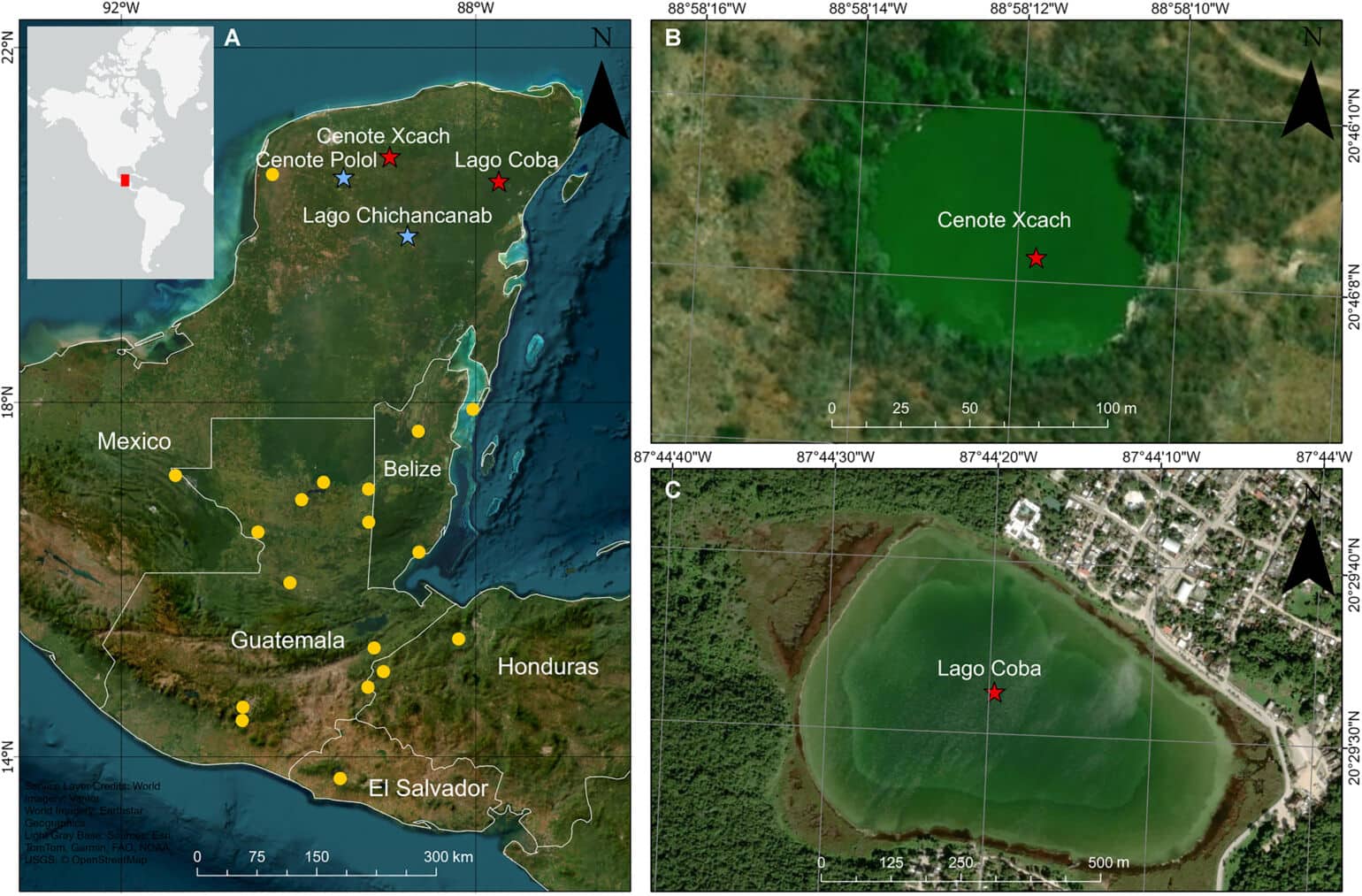
The lakes, Lago Cobá and Cenote Xcach, rest alongside stone cities that flourished more than a thousand years ago. What their mud holds is rewriting how scientists understand the environmental footprint of Maya civilization.
A toxic record buried in lake mud
In May 2023, researchers from Auburn University pulled sediment cores from Lago Cobá and Cenote Xcach. Both lakes sit directly beside Maya ruins and far from any modern industrial mercury source — a location that made the findings hard to explain away.
Each layer was dated using carbon dating of charcoal and wood fragments, then tested for mercury concentrations level by level through the core. That method produced a contamination timeline stretching back roughly two thousand years.
The natural background level at Cobá is around 0.02 micrograms of mercury per gram of sediment. That baseline makes what came next all the more striking.
Centuries of contamination — by the numbers
Mercury at Cobá began rising around 40 CE. It peaked near 2.3 micrograms per gram between 250 and 300 CE, then fell back to normal by 520 CE. Xcach told a more complicated story, with four distinct spikes across a longer timeline.
The worst of those spikes at Xcach lasted from roughly 535 to 820 CE — nearly three centuries. Concentrations during that stretch averaged 8.4 micrograms per gram and peaked at 18 around 720 CE.
Modern safety thresholds put the likely-harm line at 1.06 micrograms per gram and the severe-wildlife-damage line at 2.0. Both lakes exceeded those thresholds for extended periods. During the Classic Period, mercury buildup in both lakes ran about 10 times higher than in any other era recorded in the cores.
Where the mercury came from
To rule out airborne pollution drifting across the region, the researchers checked two other Yucatán lakes — Polol and Chichancanab. Neither showed a mercury rise, pointing directly at local, city-level sources rather than any broader atmospheric cause.
The authors believe the Maya imported liquid mercury or cinnabar — a vivid red mineral widely prized as a pigment for murals, burials, and ritual objects. Erosion then washed the metal from city surfaces and structures into the adjacent lakes, along with phosphorus-rich soil.
That connection matters. Heavy cinnabar use is one of the best-documented practices of Maya culture, and this study links it, for the first time, to measurable and lasting environmental harm.
Aquatic life collapsed as mercury climbed
The biological record inside the sediment is just as striking as the chemical one. Pigments from algae, blue-green bacteria, and purple sulfur bacteria all dropped sharply once mercury concentrations turned toxic, as explained in Science Advances.
Blue-green bacteria initially bloomed as phosphorus washed in from eroding city soils — then crashed once mercury surpassed 2.0 micrograms per gram.
The animal record disappeared too. Cobá’s mud contains no ostracod or snail shells during the toxic period. At Xcach, midge larvae became scarce, and the dominant genus nearly vanished from the record entirely. Taken together, these biological signals describe a food web that effectively broke down — not for a season, but for decades to centuries at a stretch.
A hidden stress on Maya communities
Fish and shellfish were part of the Maya diet, and both accumulate mercury efficiently. Populations living beside Cobá and Xcach may have faced toxic exposure for generations without any way to recognize what was happening.
The study didn’t measure methylmercury — the most biologically harmful form — which bacteria produce in oxygen-poor lake sediment and which concentrates as it moves up the food chain. The actual human health burden may have been considerably higher than the raw sediment numbers suggest.
Classic Period Maya societies were already under pressure from droughts, deforestation, and soil erosion. Degraded water quality from mercury contamination, the study’s authors argue, was an underappreciated additional stress — one that earlier research had largely overlooked.
That argument invites a broader rethink. Scholars have long debated what drove the decline of major Maya centers, with climate, warfare, and political fragmentation all featuring in those discussions. What the mud from Cobá and Xcach adds is a quieter, slower kind of damage — one that a civilization inflicted on itself through the very pigments it used to mark its most sacred spaces. The lakes held the evidence all along.
Read the whole thing?
Get the week's signal, not the noise
Our sharpest reporting on energy, climate and nature — free, once a week.


