Almost all migratory birds will quickly leave the harsh Arctic when it gets colder.
Food supplies become scarce, temperatures plunge rapidly, and deep snow covers the landscape.
However, the Willow Ptarmigan has adapted to the Arctic environment.
The hardy bird lives on the tundra all year round in the Bering Land Bridge in Alaska.
They have evolved many adaptations that help them survive in one of the most extreme environments on Earth.
Some help them walk through deep snow and avoid predators; the rest help them find essential water.
Feathered snowshoes and brilliant white plumage handle drifts
During the winter, there are many issues to overcome.
A bird must stay warm, walk in the deep snow, avoid predators, and find enough food to survive. Luckily, the Willow Ptarmigan has adapted to meet these challenges.
One of the most obvious adaptations the bird has is feathered feet.
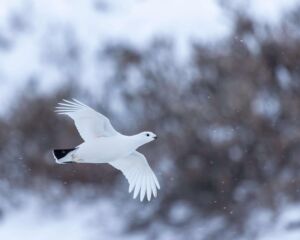
In winter, feathers grow right down to their toes. Extra insulation keeps them warm while also increasing the surface area.
That wider base acts like a snowshoe, letting them walk across deep drifts without sinking.
Their feathers also change during the seasons. They lose their brown feathers and gain bright white plumage.
White plumage makes them very hard to spot against the snow-covered tundra.
Deep snow burrows protect flocks from bitter winds
Physical traits alone are not enough to survive the Arctic’s freezing temperatures.
To shelter from the worst conditions, they rely on behavior.
When it gets very cold and the snow gets deep, they dig burrows beneath the surface.
This keeps them safe from the harsh weather and freezing wind.
Some birds spend up to 80% of their winter in these snowy shelters.
Whilst the land might look deserted from above, ptarmigans are hiding right underneath.
Willow shrubs provide reliable nourishment across barren winters
When winter arrives, the birds need to find food.
Fortunately for them, they don’t have to go far. Throughout the colder months, the Willow Ptarmigan eats mainly leaves and buds.
Willow shrubs become a key part of their diet as they provide a reliable source of food.
Heavy browsing on these shrubs can even affect how the plants grow and reproduce.
This has made them known as tundra architects, a description used by the National Park Service.
Even though they are a small bird, they can still make an impact on the Arctic landscape.
Eating snow solves winter hydration challenges
Finding water can be an issue, as much of the tundra remains frozen for a long period of time.
To overcome this, the ptarmigan has a simple solution. It eats snow.
As they browse on dry winter shrubs, they scoop up mouthfuls of snow to stay hydrated.
Year-round residency anchors these birds to northern landscapes
The Willow Ptarmigan is not a rare bird in the Arctic. As one of the most common ptarmigans in North America, it can be seen all year round in much of Alaska.
Although the birds may move between seasonal ranges, they do not migrate like many northern species.
As a result, they remain closely tied to their environment. This is why they have become such a common bird in the Arctic.
Extreme seasonal adaptations turn hostile tundra into home
The Willow Ptarmigan has adapted to overcome almost every issue it faces during the winter in the Arctic.
On the surface, the tundra doesn’t seem like a friendly place, but for the Willow Ptarmigan it provides the tools needed to survive.
By using the snow and ice to their advantage, they remain built to endure whatever harsh seasons lie ahead.
Read the whole thing?
Get the week's signal, not the noise
Our sharpest reporting on energy, climate and nature — free, once a week.