The locals in Perry County, Illinois, knew it was coming before they saw it.
They felt it first: a deep, rhythmic shudder in the ground, like something enormous breathing beneath their feet.
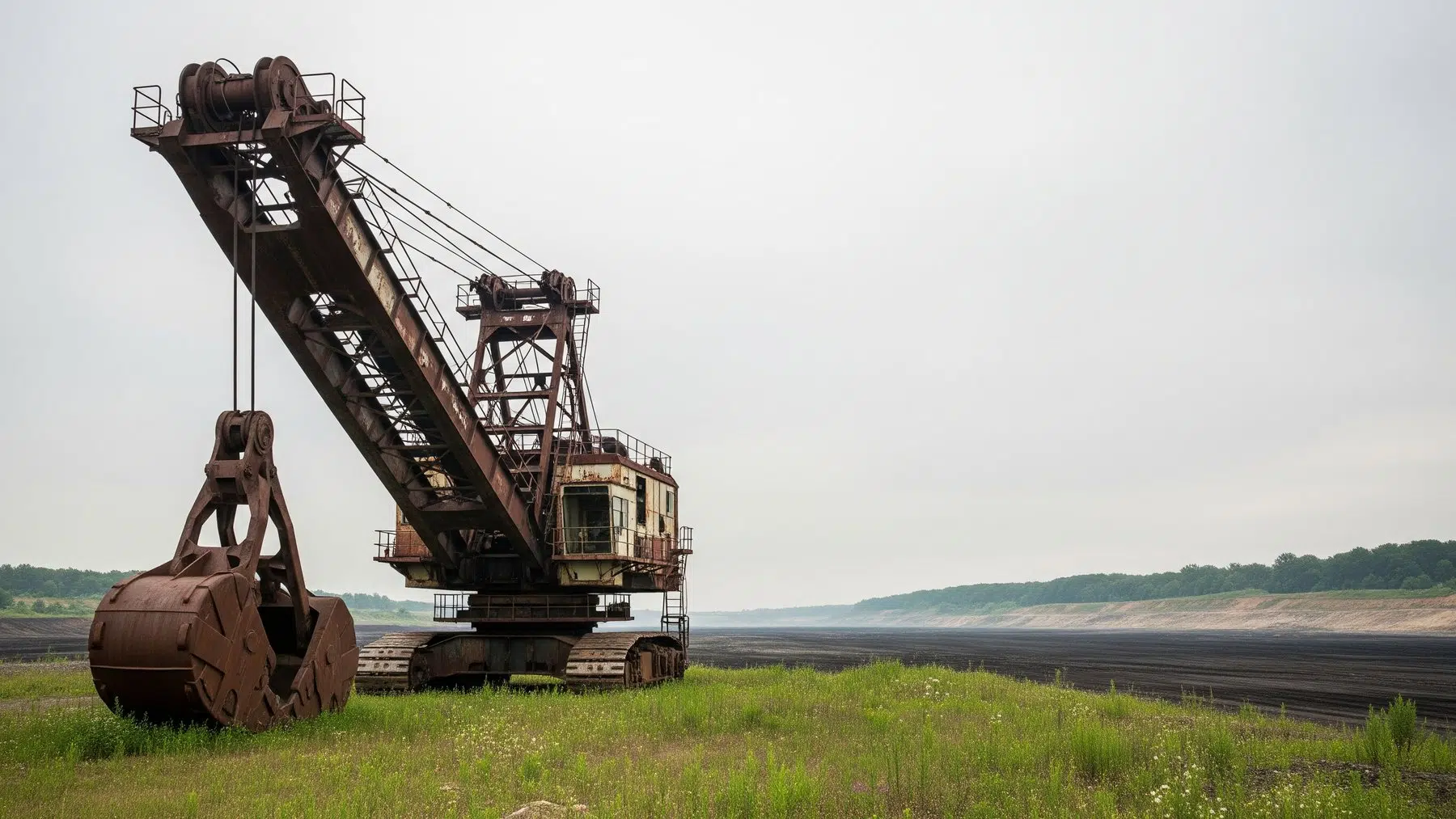
What arrived at the Captain Mine near Cutler in 1965 was unlike anything the world had ever built.
It moved at a quarter of a mile an hour, it stood 21 stories tall, and it carried a name that fit: The Captain.
A machine so large it needed its own power grid
The Marion 6360 was not assembled in a factory and driven to the site.
It was shipped to southern Illinois in pieces by rail, then bolted together in the field over ten months, the way you might build a skyscraper, except this one was designed to walk.
Its 215-foot boom swung an 180-cubic-yard dipper capable of handling 270 tons per pass.
To put that in human terms, its dipper could swallow a two-story house whole, roots and all, in a single bite.
Running it took more electricity than a small Illinois town consumed in a day, drawn through 20 main-drive motors pushing a combined 30,000 horsepower.
Workers on the ground described standing near the machine at full swing as something close to standing beside a slow, deliberate earthquake.
Four people running one of the biggest land machines ever built
Here is the detail that stops people cold.
A machine 21 stories tall, wide enough to park a fleet of school buses on its upper deck, and only four people ran it around the clock.
An operator, an oiler, a welder, and a ground man watching the trailing cable.
Each shift handed off to the next without the machine ever fully stopping, a rhythm that continued seven days a week for more than two decades.
Working around the clock, it delivered roughly 150 railroad carloads of coal a day, stripping two coal seams simultaneously in a single pass.
No other shovel in history had been designed to do that, slicing the earth open on two levels like a layered cake being peeled apart.
The day The Captain met its end in fire
For 26 years it kept moving, biting and swinging, biting and swinging.
Over that span, The Captain moved around 810 million cubic yards of overburden, roughly three times the earth shifted to build the Panama Canal.
Then on September 9, 1991, fire broke out in the machine’s lower works. Investigators pointed to hydraulic fluid as the primary fuel source, though the exact cause was never conclusively confirmed.
Fire took hold fast.
Engineers from Arch Coal and Marion Power Shovel surveyed the damage and reached the same verdict: too far gone to repair.
The machine that had moved nearly a billion cubic yards of earth was left to be dismantled where it stood, scrapped in the last pit it ever dug.
What 16,000 torn acres became once the giant went still
This is where the story shifts into something nobody who watched The Captain work would have predicted.
The 16,000 acres of the Captain Mine were donated to Illinois as the core of a new state park.
Those raw ridges and open hollows, stripped down to bare geology, turned out to be exactly what grassland birds and native prairie plants had been waiting for.
Strip-mined land, once legally regraded, can mirror the open savanna conditions that covered much of the Midwest before row crops replaced them.
Bobwhite quail, meadowlarks, and white-tailed deer moved into the recovering grassland. Reclaimed mining land across the region has followed the same arc repeatedly: the machine tears, the law requires healing, and nature fills the gap faster than anyone expects.
A machine built to take everything ended up handing 16,000 acres back to the wild.
The hidden physics that made The Captain possible
The Marion 6360 dug from above, not below, casting its dipper out on a boom and letting gravity and cable tension do the pulling.
That rope-and-boom system uses the same lever principle a child uses on a playground seesaw, which is why 28 million pounds of steel could be managed by just four people.
The principle scales almost without limit, and engineers of that era kept building bigger until economics stopped them where geology could not.
Today the land near Cutler is green and open, crossed by deer trails where crawler tracks once left grooves deep enough to hide a car.
Illinois state law required the mining company to restore the ground to its approximate original contour, and that legal obligation became, inadvertently, one of the largest acts of prairie creation in modern state history.
Just as wildlife corridors are now being engineered on purpose across America, the reclaimed mine landscape proved that connections between wild spaces can arrive by accident, written into a coal contract nobody meant as an environmental document.
It took a fire to stop The Captain, and it took a state park to reveal what the machine had been sitting on top of all along.
Read the whole thing?
Get the week's signal, not the noise
Our sharpest reporting on energy, climate and nature — free, once a week.