
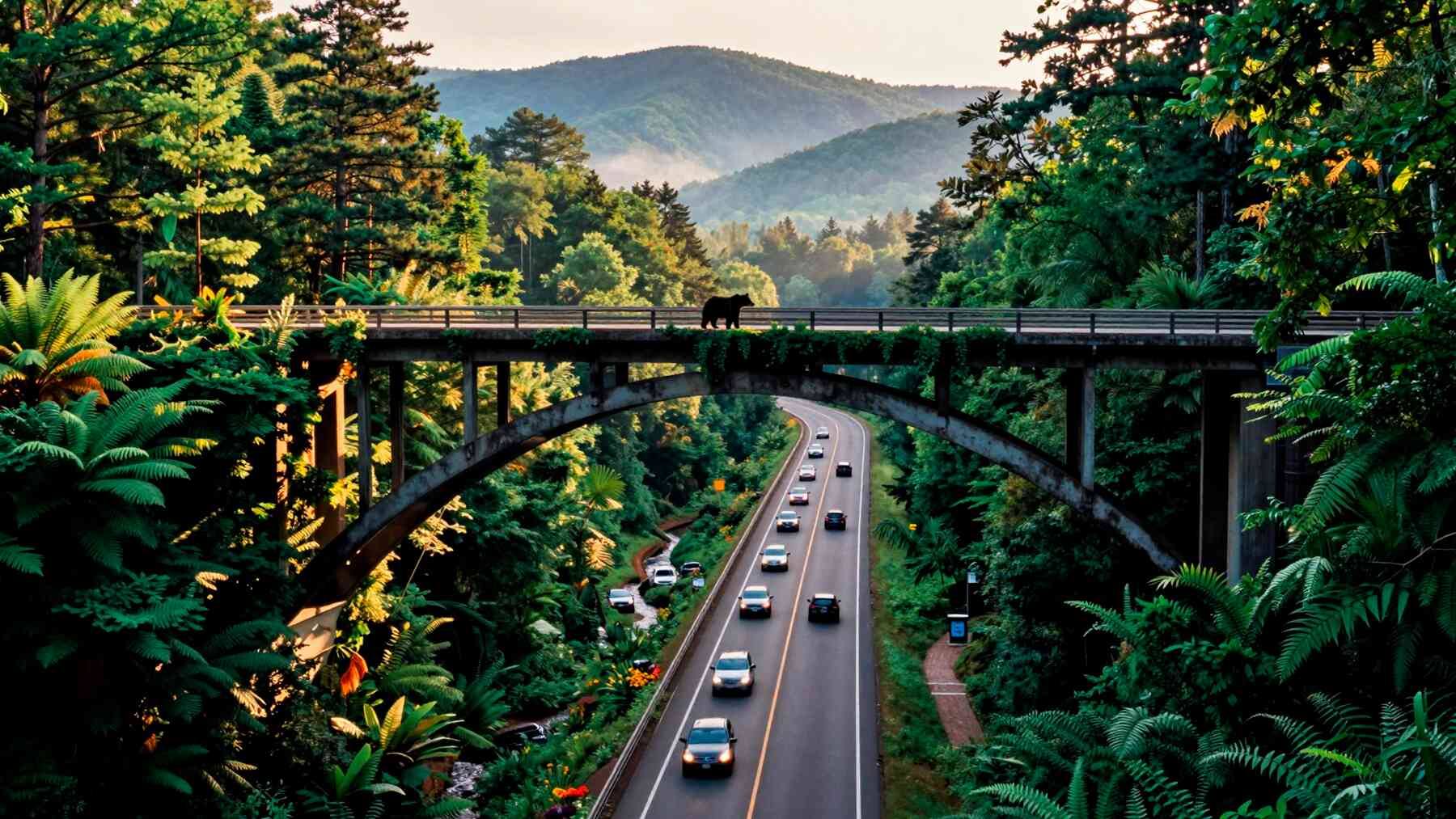
A black bear leaves the woods. Instead of crossing four lanes of speeding traffic, the bear steps onto a grass-covered bridge spanning the interstate.
Cars whizz by below.
This is not a picture taken in the future.
This is happening today on Interstate Highway 40 in North Carolina.
North Carolina is currently constructing America’s first large-scale wildlife highway.
Why animals needed a new way to cross
North Carolina is one of the most biologically diverse states in the country.
The Great Smoky Mountains National Park, Pisgah National Forest, and Cherokee National Forest come together. They create a large corridor of undeveloped land.
Interstate Highway 40 runs directly through the center of this corridor.
It divides one of the most important wildlife corridors in the state.
Black bears, elk, bobcats, deer, and other wildlife need to travel between protected habitats.
When they attempt to do so and cross over Interstate 40, the results are devastating.
According to the Federal Highway Administration, North Carolina ranked 12th for wildlife-vehicle crashes. Over 62,000 were reported between 2021 and 2023.
In total, there are approximately 2 million wildlife vehicle crashes each year nationwide. Such crashes can cause thousands of dollars in damage.
Animals were dying, habitat fragmentation was increasing, and it became clear that something needed to happen.
Funding turned the idea into reality
In 2023, North Carolina became the first state to provide specific funding for wildlife crossings. Its General Assembly allocated $2 million for such purposes.
Two years later (in 2025), North Carolina legislators provided a long-term funding solution.
Every two years since then, $10.2 million has been allocated by North Carolina. Such ongoing funding will allow long-term wildlife crossing projects to move forward over decades.
The Safe Passage Coalition, which has advocated for this type of funding since 2017, continued bringing partners together.
Nearly twenty federal, state, tribal, and non-profit agencies formed a partnership.
Together, they work to make mountain highways in North Carolina and Tennessee safer for both wildlife and motorists. Their primary goal focused on the Pigeon River Gorge area along I-40.
In 2022, the North Carolina DOT incorporated a wildlife “bench.”
During bridge repair at Harmon Den along I-40, engineers created a flat section rather than extending stone to the top of a steep embankment.
They carved it into the side of the embankment.
Now, animals may cross safely under I-40. Trail cams show that animals are indeed using the underpass already.
The vision extends far beyond one bridge
Green bridges, tunnels, and other wildlife crossings will allow bears, deer, elk, and mountain lions to move safely between habitats.
The ultimate vision for wildlife passages extends far beyond a single crossing project.
Rather than relying on a single crossing, the plan links green bridges, underpasses, fencing, and other measures together. The result is one continuous wildlife corridor.
How the wildlife highway will work
Native plant-covered green bridges spanning across highways will resemble natural hillsides from overhead. Underground tunnels or culverts will funnel animals under roadways.
Fences will redirect wildlife toward safe crossing points.
Studies have shown that such wildlife passages can decrease collisions by as much as 90%.
Similar systems have already been developed in Colorado, Utah, Idaho, and Oregon.
North Carolina is now leading similar efforts on the East Coast.
Funding will help launch additional wildlife crossing projects throughout the state. Engineers will identify where wildlife crosses highways and build crossing systems in those areas.
Maintenance costs associated with these crossings will be covered by government funding.
Those crossings will then be maintained for generations.
For the wildlife using them, the change is already evident.
A bear going through a culvert does not know that it was built by humans. It only knows it provides an easier way through.
If one highway can be changed to help wildlife, how many other parts of America’s transportation network could also be changed?
Read the whole thing?
Get the week's signal, not the noise
Our sharpest reporting on energy, climate and nature — free, once a week.


