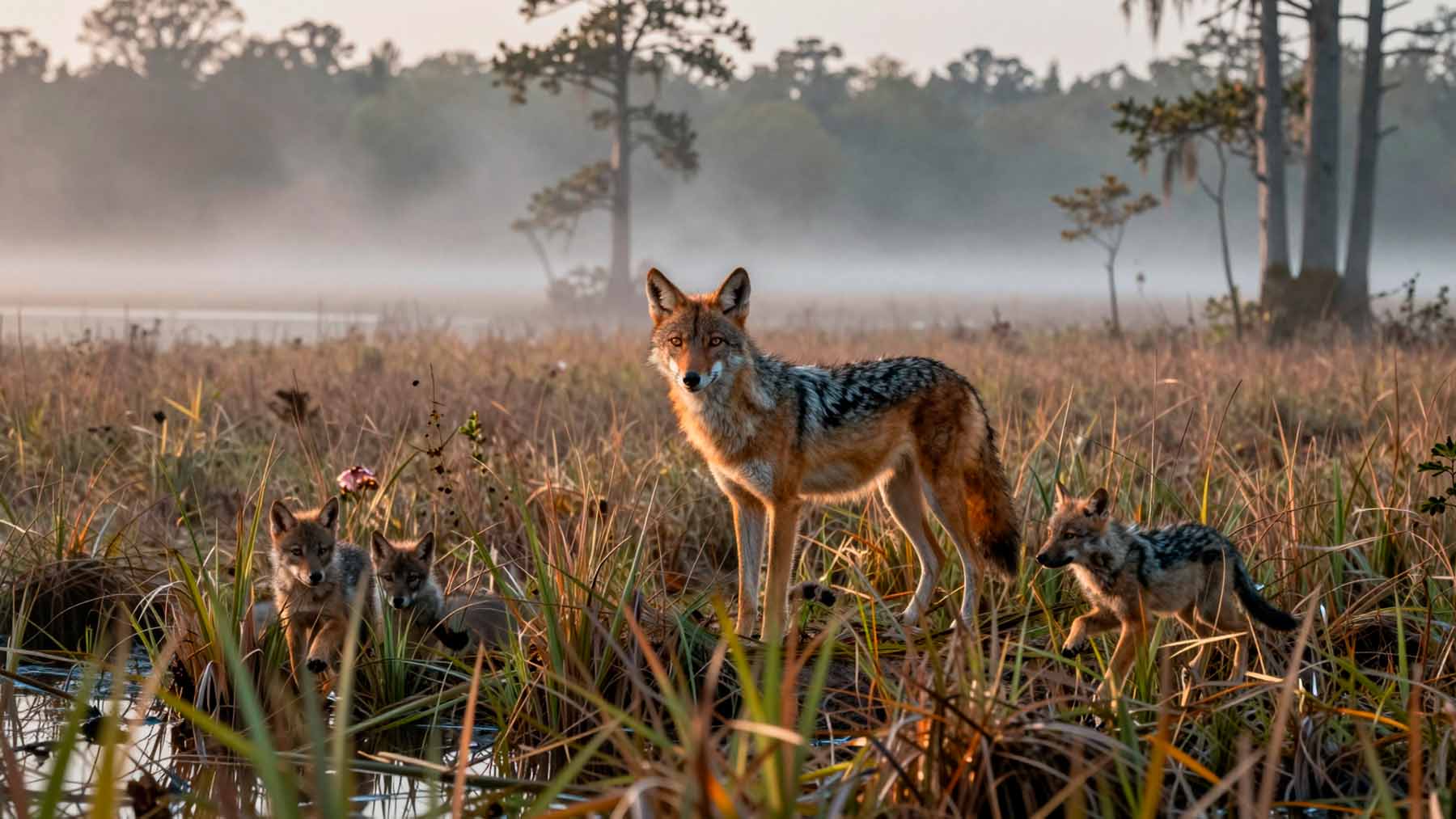
In the remote wetlands of eastern North Carolina — among the marshes and pocosins of Alligator River and Pocosin Lakes National Wildlife Refuges — one of the world’s rarest predators is quietly regaining its footing. This year, four litters of red wolf pups have been born in the wild and on private lands, a milestone conservationists have spent decades working toward.
The numbers are still fragile. As of July 2025, only 22 red wolves are known to roam free. For a species that has already come back from declared extinction once before, the margin for error remains razor-thin.
A species pulled back from the brink — more than once
The red wolf’s brush with extinction didn’t happen gradually. By the 1970s, hunting and habitat loss had pushed the species to the edge — and in 1967, lawmakers had already classified it as “threatened with extinction” under the Endangered Species Preservation Act of 1966. That early warning went largely unheeded until the situation became critical.
What followed was one of the more remarkable reversals in American conservation history. The federal Endangered Species Act, combined with the Red Wolf Recovery Program and the Saving Animals from Extinction Program, built the legal and institutional scaffolding for a comeback.
Red wolves were reintroduced to eastern North Carolina in 1987. It was a first — the only carnivorous species declared extinct to be successfully reintroduced anywhere in the world. The effort worked. By 2011, at least 130 red wolves were roaming free, proof of what sustained, coordinated effort could actually achieve.
Four litters, up to 16 pups, and a fragile new generation
This year’s pup count is the most encouraging sign in years. Four litters were born in North Carolina in 2025, with between 12 and 16 pups surviving their first months — a range that reflects the difficulty of tracking animals through dense, remote wetland terrain.
Three of those litters were born in the wild. The fourth arrived on private land, through the Prey for the Pack Program, which financially compensates landowners for hosting red wolves on their property. Private land partnerships extend the species’ viable habitat well beyond federal refuge boundaries, and that distinction matters more than it might appear.
With only 22 known wild red wolves as of July 2025, every pup carries outsized biological significance. The U.S. Fish and Wildlife Service also manages 295 captive red wolves in partnership with the Association of Zoos and Aquariums — a critical insurance population, though not a substitute for a self-sustaining wild presence.
“These pups provide real hope for the future of red wolves,” said Will Harlan, Southeast director at the Center for Biological Diversity. Hope, notably, is not the same as certainty.
Highway 64: the deadliest stretch for red wolves
The greatest threat to red wolves today isn’t hunting. It’s a road.
Since 2020, vehicle collisions have been the leading cause of red wolf death, accounting for eight fatalities over six years. Nearly all occurred along Highway 64, which cuts directly through the Alligator River and Pocosin Lakes National Wildlife Refuges — the core of the species’ remaining wild territory.
The situation illustrates a problem wildlife managers encounter repeatedly: infrastructure and habitat don’t negotiate. A highway built decades ago, long before red wolf reintroduction was imaginable, now bisects one of the only places on Earth where these animals live free. Eight deaths in six years may sound modest in the abstract. For a population of 22, it represents an existential rate of attrition.
Crossings, funding, and a rare moment of bipartisan backing
The response to the Highway 64 problem has been unusually concrete — and unusually well-funded.
North Carolina Governor Josh Stein signed a state budget allocating $10.2 million every two years for wildlife crossings under major highways. Separately, $31.25 million in federal and state grants and private donations has been raised specifically for underpasses beneath U.S. Route 64. Those crossings will benefit red wolves alongside black bears, river otters, and spotted turtles — all species navigating the same fragmented landscape.
The political dimension is worth noting. In August 2025, Democratic Representative Valerie Foushee and Republican Representative Greg Murphy filed a joint congressional resolution supporting red wolf repopulation and recovery efforts. Bipartisan agreement on wildlife conservation isn’t always easy to come by, and when it appears, it tends to signal the kind of broader public support that can sustain programs through changing administrations.
What this recovery actually means — and what still hangs in the balance
Twenty-two wild wolves. Four litters. Sixteen pups at most. The numbers are simultaneously encouraging and sobering.
Conservation experts are careful not to overstate what this year’s births represent. The pups are biologically meaningful additions to a population that has hovered near collapse — real progress, not a symbolic gesture. But a secured future looks different from a hopeful moment, and the red wolf isn’t there yet.
What has changed, compared to earlier phases of the recovery effort, is how many pieces are now moving at once. Habitat protection, private landowner incentives, infrastructure investment, and legislative backing are all operating in parallel — a combination increasingly cited as a model for multi-stakeholder wildlife recovery.
The underpasses beneath Highway 64 are still to be built. The pups born this year are still growing. The congressional resolution is still working its way through a crowded legislative calendar. What comes next — for the wolves, the funding, and the political will behind both — will determine whether 2026 is remembered as a turning point or simply another chapter in a much longer struggle.
Read the whole thing?
Get the week's signal, not the noise
Our sharpest reporting on energy, climate and nature — free, once a week.