The insect appears fairly normal, clinging to a prairie stem. It is carrying a high-technology rider.
This fall, thirty migrating monarchs at the Goose Pond Sanctuary in Wisconsin had BlūMorpho solar transmitters installed.
These were installed by sanctuary staff and local citizens who participated in the public outreach portion of the project.
Each captured butterfly was treated gently before being released back onto its migration route toward the oyamel fir forests in Mexico.
Weighing the rider against the route
Each transmitter weighed about as much as a single grain of rice.
The unit’s weight mattered greatly because many monarch tracking programs relied on tags that were later recovered by researchers.
These paper tags indicated a butterfly’s location only after it was recaptured many months later.
Previous tagging typically provided only two data points: where a butterfly was tagged and where it was eventually recovered.
Thus, the majority of the vast expanse of wilderness remained invisible to researchers attempting to chart the butterflies’ journeys.
Additionally, no one knew what fate befell butterflies that were not recovered by researchers.
Were they killed by early frosts? Did they wander away from their intended flight paths? Or did they simply pass over areas devoid of suitable habitats?
The journey between departure and arrival
Innovative Bluetooth technology has helped close some of these gaps by changing the way migration data can be collected.
Using everyday smartphone capabilities, receivers may pick up active signals transmitted by tagged animals without the need for special radio tower equipment throughout rural areas.
Whenever individuals use the Project Monarch app, they act as passive receivers when a tagged insect flies within range.
A single butterfly can generate multiple detections during its migratory journey.
Instead of connecting a departure point to a recovery point, researchers can now see parts of the journey that were previously hidden.
Cold fronts and favorable winds may become easier to observe through the movement patterns revealed by the tracking data.
Powering across borders through community science
Previously, battery limitations prevented small transmitters from continuously sending signals over such long distances.
Chemical batteries powering tiny transmitters held insufficient amounts of “juice” to continue sending signals for thousands of miles.
Solar panels attached to the tag provide power when sufficient sunlight is available during the butterfly’s migration.
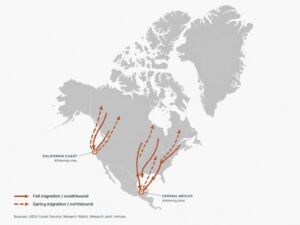
More than 1000 monarchs from across Canada and the U.S.A. were equipped with solar charging units during the fall migrations through Monarch Joint Venture.
Personal phones placed along major north-south flyways across North America have begun detecting these signals.
These detections show butterflies continuing their journey toward warmer temperatures, transforming an historic mystery into a dynamic map of travel routes.
Following the clues left behind along the route
Detection data collected by nearby receivers may help conservation biologists identify areas that appear especially important along migration routes.
These may be areas where researchers observe changes in movement patterns that deserve closer study.
Land managers may eventually use this information to guide restoration efforts more precisely.
These efforts can focus on areas identified as potentially important along migration routes.
The app provides an international platform for participation as part of a global citizen science network that includes the Southern Wisconsin Bird Alliance.
A location signal is not proof of survival
Although significant technological advances have been made, biological limits remain a threat to the success of butterfly migration.
Historical obstacles such as crosswinds, sudden frost, predators, and habitat loss continue to challenge migrating butterflies.
Subsequent generations of butterflies will continue to face the same environmental challenges during migration. Additionally, scientists recognize these biological limitations.
Solar tags allow researchers to determine the location of tagged butterflies when they pass within range of active receivers.
Even though solar tags can identify the general area where a butterfly is located at a specific moment, they do not provide any information about whether it remains alive afterward.
Read the whole thing?
Get the week's signal, not the noise
Our sharpest reporting on energy, climate and nature — free, once a week.