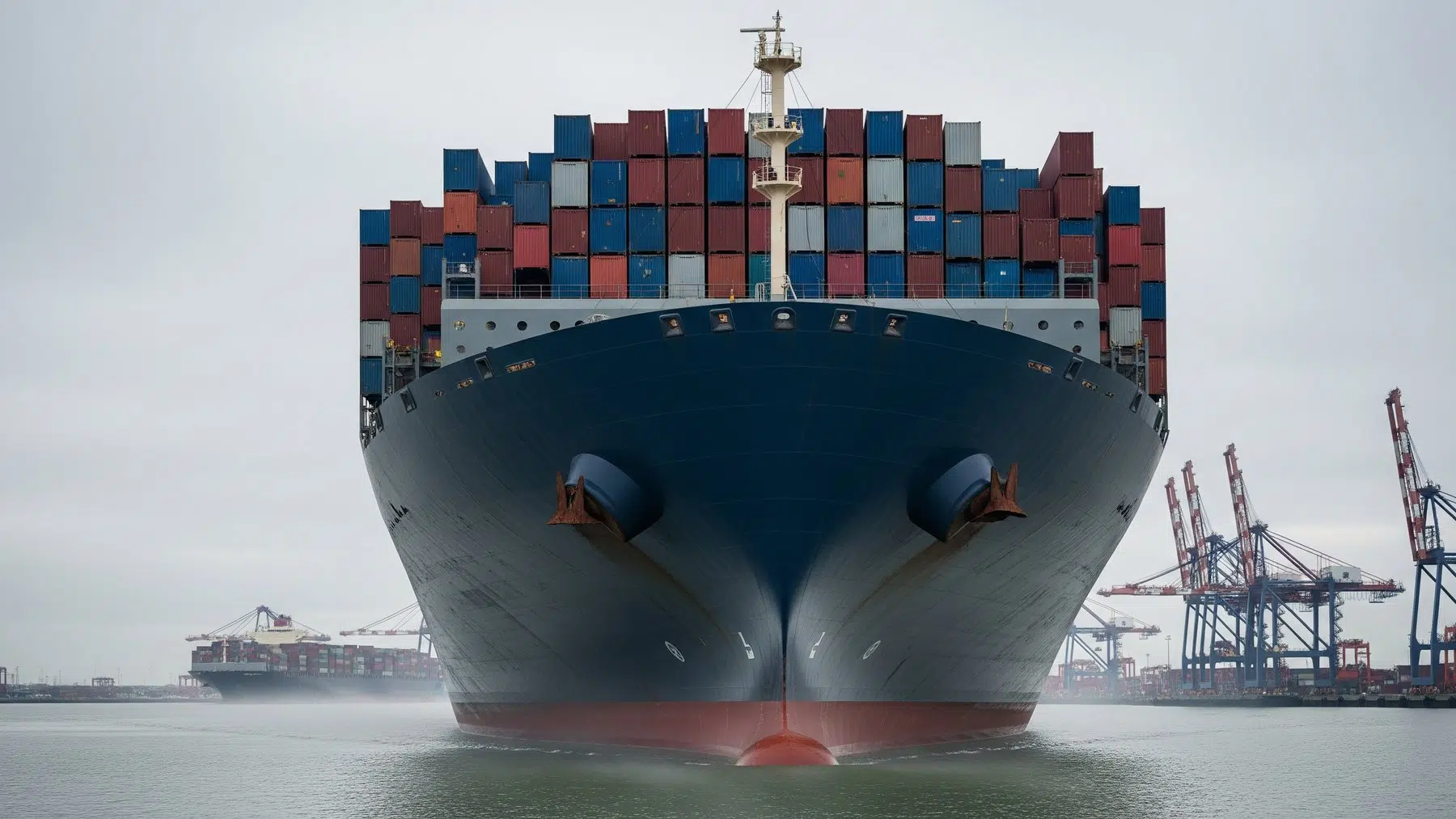
Stand at the waterline of any American container port and watch one come in.
The hull rises higher than a six story building before you even see the deck.
The bow pushes a wall of green water ahead of it, and the stern is so far back it disappears into the haze.
Something that large and heavy should not be able to move at all, and yet it crosses the Pacific in about two weeks without stopping.
Inside that floating steel mountain, a fight is brewing that could reshape what lands on American shelves, and the ship itself carries a wonder almost no one thinks to ask about.
A machine that bends the ocean
The numbers around a modern container vessel are almost too large to feel real.
A typical large ship stacks around 13,000 standard containers from waterline to sky.
Its net tonnage runs to roughly 65,000 tons on a single vessel.
The ocean literally deflects downward under that weight through a process called squat, where the hull sinks several extra feet as speed increases.
Engineers calculate that drop precisely, because in a shallow harbor channel even a few extra feet of sinkage could grind a ship worth hundreds of millions of dollars into the seabed.
These vessels run on engines the size of a small apartment building and are crewed by fewer than 25 people.
The ocean hitches a ride
What nobody standing on the dock ever imagines is what travels with the ship.
Within weeks of a hull hitting the water, barnacles colonize the steel below the waterline, building micro reefs across thousands of square feet of iron.
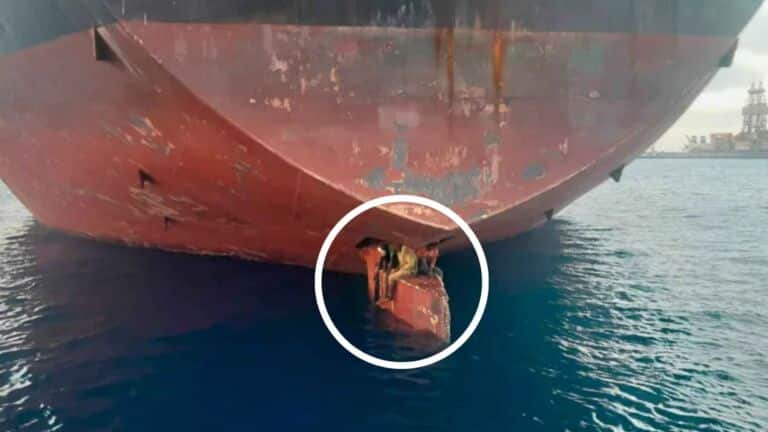
Pilot fish slip into the turbulent pressure zone just ahead of the bow, riding displaced water for hundreds of miles without spending a calorie of their own energy.
In warmer stretches of the Pacific, whale sharks and sea turtles have been documented cruising in the warm wake churned out by a container ship’s propeller.
The ocean treats these vessels the way it treats a reef: as an interruption in open water that concentrates life.
A ship crossing from Asia to California is not just a freight machine.
It is, for a few weeks, a traveling island with its own ecology hanging off the bottom and trailing behind in the water.
The atoms that built the hull
Here is where the night sky enters the story.
Every ton of steel in a container ship’s hull is mostly iron, and every atom of iron on Earth was forged inside a dying star.
Iron is the heaviest element a star can fuse in its core without losing energy.
When a massive star finally runs out of room to grow, it collapses and explodes in a supernova, scattering its iron across space.
That scattered iron eventually clumped into planets, was mined from the ground, smelted into steel plate, and welded into the hull of a ship now sliding under a crane in Long Beach.
The same stellar explosions that seeded the periodic table also built every container vessel on the ocean, whether the shipyard was in Nanjing or Newport News.
The $3.25 million question at the dock
The shipyard, it turns out, matters enormously right now.
In 2024, Chinese-built container vessels held 81 percent market share globally.
Atlantic Container Line, a carrier that handles large industrial cargo including wings for Airbus aircraft, says it will abandon the US market if the government follows through on plans to fine Chinese-built shipping vessels.
Its CEO warned that freight rates will return to Covid-era surge levels, with a customer surcharge of $2,000 to $2,500 per container compared to roughly $800 for the largest carriers today.
For a large COSCO vessel, one maritime analyst put the fee at $3.25 million per voyage rotation under the new rules.
The US Trade Representative imposed the fees on Chinese-owned, operated, and Chinese-built vessels starting in October 2025.
You can read more about what happens inside the hull of a cargo ship at speed, and how Chinese shipbuilding came to dominate global fleets in ways most people on the shore never picture.
Chinese-made vessels are projected to represent 98 percent of the world’s trade ships in the near future, which means the fee does not target a slice of the fleet.
It targets nearly all of it.
What happens to the ocean when the ships reroute
If the fees take effect in their current form, ships would likely be pulled from the Atlantic and US trades and redeployed to Asia instead.
Fewer ships calling at American ports means fewer dock jobs, fewer goods moving, and higher prices in American homes.
Proponents argue the fees are meant to diminish China’s influence in global shipping and promote American shipbuilding.
Critics including the World Shipping Council caution that the fees may raise consumer prices and hurt traffic at smaller US ports.
The barnacles, the pilot fish, the whale sharks trailing in the wake: they will follow whichever route the ships take.
The iron in every hull will still carry the memory of a star that died long before the first human ever looked up and wondered what those lights were.
Read the whole thing?
Get the week's signal, not the noise
Our sharpest reporting on energy, climate and nature — free, once a week.