Offshore wind is expanding further and further offshore. The deeper waters off the Scottish coast are no exception, where the clean energy boom has seen several new installations.
It is a well-known fact that the heavy pile-driving that goes on during the construction phase disperses the marine life. Researchers expect normal behavior to resume once operation begins.
Instead, acoustic monitoring near floating arrays recently recorded a notable decline in echolocation clicks. Porpoises had fallen silent.
Were these animals able to adapt in the end, or is the disruption permanent?
How the acoustic footprint of wind turbines is measured
Most people picture offshore wind turbines as similar to those on land, just with monopiles fixed to the seabed instead of standing on land. Floating turbines are different.
There are two kinds of floating structures operating in Scottish waters. Kincardine, for example, features 9.5-megawatt turbines mounted on semi-submersible platforms. The Hywind Scotland has 6-megawatt turbines mounted on spar-buoy setups
Both kinds need extensive mooring for stability in high seas and extreme weather, which requires fixing heavy cables or chains fixed to the ocean floor.
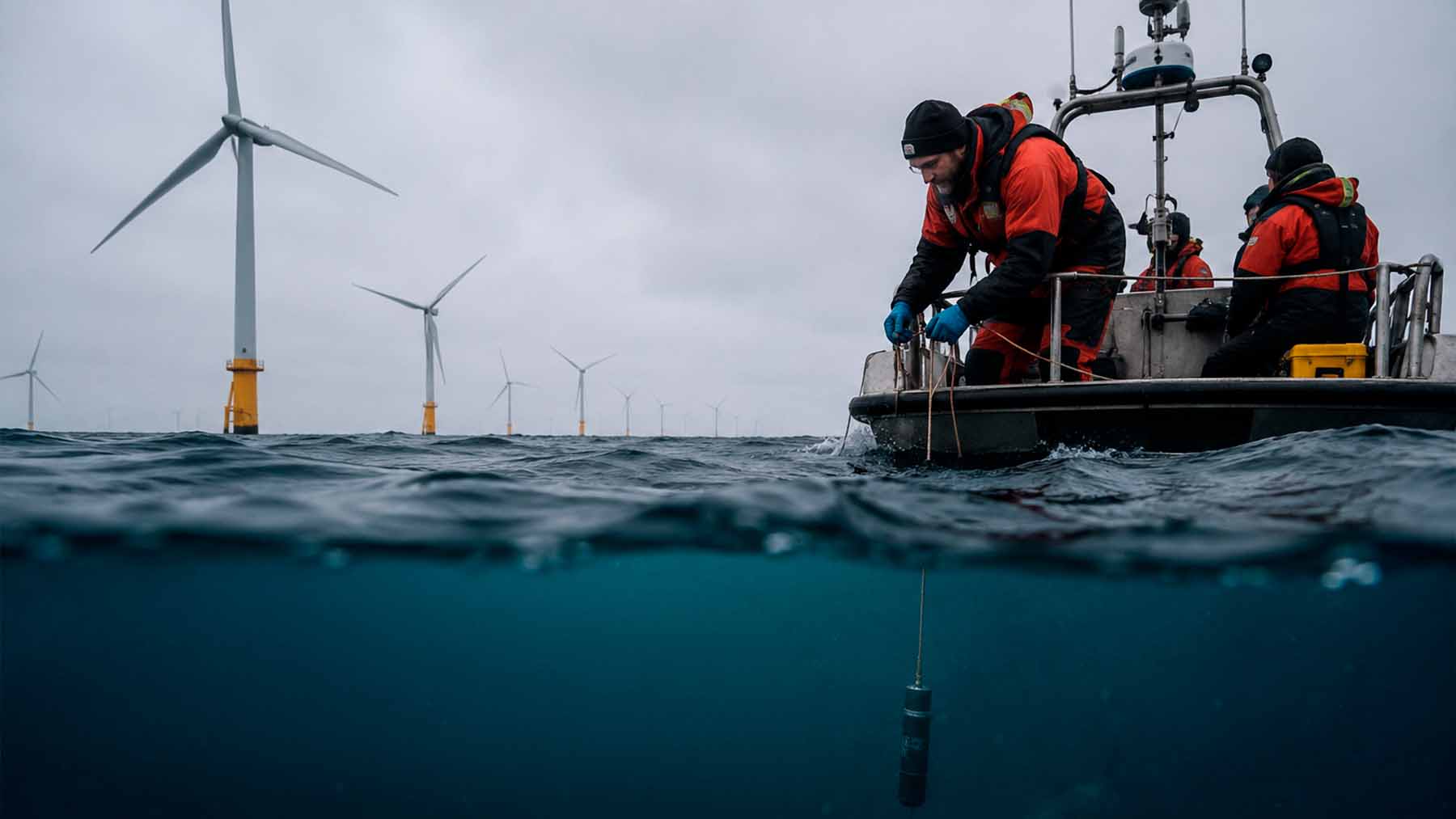
The acoustic footprint was investigated by recording sound profiles underwater at varying distances of between 650 feet and 1.5 miles away from the turbines. The data showed that operational noise is present in low frequencies below 200 Hz. Tonal peaks reach 25 Hz to 80 Hz, depending on how fast the blades are spinning.
When the wind reached 33 knots, the operational noise reached source levels of 148.8 dB re 1 μPa. This created sound fields that remained detectable above baseline North Sea ambient noise across distances of 2.2 to 2.5 miles.
Porpoises are being affected to the point of navigational ‘blindness’
The constant hum of the turbine blade action is not the only noise that reaches the water. There are also random structural sounds generated by floating turbines.
For example, when wind speed increases, changes in the tension of the mooring cables produce short impulses called transients.
It is also about the type of mooring system. Researchers picked up higher transient frequencies and higher mean kurtosis values around semi-submersible platforms compared to spar-buoy systems.
The floating wind farms in the Scottish waters overlap with harbor porpoise habitats. These mammals rely on narrow-band high-frequency echolocation clicks around 130 kHz to navigate, look for prey, and communicate. The result of rising underwater noise is acoustic masking, or even physical discomfort.
The disruption was confirmed by hydrophone monitoring, according to the Scottish Association for Marine Science. Porpoise detection rates dropped notably closer to the turbines when compared with control habitats with no turbines.
Did porpoises abandon the water? Or just adjust?
The lower levels of acoustic detection don’t necessarily mean that the harbor porpoises left the territory completely. Drawing on previous studies, we know that there are two effects of chronic underwater noise: physical displacement or behavioral suppression.
Displacement means the porpoises abandon the installation environment in a 2-mile radius, seeking out quieter feeding grounds, says National Wind Watch.
But this is not always the case. Similar offshore zones show the presence of the porpoises, but with a highly reduced frequency of vocalizations. Instead of trying to make themselves heard above the drone of the turbines, they simply reduce their echolocation clicks.
Not recording any porpoise sounds doesn’t mean they aren’t there
Ultimately, the harbor porpoises displayed a combination of displacement and masking. One portion of the population decided to vacate. The other adapted by going silent, effectively navigating blindly to avoid acoustic interference.
Understanding operational noise signatures like these is vital as floating wind developments scale up across our oceans. Balancing offshore renewable energy generation with marine conservation requires continued acoustic modeling to mitigate long-term impacts on sensitive marine species.
Read the whole thing?
Get the week's signal, not the noise
Our sharpest reporting on energy, climate and nature — free, once a week.