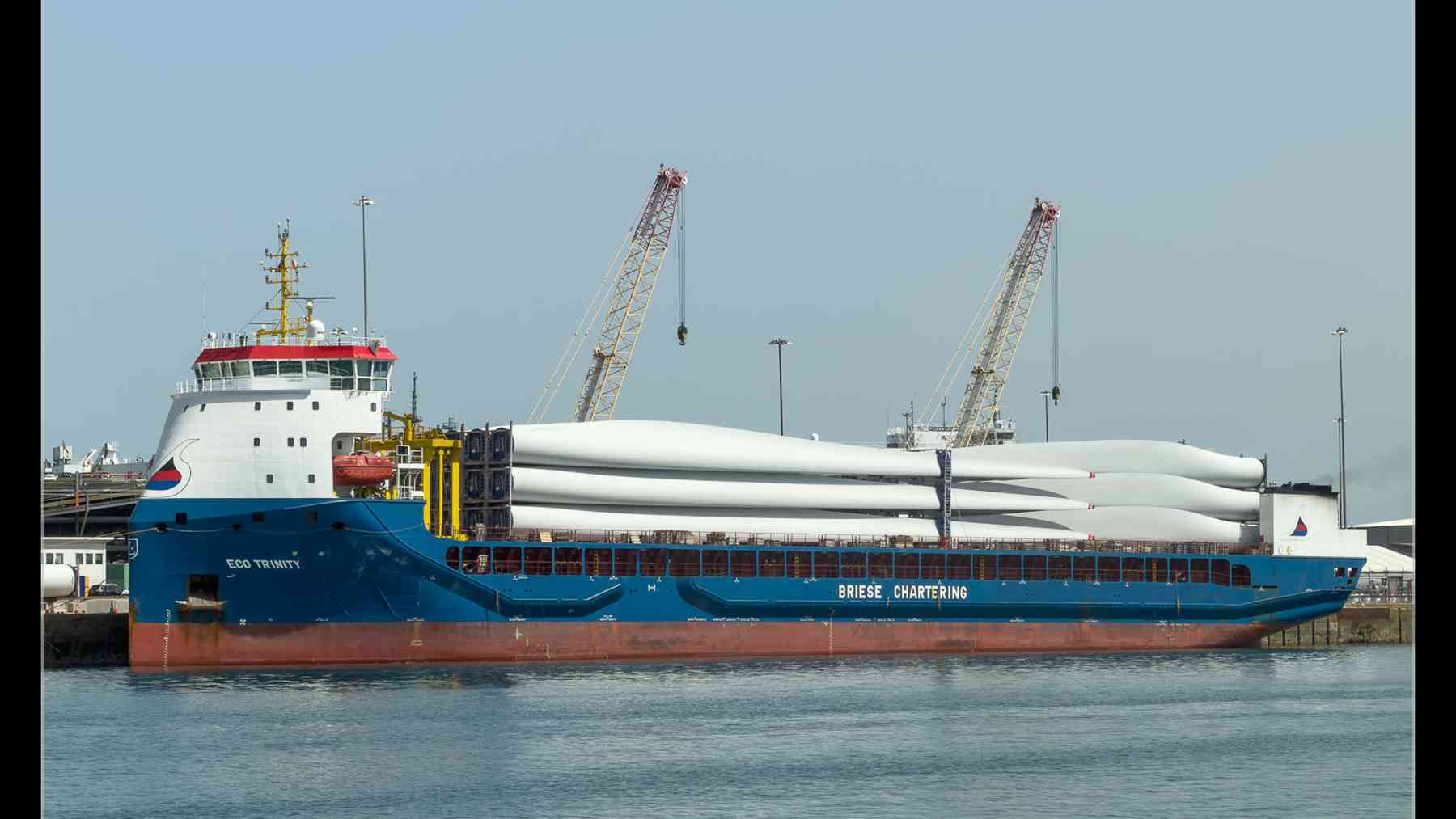
A crane swings a long, pale shape over a quayside in Hull.
Padded cradles take the weight.
From the dock it looks like ordinary cargo.
But the shell holds a material that was never meant to be permanent.
It was built to come apart on command, in a warm acid bath, decades from now.
The question is what that bath leaves behind.
A warm acid bath can pull the resin apart from the fibers
Conventional blades are cast from glass and carbon fiber, a core of wood or plastic foam, and a resin system that binds every component together. Those parts are bonded so thoroughly that the blade becomes a single integral unit, which is why most retired blades have ended up in landfill.
Half the turbines at the Sofia Offshore Wind Farm use a different resin instead. It is a novel formula that can be separated from the other components at the end of a turbine’s working life, with the blade immersed in a heated, mildly acidic solution, the same family of acid that gives vinegar its bite.
What comes out is not a slurry. The solution separates the resin from the fiberglass, plastic, wood and metals, and the materials are then recovered, rinsed and dried for secondary use. The resin itself dissolves within hours in the warm bath.
Fifty turbines on Dogger Bank now carry the new blades
The operator has finished installing all 150 recyclable blades at Sofia, 50 sets of three blades per turbine, which it describes as the first large scale deployment of the technology at a UK offshore wind farm. The other half of the fleet carries conventional blades, so both resins now meet the same salt, wind and fatigue in the same patch of sea.
All 100 turbines are now in position on Dogger Bank, about 120 miles off England’s east coast. Each stands 827 feet tall at its highest point, with a rotor 728 feet across. Commissioning of the project’s high voltage link has been under way ahead of full commercial operation.
Each blade stretches about 354 feet, a touch shorter than a football field measured end zone to end zone. That puts the recyclable resin into service at full commercial scale rather than in a demonstration rig, which is the part the industry has been waiting on.
Lab tests at three temperatures mapped the acid soak first
Before any of this went offshore, the recipe had to be pinned down in the laboratory. In published solvolysis research on the recyclable composite, specimens were treated in a 32 percent acetic acid solution at 158, 176 and 194 degrees Fahrenheit, with the acid acting as the catalyst for the reaction between water and resin.
Acetic acid was chosen because organic acids in warm aqueous solution are known to catalyze this kind of reaction, and the three temperatures let the team see how heat changed how fast the resin gave way. That is a long way below the furnace temperatures used in other chemical recycling routes.
The approach had already left the bench once. The offshore version of the recyclable blade was launched roughly four years ago and installed at the 342 megawatt Kaskasi offshore wind farm in Germany the following summer, a world first that the UK project builds on.
Recovered fiberglass could end up in suitcases or screen casings
None of these blades have reached retirement yet, so nothing has gone into a tank at full size. The manufacturer has pointed at ordinary destinations for recovered material, with suitcases or flat screen casings given as examples. The same logic runs through other recycling projects that treat a waste stream as a supply.
A different route avoids the tank altogether by keeping the structure aloft longer. A research blade in Germany focused on the worn leading edge rather than the whole blade. Both paths aim at the same place, a blade that never has to be buried.
Economics will decide which one scales. A recycling route only works if someone will pay for the glass fiber and resin that come out of it.
The real test still waits decades for a retired blade
Every result so far comes from samples, early installations and laboratory soaks, not from a full 354 foot blade that has spent a working lifetime flexing through North Sea gales. Saltwater exposure, lightning strikes and fatigue cracking could all change how the resin behaves before these blades come down.
Even so, half the turbines at one of the UK’s largest offshore projects now carry this chemistry into daily service, which moves it from laboratory promise toward ordinary operating practice. Once fully operational, the farm is expected to supply around 1.2 million homes with power.
The next milestone will not be another installation announcement. It will be the day crews lower a worn blade into that acid bath and weigh what climbs back out.
Read the whole thing?
Get the week's signal, not the noise
Our sharpest reporting on energy, climate and nature — free, once a week.