Picture a machine that acts like the world’s largest vacuum cleaner, dragging its nozzle across the ocean floor at depths where sunlight never reaches.
It does not look like a vacuum.
It looks like a city block that somehow learned to float.
And the thing it picks up on every single run would fill more than 18 Olympic swimming pools with sand, silt, and everything living inside it.
A machine so big it has its own horizon
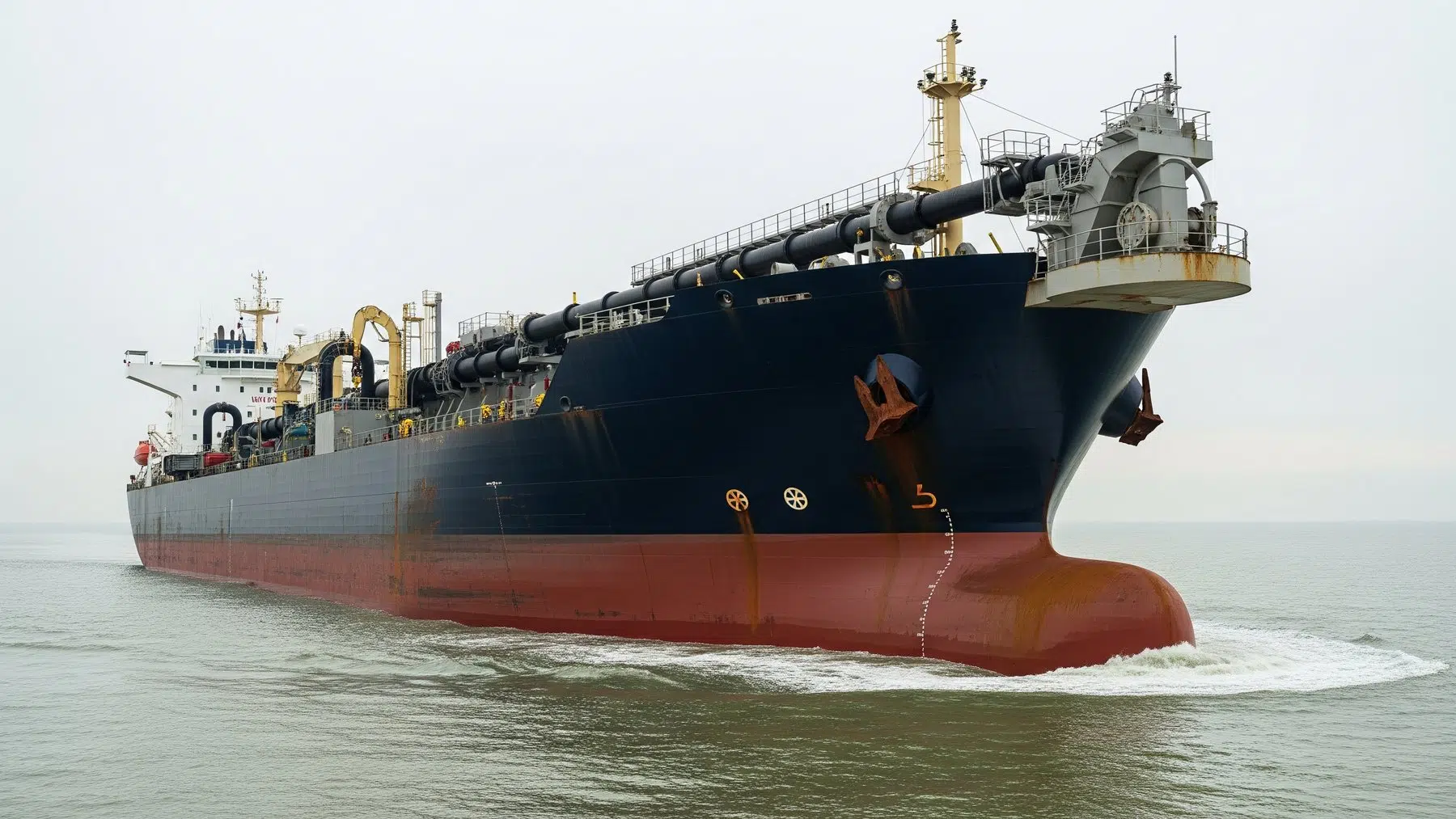
Walk up to this vessel on a dock and your eye cannot find the far end of it.
The hull stretches 730 feet from bow to stern, roughly two and a half football fields laid end to end.
It stands 41 meters wide at the beam, wider than most American highway overpasses are long.
Below the waterline, its hull sinks more than 49 feet before it touches open water.
Most people drive past a harbor and see a big ship and think they understand ships.
They do not understand this one.
The pipes that reach into the dark
The real work happens far below the surface, hidden from anyone watching from shore.
Two suction pipes, each measuring 1,300 millimeters across, lower from the hull and trail along the seabed like a pair of mechanical arms feeling through the dark.
Each pipe is fitted with a drag head at its tip, a heavy steel jaw that breaks up the sediment and draws it upward.
The pumps pulling material through those pipes run at 6,500 kilowatts each, enough electrical draw to power thousands of homes.
The sand, silt, clay, and gravel rush up through the pipes and pour into a cavernous hold called the hopper.
That hopper holds 46,000 cubic meters of material, a volume with almost no everyday comparison that makes sense.
Think of it as scooping up an entire city block’s worth of seabed and carrying it somewhere else.
How a ship this heavy stays afloat
Here is the part that most people, even engineers who work near these machines, find hard to fully picture.
A ship floats because the weight of the water it pushes aside equals its own weight.
This vessel, fully loaded, has a deadweight of 78,000 tons.
That is the weight of roughly 8 Eiffel Towers pressing down on the hull, held up by nothing but displaced ocean.
The deeper the ship sinks into the water, the more water it moves out of the way, until the forces balance.
At that point, 78,000 tons of steel and wet sand simply sits on the surface of the Atlantic as if it weighs nothing.
The hull is shaped so precisely that even at 18 knots, the loaded vessel moves through the water with less drag than its size seems to allow.
The living city in the sand
What that suction pipe lifts from the seafloor is not just gravel and silt.
The Cristóbal Colón, holding the Guinness record as the world’s largest trailing suction hopper dredger, reaches down to 155 meters below the surface.
At that depth, most of what you think of as the ocean floor turns out to be densely inhabited.
Sea worms, brittle stars, bivalves, sand dollars, and thousands of invertebrate species build their entire lives inside the top few inches of that sediment.
Some have spent years building burrows only a few centimeters below the surface.
When the drag head passes, their world is simply gone.
Scientists studying seabed recovery after large scale disturbance have found that some invertebrate populations return within months, while others take far longer or never fully come back.
The sand carried away was also their food source, their shelter, and in many cases the substrate where fish lay their eggs.
Dredging also matters to the communities that depend on habitat connectivity across coastal ecosystems, linking the offshore seabed to the shorelines where birds and larger animals feed.
What the engineers on the bridge cannot see
Dredging builds the ports, deepens the shipping lanes, and raises the islands that allow modern trade to function.
Without machines like this one, container ships could not enter harbors, and coastal cities could not be defended against rising water.
The Cristóbal Colón does work that genuinely cannot be done any other way at this scale.
But the operators on that bridge see tonnage figures and depth readings on screens.
They do not see the brittle star that spent three years building its burrow in 140 meters of cold dark water.
A growing number of dredging projects now include pre survey mapping of seabed communities.
Some operators deposit finer material back in ways that give recovering animals something to settle into.
The machine is extraordinary.
The world it moves through, one careful drag head pass at a time, turns out to be just as extraordinary and far more fragile than the steel above it.
Read the whole thing?
Get the week's signal, not the noise
Our sharpest reporting on energy, climate and nature — free, once a week.