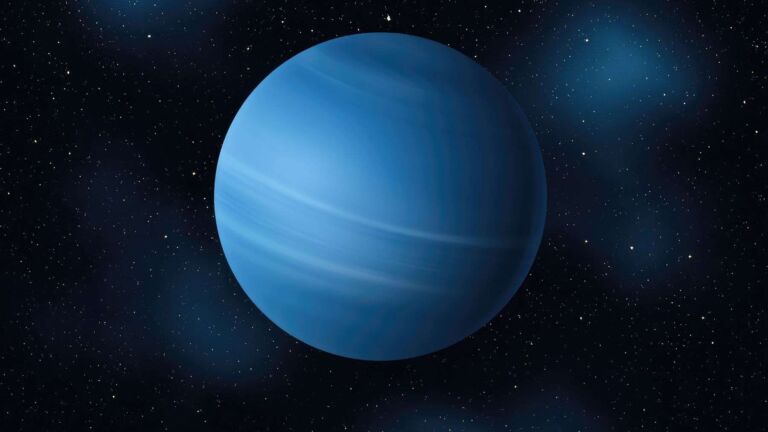
They are the most common type of planet in the Milky Way — nearly 3,300 confirmed, more than half of all known exoplanets — yet sub-Neptunes remain stubbornly mysterious. No analog exists in our own solar system, and their thick, hazy atmospheres have resisted even the sharpest instruments humanity has ever launched.
Now, researchers suggest that JWST may be reading these worlds only at face value — and that what lies beneath could be far more than the telescope can see.
The galaxy’s most common planet, hiding in plain sight
Sub-Neptunes account for roughly 3,300 of the 6,300-plus confirmed exoplanets — more than half of everything we’ve found — making them the dominant planet type in the Milky Way by a significant margin. Yet despite those numbers, scientists still can’t say with confidence what they’re actually made of.
Part of the problem is a gap in our own backyard. Our solar system contains no sub-Neptune analog, which means researchers have to build every inference from scratch, from light-years away, without the close-up reference points they rely on when studying gas giants or rocky worlds.
Their atmospheres don’t help. Thick and hazy, they scatter and absorb starlight in ways that complicate spectroscopic analysis — even for an instrument as capable as JWST. The telescope can detect chemical signatures in the upper atmosphere, but what those signatures reveal about the planet’s deeper interior is a separate question entirely. Fundamental puzzles about sub-Neptune composition remain open despite years of data.
TOI-270 d: a test case 73 light-years away
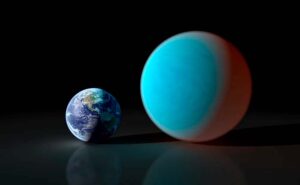
To start narrowing those puzzles down, researchers at the University of Chicago focused on one specific world: TOI-270 d. Discovered in 2019, this sub-Neptune orbits a red dwarf star roughly 73 light-years from Earth. About twice Earth’s radius and 4.2 times its mass, it completes a full orbit every 11.4 days — placing it well inside its star’s habitable zone.
JWST had already taken a look. Its instruments detected carbon dioxide, methane, and hydrogen in the planet’s atmosphere, a combination that’s chemically suggestive — it points toward the presence of water somewhere in the system. But the telescope couldn’t answer the obvious follow-up: in what form does that water exist, and where exactly is it?
That’s what the UChicago team set out to answer. Their approach wasn’t to point more telescopes at TOI-270 d. It was to model what the planet’s interior might actually look like, given everything JWST had already told them.
When water sinks below the reach of telescopes
Using computer simulations of TOI-270 d’s atmospheric and interior conditions, the team found that two variables determine whether water and hydrogen mix together or separate into distinct layers: temperature and the ratio of water to hydrogen.
TOI-270 d runs hot — surface temperatures around 537 °C (roughly 1,000 °F). Combined with a composition that appears water-heavy relative to hydrogen, those conditions could cause water to sink. Rather than blending uniformly through the planet’s interior, the water may settle below the hydrogen atmosphere in a distinct, deeper layer, with the hydrogen above acting as a kind of shield.
JWST reads the atmosphere from the top down. If a vast water reservoir sits beneath that hydrogen layer, the telescope may never detect it — the signal simply doesn’t reach the surface. This directly challenges a long-standing assumption in planetary science: that sub-Neptune interiors are well-mixed. The study suggests layered, separated interiors may be common, not exceptional.
Rethinking what ‘wet’ worlds really look like
The implications extend well beyond TOI-270 d. Lead author Dr. Caroline Piaulet-Ghorayeb put it plainly: “It’s very possible these planets are hiding much more water than their atmospheres let on.”
That’s not a minor calibration issue. Water abundance is one of the key markers scientists use when assessing a planet’s potential to support life. If current methods are systematically underestimating how much water sub-Neptunes contain, assessments of their astrobiological potential may need to be revisited across the board. An atmospheric reading reflects conditions at the top of a planet’s atmosphere — not necessarily its bulk composition. Treating those surface-level signals as the full picture may be steering scientists toward the wrong conclusions.
The research was published in The Astrophysical Journal and involved collaborators from both the United States and Canada.
Next-generation telescopes that could pierce the veil
Better tools are on the way. NASA’s Nancy Grace Roman Space Telescope is scheduled to launch on August 30, 2026. Its coronagraph instrument is designed to directly image exoplanets — blocking out starlight to reveal the planets themselves — which could help probe deeper atmospheric layers than spectroscopy alone allows.
On the ground, the ESO’s Extremely Large Telescope is under active construction and expected to begin science operations around December 2030. Its atmospheric spectroscopy capabilities could push the analysis of sub-Neptune interiors further than anything currently possible. Together, these two instruments could help test whether the separated-interior model holds across a wider population of sub-Neptunes, not just the single world the UChicago team examined.
Their computer models offer a concrete framework — a set of predictions that future observational campaigns can directly target and either confirm or challenge.
The most common planets in the galaxy may be concealing oceans we haven’t yet learned how to see. The next decade of astronomy will be, in large part, about learning how to look deeper.
Read the whole thing?
Get the week's signal, not the noise
Our sharpest reporting on energy, climate and nature — free, once a week.