The bottle leaves a New Orleans bar still smelling faintly of wine.
Within days it is dust.
Then it is something else entirely.
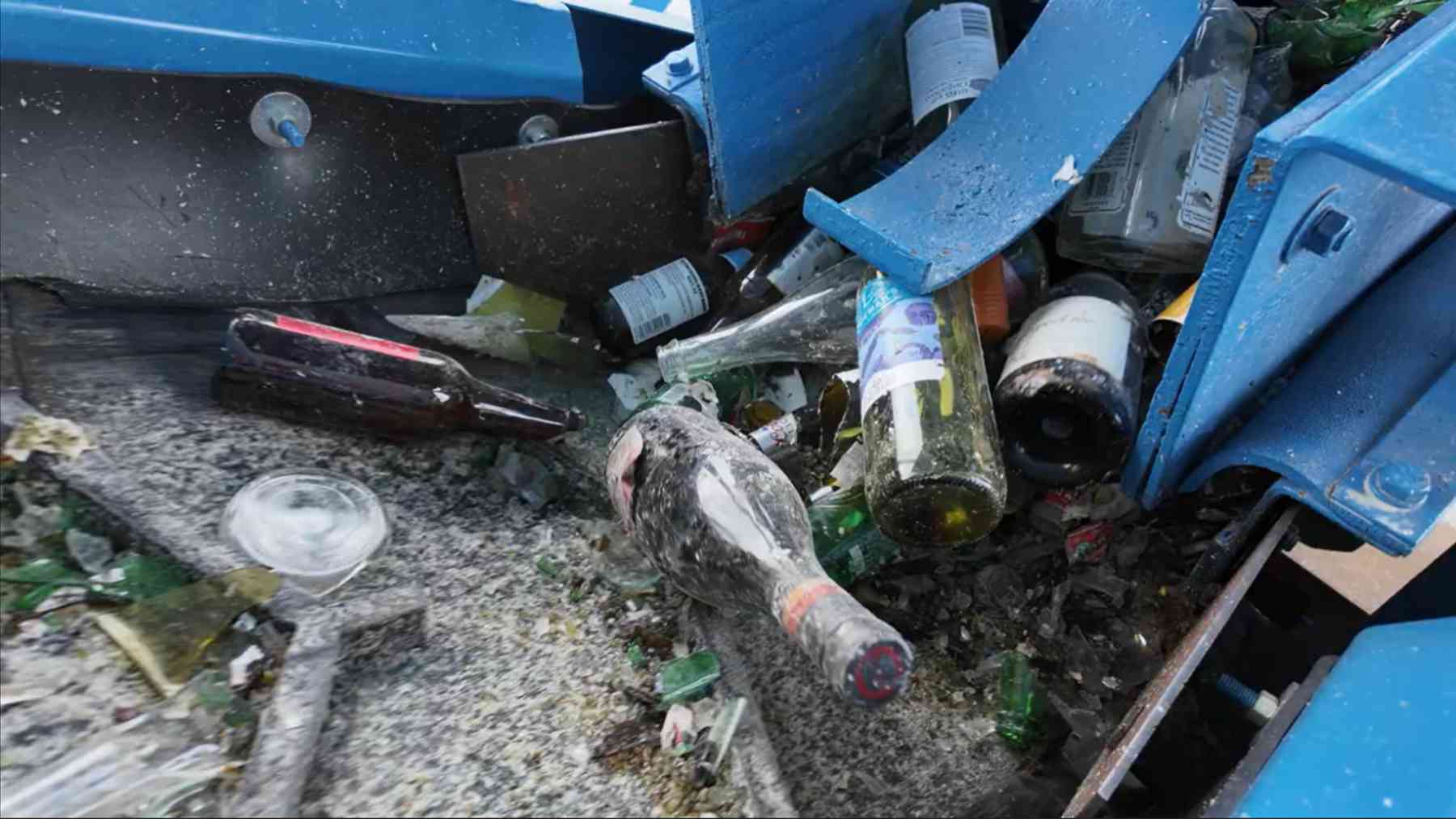
At a warehouse in Chalmette, Louisiana, a machine swallows truckloads of old glass and spits out what looks like beach sand.
That sand is now headed somewhere specific.
So what turns a wine bottle into a building block for a vanishing coastline?
Crushed glass behaves almost exactly like the sand it came from
Glass starts as silica sand fused under heat, so grinding it back down returns the material close to where it began. The machine doing the work is a glass pulverizer, and the operation turns glass into sand and gravel in sizes ranging from a very fine powder up to a small gravel.
Grain size decides whether the material stays where it is put. The coarse grade, closer to glitter than to powder, is the fraction used for coastal restoration, because water does not wash coarse sand away as easily as finer sand.
That is the simple mechanical trick underneath the whole operation. Nothing about the glass changes chemically on the way down, a bottle becomes grains, and the grains behave like sand because they largely still are sand.
A three acre site can process 300,000 pounds a day
The company, Glass Half Full, moved out of a cramped Upper Ninth Ward lot into a purpose built warehouse in Chalmette, on a three acre former landfill site. The building has a recycling capacity that exceeds 300,000 pounds of glass per day, which co founder Franziska Trautmann has described as around 600,000 beer bottles every day.
That is a rated capacity, not a daily tally of what actually arrives. The 10,000 square foot warehouse represents a thirty fold increase over the previous facility, and the extra headroom was meant to widen the collection radius into surrounding states.
The bottles keep arriving by the truckload from well beyond city limits. The company collects glass waste from residential and commercial clients across New Orleans, parts of Mississippi and Alabama, and says it has collected 13 million pounds of glass to date, up from roughly 1 million pounds in its first year, in a region where municipal programs have long left glass out.
Two college students built this after curbside pickup refused their bottles
The idea traces back to a kitchen table problem rather than a corporate plan. In New Orleans, where Trautmann was studying chemical engineering, curbside recycling existed but did not take glass bottles, and the same was true throughout much of Louisiana.
What they found instead was almost absurdly literal. With a little more research, Trautmann and co founder Max Steitz discovered a machine that could turn glass into its original form, sand.
A pulverizer became the business model. Trautmann, now the company’s chief executive, told NPR she is optimistic the sand will play a part in restoring Louisiana’s barrier islands and shoreline, and protect land from disasters like floods.
Louisiana loses a football field of land roughly every hundred minutes
That statistic is the baseline the whole project runs against. A federal assessment of land area change in coastal Louisiana found a net land loss of about 2,007 square miles from 1932 to 2016, roughly 25 percent of the 1932 land area, equal to a football field of coastal wetland within 34 minutes when losses were rapid and within 100 minutes at more recent, slower rates.
Louisiana currently experiences greater coastal wetland loss than all other states in the contiguous United States combined. Marsh grass needs solid ground to grow in, and solid ground is exactly what keeps disappearing.
The sand has moved past the laboratory. Through research funded by the National Science Foundation, its safety has been tested with plants, animals and invertebrates, alongside coastal modeling, and the glass to sand work has been demonstrated at Big Branch Marsh National Wildlife Refuge and on the land of the Pointe au Chien Tribe. Whether it holds a shoreline like natural sediment at full restoration scale remains an open question.
The sand still has to prove itself one restoration site at a time
None of this solves coastal erosion on its own, and nobody running the plant claims otherwise. Trautmann has said the sand is not nearly enough for high profile work like creating barrier islands, which would require millions of cubic yards.
Even so, every pound diverted is a pound that never reaches a landfill, and every grain delivered to a marsh project is one fewer that had to be dredged or trucked in from somewhere else. It is the same kind of shredded waste stream that now props up a Nebraska city road and keeps a market absorbing ground up scrap tires moving in a similar circular direction nationally.
What started as two students annoyed that their recycling bin would not take wine bottles has become a working answer to two problems at once. The glass goes in broken, and what comes out is being spread, grain by recycled grain, on ground that is otherwise going under.
Read the whole thing?
Get the week's signal, not the noise
Our sharpest reporting on energy, climate and nature — free, once a week.