In a hall in the hills of Provence, nine curved pieces of stainless steel are waiting to be joined.
Together they will form a single ring, and each piece covers 40 degrees of it.
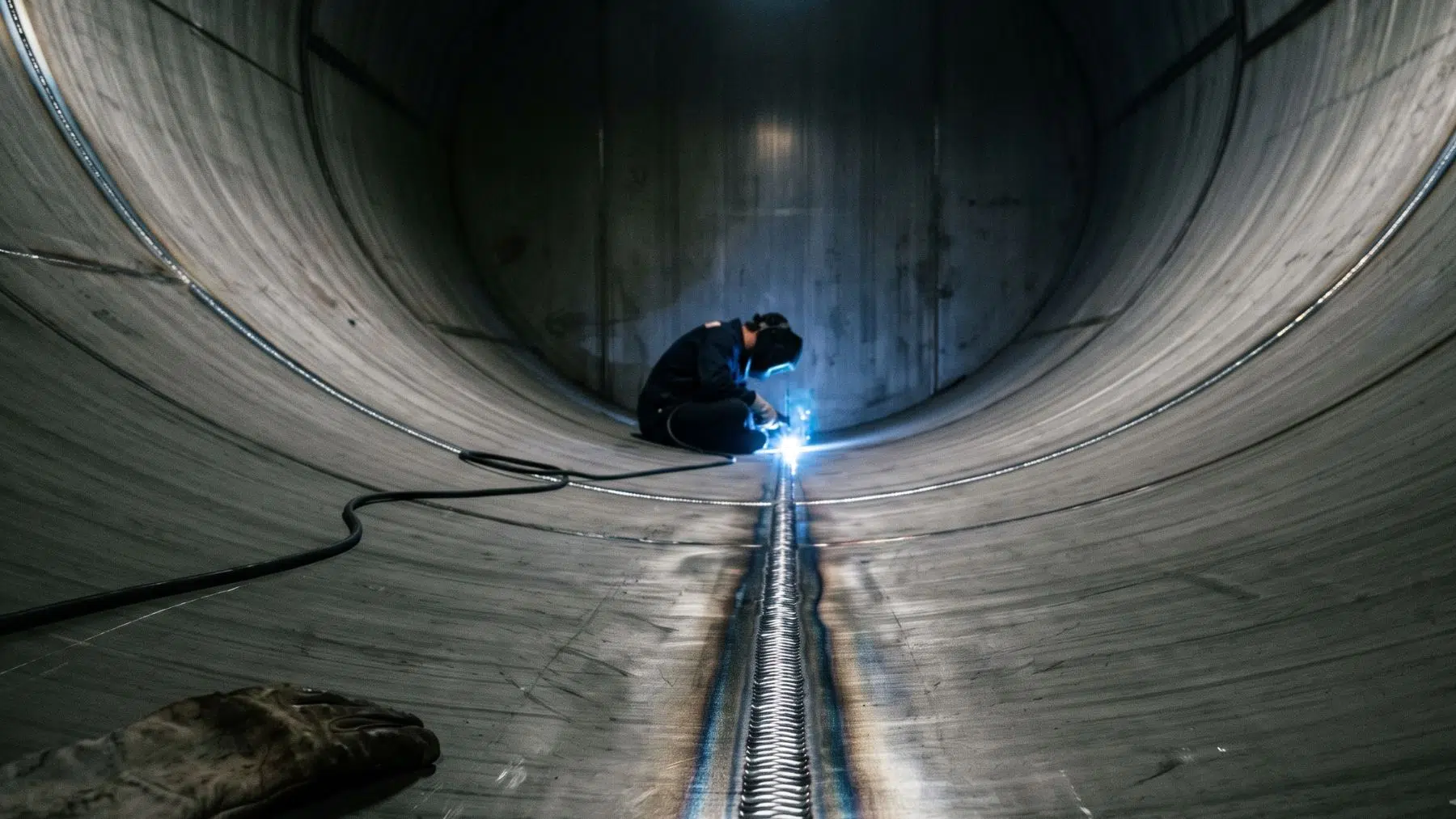
Closing it takes more than 10,000 separate welds, laid one at a time over 30 months without a break.
An American company has been paid 180 million dollars to do exactly that.
And when the last seam cools, the point of the whole structure is that it holds a near perfect nothing.
What the ring actually is
This is the vacuum vessel of ITER, the international fusion machine under construction in southern France.
It measures roughly 64 feet across and 37 feet tall, a hollow doughnut of steel with about 1,400 cubic yards of space inside it.
With its inner shielding and the divertor installed, the assembly weighs somewhere near 9,400 tons.
The nine sectors were fabricated in Korea and in Europe, then shipped across the world to the site in one piece each.
Two were already lowered into the pit when the welding contract was signed, with a third expected before the end of that year.
Inside the finished vessel, a little over 1,000 cubic yards of that space will be occupied by the plasma itself.
Everything else has to be emptied of air and kept that way.
The welding job
Which is where the numbers stop sounding like construction and start sounding like something else.
Each joint between two sectors runs about 115 feet long and roughly two inches thick.
Laying all of them consumes over 10 tons of filler metal, fed into the joints a bead at a time.
Westinghouse will run the operation for 30 months without a pause, 24 hours a day and six days a week, from the first seam to the last.
That means around 180 specialists working in three shifts of 60, handing the same seam to each other at the change of shift.
The equipment and tooling go into place from 2027, before a single arc is struck on the vessel itself.
Nobody anywhere has welded a pressure boundary of this size to this standard before, so there is no manual to work from.
Why it has to be perfect
Because the vessel is not really a container. It is the boundary of an emptiness.
Fusion needs the fuel heated to about 150 million degrees, which is roughly ten times the temperature found at the center of the sun.
At that point the fuel is a plasma, and any contact with a solid wall ends the reaction instantly.
So magnetic fields hold the plasma suspended in the middle of the chamber, touching nothing at all.
A single leak in a single weld lets air into that vacuum, and the whole machine stops until somebody finds it.
Which is why a welding contract, of all things, is being treated as one of the defining tasks of the entire project.
Where the fuel really comes from
People often say the fuel is simply seawater, and that is half true at best.
The first half is deuterium, a heavy form of hydrogen present in the ocean at about 33 milligrams per liter, separated out as heavy water and then split by electrolysis.
It costs in the region of 4,000 euros a kilo, and the supply is effectively unlimited.
The second half is tritium, and tritium is not in the ocean.
It barely exists in nature, so it has to be bred from lithium inside the machine that burns it, which is one of the hardest unsolved problems in the field, as the project documents alongside the welding work.
Anyone who has followed the gap between promise and delivery at a solar site or an offshore project will recognize the shape of that problem.
When any of this happens
So the honest answer on timing is that the schedule was rebuilt from scratch.
The plan agreed in 2016 aimed at a first plasma in 2025, and that was a brief demonstration shot at 100 kiloamperes.
It was never going to be met, and the director general of the project has since said so plainly in public.
The revised baseline drops first plasma as a milestone entirely and moves the start of research operations to 2035, running at 15 megaamperes from the beginning, as the coverage of the new timeline explained.
Burning deuterium together with tritium, the reaction the whole machine exists for, comes later still.
That amounts to a decade of slippage, and it is also a far more capable first step than the one it replaced.
Meanwhile 35 nations keep paying, and a crew in Provence is about to spend two and a half years making sure that a steel ring holds nothing at all.
Read the whole thing?
Get the week's signal, not the noise
Our sharpest reporting on energy, climate and nature — free, once a week.