Four in the morning in a peach block, air temperature at the freezing mark, buds already swollen.
A steel tower starts up and a 15 foot fan begins turning 30 feet above the rows.
It makes no heat. It reaches up and pulls warmer air down.
The trick works only on a still night.
That turns out to matter.
Five miles an hour, and it stops
After sunset the ground radiates heat to the sky faster than the air above it cools. Cold air settles into the rows and warmer air sits on top of it, which is a temperature inversion.
That layering is fragile. It holds only while the air is calm, because any real wind stirs the two layers together and erases the difference a fan would otherwise exploit.
So a frost fan does not fight the cold. It borrows from a reservoir that exists only in dead calm, and the reservoir is gone the moment the air starts moving.
The threshold is specific. Above about 5 miles an hour of ambient wind, a frost fan provides no protection at all.
Every machine that works this way inherits that limit, which is the detail that decides whether the comparison in the headline holds up.
Still air builds the layer. Wind removes it.
Fifteen feet of blade over 10 acres
The standard rig is one or two 15 foot fans on a steel tower at least 30 feet tall, started when air temperature reaches 32 degrees.
Sizing runs on power rather than reach. About 10 brake horsepower per acre is needed for a single machine, falling to roughly 8 when several work together.
One machine usually covers 8 to 10 acres. Putting a second fan on the same tower raises the protected area by about 60 percent.
The gain is modest and uneven. Close to the tower growers can expect 3 to 5 degrees of protection, while the edge of the covered block may not exceed 2.
Paired with heaters under ideal conditions and well hardened trees, California growers have reported holding blocks down to 22 degrees.
Ten horsepower an acre. Two degrees at the edge.
One point three degrees per decade
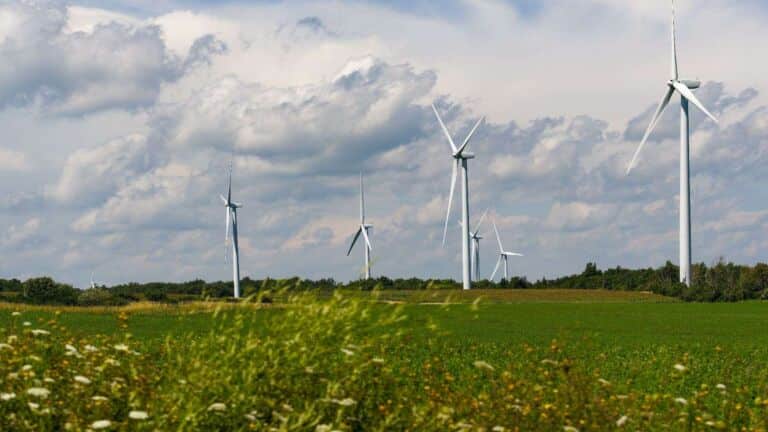
The wind farm claim comes from satellite work over west central Texas, covering about 3,863 square miles with 2,358 turbines, using surface temperature data from 2003 to 2011.
The headline figure is a warming trend of up to 1.3 degrees Fahrenheit per decade over wind farm pixels compared with neighboring ones.
Read that carefully, because it is a trend across nine years of data and not a temperature difference you would feel on a given night.
Daytime showed no significant trend at all. The nighttime winter figure was about 0.8 degrees Fahrenheit per decade.
It is also land surface temperature from orbit at about two thirds of a mile per pixel, not air temperature at bud height in a row of trees.
Nine years of satellite data. One tenth of a degree a year.
Zero protection above 5 miles an hour
Now put the two machines side by side, which is where the comparison comes apart.
A turbine only turns when wind is blowing. The mixing it adds to the night air exists because the rotor is extracting energy from moving air, and a still night produces neither.
An orchard fan only helps when wind is not blowing, because above roughly 5 miles an hour the inversion it depends on has already been mixed away.
The two devices need opposite weather. On the calm clear night when an orchard is in danger, the turbines next door are most likely standing still.
Surface temperature is its own measurement, as an artificial plastic lawn running hotter than concrete showed.
How much land a modern build occupies was covered here in a piece on California acres.
One needs wind. The other needs none. Same night, different machine.
Point eight degrees in the frost season
There is a second mismatch worth stating. The strongest signal in that satellite study was in summer, not in the frost season.
Summer nights produced 1.3 degrees per decade against 0.8 in winter, so the effect is weakest exactly when an orchard would want it.
None of this makes the measurement wrong. Rotors do mix the lower atmosphere, the coupling with turbine locations is strong, and the authors call the link causal.
What it is not is a heat source, a frost service, or anything a grower could schedule. It is energy moved between heights by a machine built for something else.
The trend figures, the study area and the turbine count are published in the paper.
The fan specifications and the wind threshold come from an extension service.
The orchard fan and the turbine do move the same air, and the weather each one requires is exactly the weather the other cannot use.
Read the whole thing?
Get the week's signal, not the noise
Our sharpest reporting on energy, climate and nature — free, once a week.