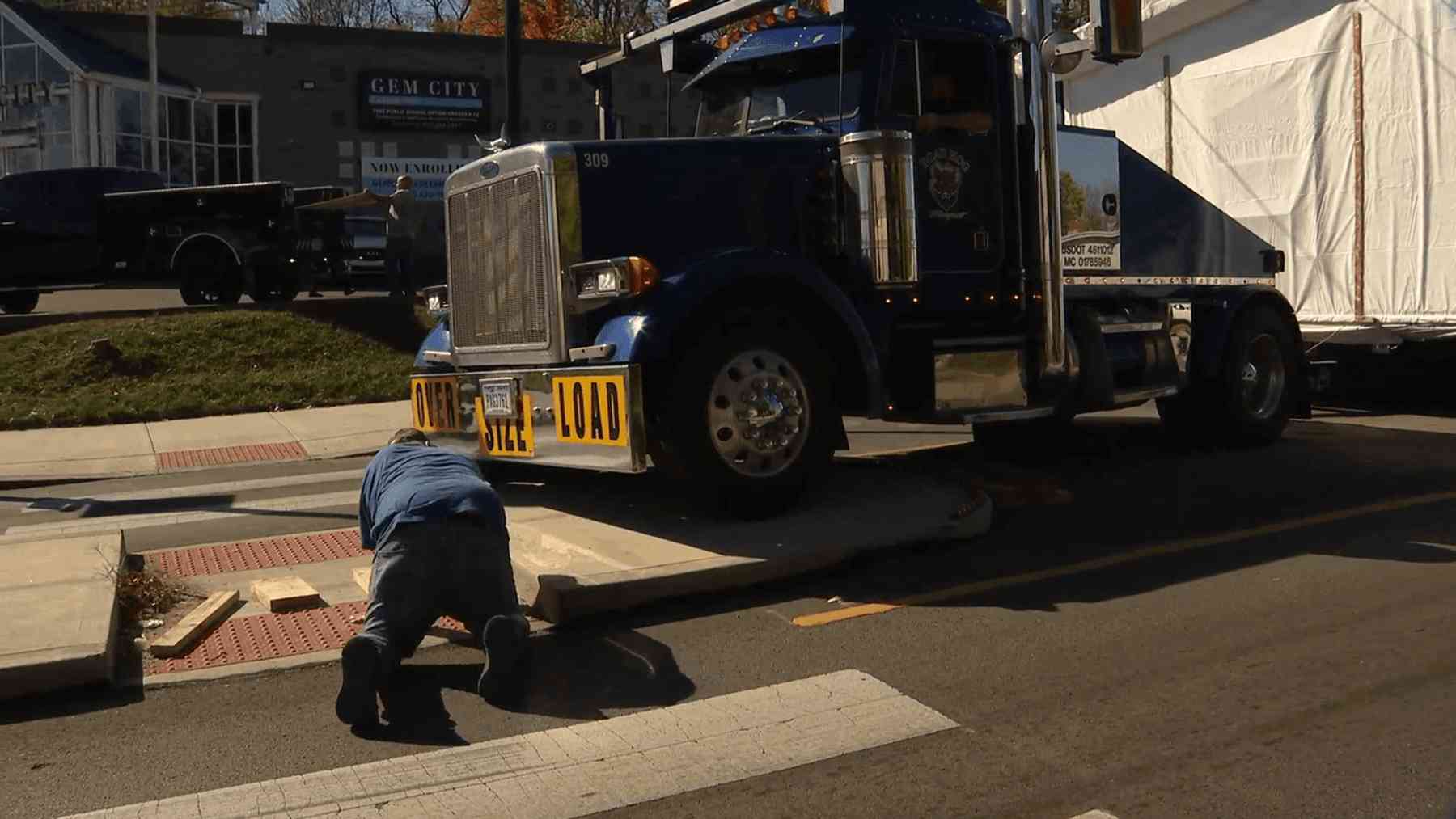
A flatbed eases onto North Main Street in Dayton, Ohio, with half a house riding on its trailer.
The load is wide, and it is going somewhere that needs a foundation.
Then the lane narrows.
Orange barrels crowd the curb where construction has pinched the roadway.
The truck stops in the 1700 block, too wide to keep going.
What happens next turns a stalled delivery into a street level puzzle.
Construction work had narrowed the one road the permit allowed
The driver had papers in hand for exactly this route, cleared in advance for a load wide enough to need its own lane and then some. Ohio writes special hauling permits route by route, and the state’s own operating conditions require that a copy of the permit ride with the driver and be shown to any law enforcement officer who asks. What the paperwork could not do was account for a stretch of street that crews had already squeezed down.
The driver told officers on scene that he had been given this exact route by the state, and that the road was narrowed through construction, which left no margin for a trailer carrying something as wide as half a house. A permit is only a snapshot of a road on the day it gets issued, and here the pavement had changed underneath it.
That mismatch brought a multi ton load to a complete stop in the middle of a city block, with nowhere left to inch forward.
Officers closed the block after a 1 pm dispatch while crews improvised a fix
Dayton crews were sent to the 1700 block in the early afternoon, arriving to find the truck stuck in the street and going nowhere under its own power. Officers shut down North Main Street so the recovery work could happen safely, clearing the lane of traffic while the problem was sized up.
With the street sealed off, the actual fix turned out to be almost shockingly simple.
Lumber was used to jack up the trailer carrying the house, lifting it enough to get over the median that stood in its path. Signs were removed on the side of the road so the wide load could finally make it through.
It was carpentry, not machinery, that freed a load too big for the street it was permitted to use. The whole fix leaned on stacked boards and a few unbolted signs rather than a crane or a second truck.
A police escort took the load back toward the highway afterward
Once the trailer cleared the median, the job was not finished. The load still needed a safe route back to the highway system it had left, and police escorted the truck out once it was moving again.
That escort mattered because a load wide enough to carry half a house cannot simply merge back into traffic unattended. Clearance has to be read ahead of the trailer rather than discovered at the bumper, which is the same block by block attention that got the truck unstuck in the first place.
Patience mattered as much as equipment did, and so did the second set of eyes checking each intersection before the trailer rolled through it.
What the police account does not settle is where the house started, where it was going, or how much of its permitted route was left. The documented part is the block itself, the lumber, the signs and the ride back out.
A Dayton sergeant credited the afternoon to teamwork across departments
Sergeant Creigee S. Coleman said he thanked all of the city departments that collaborated to get the vehicle safely out, a line that captures how many different skill sets a single stuck truck can pull together in one afternoon.
The closure lasted only as long as the recovery itself, a detail that echoes another roadway cleanup where a nearby farmer cleared a full truckload of spilled sugar beets off a North Dakota county road in just five minutes.
The same basic problem shows up anywhere construction and oversize freight overlap. A permit measured for one version of a road can stop matching reality the moment barrels and barriers move in, and the gap only becomes obvious once a truck is already committed to the lane.
The fix cost stacked lumber, not heavy machinery
It also shows how little exotic equipment it actually takes to close that gap. Stacked lumber, a few removed signs and a patient police escort did what no amount of horsepower could, nudging a half house back onto the road it was cleared to travel.
Dayton’s streets will keep narrowing and widening as construction moves through the city, and so will the loads that have to find a way past the work.
The fix this time was a stack of lumber and an afternoon of coordination between departments, a reminder that some of the biggest problems on the road get solved with the smallest tools.
Read the whole thing?
Get the week's signal, not the noise
Our sharpest reporting on energy, climate and nature — free, once a week.