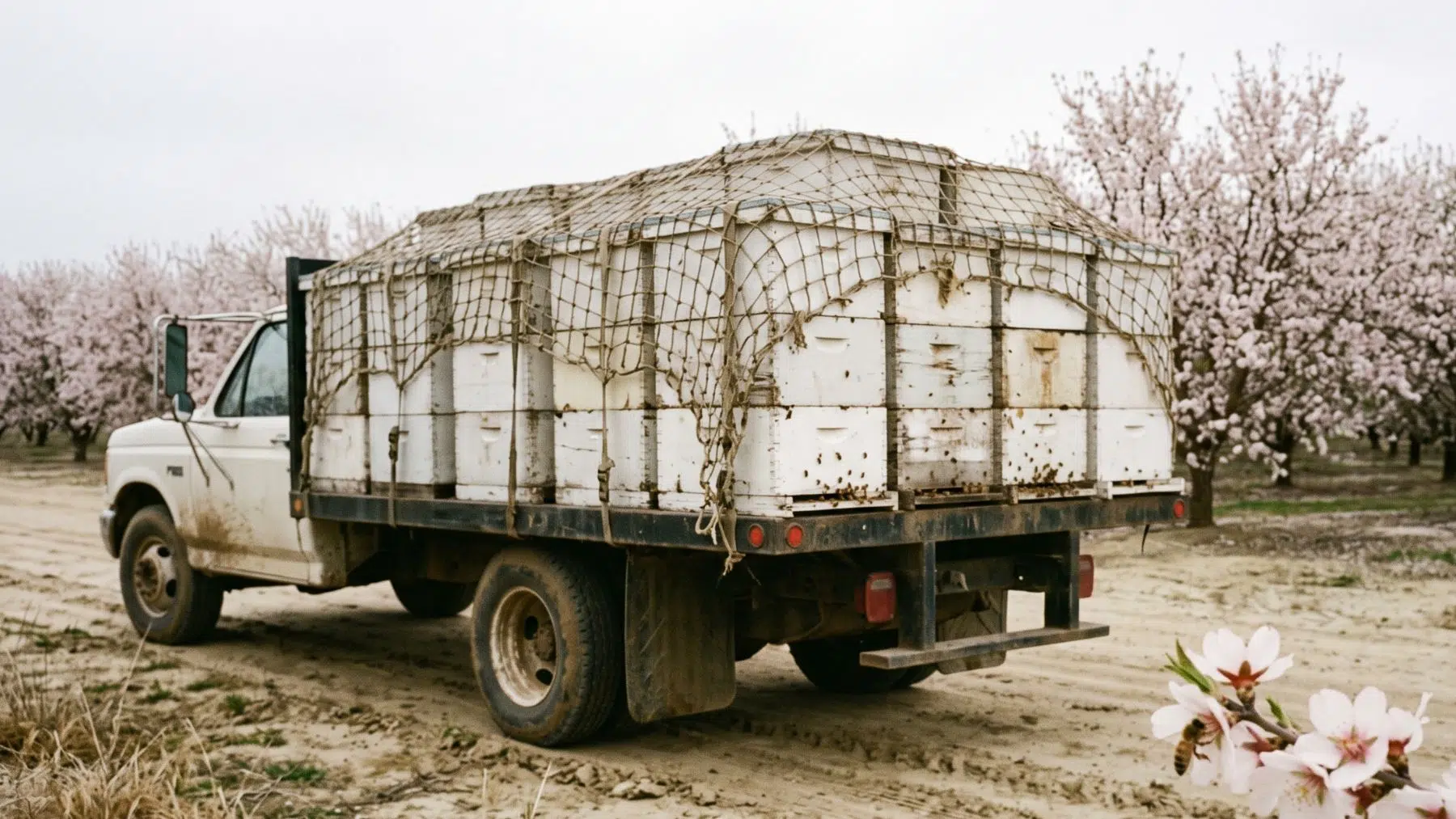
Every spring in California, long trucks pull up to the orchards loaded with boxes that hum.
Inside are rented honeybees, hauled in by the colony to pollinate the coming crop.
Farmers pay hard cash for that service, because the bill is easy to read.
But a second workforce shows up in the same fields and asks for nothing.
These are the native wild bees, and they labor for free.
Nobody writes them a check, so nobody counts what they are worth.
The whole arrangement runs on an invoice that lists only half the crew.
The other half has been showing up, unpaid, for far longer than the trucks.
The hired bee and the free one
More than a million honeybee colonies are trucked into California every year.
They are the reliable rental, moved from farm to farm and stacked by the row.
Yet the honeybee is not native to this continent, having arrived with European settlers centuries ago.
The bees that were here first still work the same blossoms without a contract.
There are roughly 4,000 species of native bee across the United States.
They nest in bare soil, in hollow stems, and in old beetle tunnels in dead wood.
Most are small, solitary, and easy to walk past without noticing.
Some are no bigger than a grain of rice and never make a hive.
Yet for many crops they are quicker and more thorough than the rented boxes.
What an acre actually does to your grocery bill
The value of all this shows up quietly, buried inside the price of food.
Apples, cherries, blueberries, and almonds all lean on insects to set fruit.
When wild bees join the honeybees on a bloom, the fruit often sets fuller and heavier.
Economists file this under ecosystem services, the free work nature does for an economy.
It is the same category as clean water from a forest or flood control from a marsh.
None of it lands on a grocery receipt, yet all of it shapes what you pay.
Take the bees away and the same food gets scarcer and more expensive.
A poorly pollinated orchard drops small, lopsided fruit that never reaches a store shelf.
The cost of that lands on shoppers long before anyone traces it back to a bee.
The hidden map of decline
The trouble is that the free workforce is shrinking fast.
Wild bees need flowers and undisturbed ground, and modern farming leaves less of both.
Hedgerows get cleared, field edges get plowed, and the nesting sites vanish.
At the same time the demand for pollination keeps climbing higher.
More acres of almonds and berries mean more blossoms that need a visit.
So the supply of wild helpers falls just as the crops that need them spread.
That squeeze is worst in the very places that grow the most fruit and nuts.
Where the need is highest, the free workforce is often thinnest on the ground.
The numbers nobody put on the books
When scientists finally ran the math, the free labor was startling.
Berkeley researchers led by Claire Kremen put the value of California’s wild bees at 2.4 billion dollars in a strong season.
Even the low end of their estimate came to 937 million dollars a year.
That is up to a third of all the crop pollination the state relies on.
Across the country the picture is the same, with native pollination worth about 3 billion dollars a year.
A separate Vermont team mapped wild bee abundance and found it falling across 23 percent of the country between 2008 and 2013.
Roughly 39 percent of the croplands that depend on pollinators now face a widening gap.
One global study even found that just 2 percent of wild bee species do about 80 percent of the crop work.
A service no invoice ever caught
All of that money moves through the food system and never touches a ledger.
A farmer who rents a thousand honeybee colonies knows the cost to the dollar.
The wild bees in the hedgerow next door do their share and send no bill.
That is exactly why the service is so easy to lose, since nothing on paper protects it.
Bringing it back is often cheap insurance rather than a grand rescue.
A strip of wildflowers or an untilled bank can rebuild the nesting ground the bees need.
Those same flower strips can pay for themselves in a season or two of steadier yields.
They also feed butterflies, birds, and the honeybees the farmer is already paying for.
Left out of every tally, the wild bee is a bit like the offshore wind that turns a turbine unpaid.
It is the same quiet loss as a fox pushed off its den by solar panels, real but unbilled.
The cheapest pollinator in California has always been the one nobody counted.
Read the whole thing?
Get the week's signal, not the noise
Our sharpest reporting on energy, climate and nature — free, once a week.