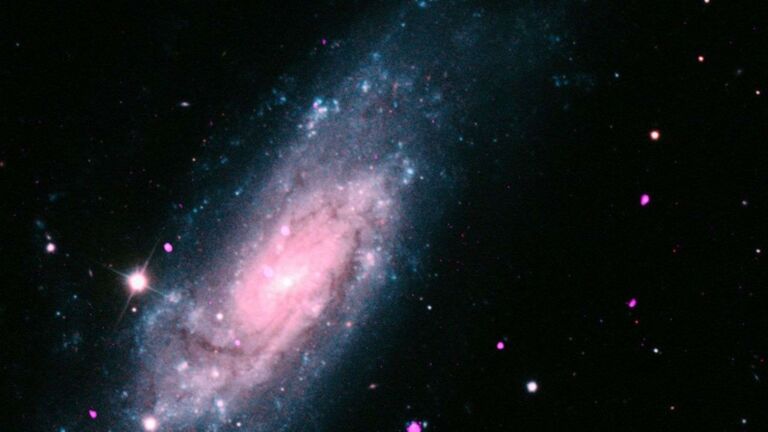
Sometimes the universe throws us a curveball. In this case, we have a bright radio source that looks similar to a giant treble clef
The radio source lies behind some of the confusing stuff in our Milky Way galaxy.
Astronomers had to find a way to explain the odd object using the stars, gas, and dust in front of them.
The odd object appears to be the result of two very different events, neither of which could produce it alone.
Early energetic activity set the process in motion
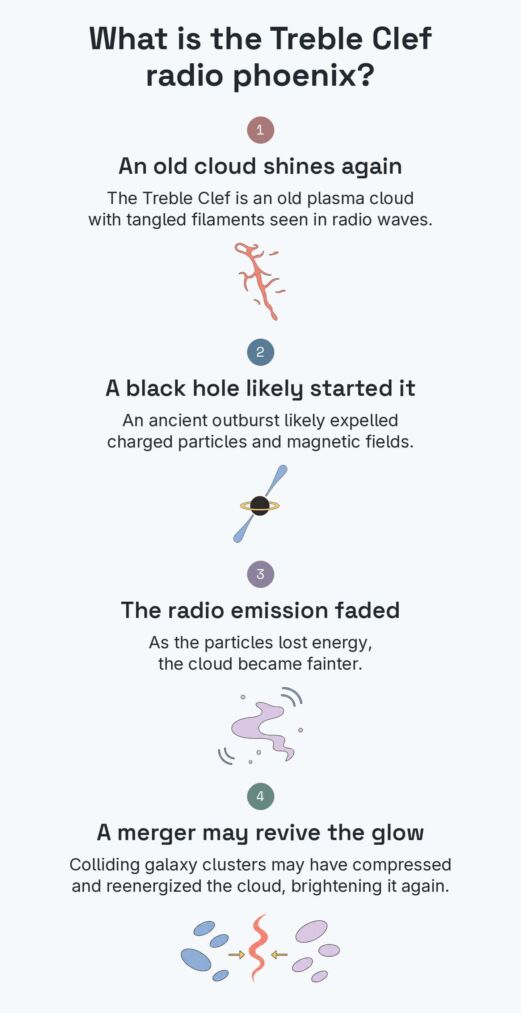
The supermassive black hole seems to have caused it all to start.
As material was thrown out, the magnetic fields were also ejected.
Those released particles moved at near light speeds, and bright radio emission followed.
As time progressed, though, energy was lost, resulting in weaker radio emission.
However, an old cloud of energetic material was still left behind. That then raised the question of why the leftover material became bright again.
Hidden surroundings made identification far more difficult
The source is located at a very low galactic latitude. As a result, it sat behind the Galactic plane, and that made it difficult to classify.
It was originally thought to be a pulsar, and the system around it was also difficult to observe due to the foreground material.
Eventually, it was realized that this was linked to a heavily obscured cluster of galaxies, creating a bigger puzzle.
The object had unusual properties, but the larger system also required explanation.
Multiple observations revealed a merging cluster system
Chandra and eROSITA have shown that there is diffuse hot gas at this position.
The hot gas confirms that there is a galaxy cluster present.
Further analysis has shown that this object is, in fact, two clusters merging.
The unique filamentary structure can be seen in radio observations taken by LOFAR.
X-ray observations revealed more about the environment around the object. The evidence suggests that the object is a radio phoenix, with old radio material being re-activated, as discussed in arXiv.
This interpretation fits with the appearance and environment. However, there are limitations because astronomers are looking back in time to determine what has happened.
Foreground dust limited what could be seen from Earth
The Milky Way is in the way of the source.
That makes the unusual object harder to understand, and some key details may be missed.
Astronomers used multiple observation methods. No one data set could give the whole picture, so information from multiple wavelengths had to be combined.
Many complicated systems require this. The Treble Clef seems to be one of those.
Merger driven activity reshaped the older radio material
The collision led to some new factors. Conditions within the intracluster medium became highly energetic.
The old particle cloud appears to have been heated again, causing brighter radio waves.
Shocks may have occurred and large sonic booms were created.
The motion of the gas due to the merger may have contributed to the creation of the structure.
Such movement could account for the complex structure of the cloud and the multiple events likely being recorded.
It shows how a long series of interactions has occurred to create the final result.
Remaining uncertainties continue guiding future observations
It is unclear exactly what processes may have caused this.
The unusual filaments are particularly interesting because the merger may also be linked to a candidate radio halo, although that connection is still being investigated.
Observations at very low radio frequencies may prove useful in the future because this remains an appealing source for follow-up work.
The Treble Clef gives us a rare insight into energized material that would otherwise be difficult to study. However, there could be more surprises hidden within its full history.
Read the whole thing?
Get the week's signal, not the noise
Our sharpest reporting on energy, climate and nature — free, once a week.